Showing posts with label Citrix. Show all posts

Thursday, October 5, 2017

How Big is the Hosted Desktop (DaaS) Market - Part 1

Originally published on Citrix Blogs

Without question, “How big is the hosted desktop market” is the top inquiry I get from our Citrix Service Provider (CSP) partners.
Our thousands of global partners are constantly making investments in infrastructure, marketing, business operations and sales. And frequently they are going to their board (and sometimes to external investors) for funding to chase the high-margin, high-value hosted desktop market.
The problem is, how do you estimate the size of a market that’s so relatively new that it hasn’t yet been tracked?  Well, it turns out that some surveys have already been taken, and that there are also a number of “adjacent” markets that will convert to hosted desktops….
What is a cloud-hosted desktop? Desktop-as-a-Service? 
First, let’s define terms. Traditionally, your “desktop”  (typically Microsoft Windows) is the container for all of your personal and workplace productivity apps. It’s your customized environment with your data and personalization information – not to mention being protected by your security credentials.  This environment is also traditionally run locally on your personal hardware (laptop, desktop, etc.).
Enter Virtual Desktops. These can be fully-functional desktops – complete with apps, personalization and security – but their software physically runs on a server elsewhere… but typically somewhere on the same network in the same business, and typically on a server in a datacenter.  These server-based desktops are owned and managed by the company’s IT department, and then provided to each user.
However, the cloud-hosted virtual desktop goes one step further. It runs on a server, but perhaps in a 3rd-party data center that is off-premesis.  Its data and user experience is delivered over the public internet. The 3rd party is typically a managed service provider (MSP) under contract by the business to provide and maintain desktops. The user can expect an identical desktop & application experience… except all of the compute power resides somewhere in “the cloud”.
Some now term the cloud-hosted desktop model “Desktops-as-a-Service” (DaaS) in that the desktop is no longer considered local executable software. Rather, it is delivered and managed as an on-demand internet service – meaning it can be turned on/off at will, and billed-for as an hourly, daily, or (typically) monthly service.
Why is Cloud-Hosted DaaS so new?
To be honest, for as long as we’ve had the notion of cloud computing, there’s been the desire to host desktops. But the inhibitors revolved around two main areas: Physics and the more mundane aspect of licensing. While the licensing aspect of a 3rd-party owning desktop licenses has been solved-for, it took longer to work around Nature.  The internet’s networks needed to be faster and have lower latency – two factors that contribute to the user experience.
The good news is that both of these issues have been solved-for to the satisfaction of all involved.
OK: So how big is the market? What’s the Opportunity?
Since the market for DaaS is so new, we’ll have to look at a variety of existing and adjacent metrics. We’ll also have to use some best-guess methods to gauge the opportunity.
Note that a number of these statistics are excerpts from research from a number of analysts/sources. Complete reports not in the public domain are only available from the analysts themselves.

  • The existing Desktop Outsourcing market.  This is defined as the desktop owner (usually running desktops locally) turning to a 3rd-party to manage and maintain those desktops. According to Gartner Research, the worldwide market for this is nearly US$30 billion.  One could expect that over time, some percentage of the companies in this category would instead turn to a cloud-hosted model for maintenance and support – rather than continue a model of local execution and outsourced maintenance.  Even a 1% shift of this market would translate into a DaaS market of  US$300 million.
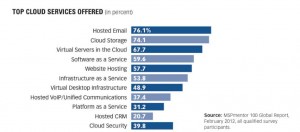
  • As a % of cloud services offered. MSPmentor, in their 2012 Global Report (part of TalkinCloud), notes that Virtual Desktop Infrastructure (VDI) represents is offered by 48.9% of the top 100 MSPs. (note that some of this number probably includes on-premesis VDI hosting) While revenue breakdown numbers for services-offered is not available, the top 100 MSPs annual recurring revenue in 2011 was over US$1 billion. If even a small fraction of a given MSP’s revenue mix includes cloud-based desktop hosting, we still have the makings of a healthy market.
  • The broader Desktop Virtualization Market. According to The 451 Group, the market for the Desktop Virtualization Ecosystem Market is estimated at US$5.6 billion by 2016. (This includes server-, client- and cloud-based hosting; session-based computing; application virtualization; management). Again, if even a few percent of the cloud-based hosting component manifests itself, we easily have a market in the hundreds of millions of $US.
  • Hosted Workspace-as-a-Service market. Again, this market definition varies from pure DaaS. But according to a recent IDC study, the total WW market by 2016 is estimated in excess of US$661 million.

What We Still Need
Surprisingly few industry analysts and associations formally track DaaS.  Neither MSPmentor, MSPalliance, nor The Web Host Industry Review track the DaaS market as they do other traditional hosting statistics – nor do they index which leading MSPs, CSPs and HSPs offer cloud-hosted desktops, DaaS, etc.  I certainly hope that changes soon.
However, the news is good on 2 fronts. For the service providers, the opportunity to host desktops is new, growing, and highly profitable. And for the enterprise users, hosted desktops represent a new world where your workspace is available anywhere, anytime, and not subject to hardware failure/loss.
Stay tuned for another Blog in this series that will further help outline the opportunity for hosted desktops and workspaces. [ Part 2 Here ] 

Your Next Computer.... in the Cloud ?

For years, the “virtual PC” has been the dream of users and corporations alike. After all, why do millions of us lug around a laptop with our Windows desktop stuck to it? Why do we risk theft, loss or damage to valuable data when our entire workspace — and data – could instead live in the cloud and be accessed from anywhere by any of our devices….

[This is a re-post of my Blog on Wired Innovation Insights. Click to read more]

The Beginning of the Non-Dedicated Device World?

Originally published on Citrix Blogs.

What makes your phone your phone? Or, for that matter, what makes your desktop, your laptop or your tablet yours? After all, millions of people own identical hardware/software configurations of iPhones, Android-based phones, tablets, laptops and other devices.
The answer lies in two defining aspects of each device: The user’s data that is locally-stored, and the user’s personalization information.
But in the very near future, I foresee that people will move interchangeably among many more devices, and will do so fluidly. They will rent, exchange, or even borrow devices that become theirs perhaps only for minutes or days, before being re-used and re-personalized by others.  These devices might even be un-assigned, yet can take on the personalization, features, and data access of each new user, and these users will do this because the devices are specifically fit-for-purpose, or just available at the time.
For example, have you ever forgotten your phone, but your wife has hers? Wouldn’t it be great to just borrow hers and have it instantly (but temporarily) take on your persona and contact list?  Have you ever walk into a meeting and your laptop battery dies? The conference room has a shared PC. No problem – the PC will become “yours” for the next hour.
You get the picture.
It’s Already Started: Your Data is Anywhere
Why would we want mobile data/personas?
Looking at mobility from a data context, we’re already seeing wholesale evolution with services such as iCloud, ShareFile, Amazon Cloud Drive, Google Drive and others.  Wherever you are, whatever device you use, your data is instantly accessible. Gartner terms this your “personal cloud.”  We even see this metaphor paired with applications – for example with Xmarks on my FireFox browser, where any FireFox browser I launch on any device instantly brings along my set of stored bookmarks. My personal data store always follows me.
Also consider this: If you think of content as another form of your personal data store, we’re also seeing your data served up in a similar manner. Personalized services such as NetFlix, Hulu, Amazon, Pandora and others are offering content – custom to you – on any device you hold, even through a personalized device known as your networked living room TV.
Whether we realize it or not, the need for locally-stored data is quickly being obviated by online data portability services – all living in the Cloud.
Next: Your Personalization Anywhere
As Gartner recently highlighted during the Data Center conference this month, the personal laptop is no longer the “hub” of your activity. Rather, all devices you own are in effect peers. And pretty soon, all devices you touch will be equivalent peers too.
Here are a few illustrations:

  • Cell phone loss: Lose your phone?  Instantly recover your data, apps, personalization, ring tones etc. This won’t just be an in-store service anymore.
  • Cell phone missing?  Just borrow a nearby phone and temporarily personalize it
  • Work and personal phones? Sure. Combine your work profile and number, plus personal profile and number accessible from a single device.
  • Moving from your desktop in your office to a Tablet on the road? No problem – data, personality and session are all portable
  • No laptop for a business meeting: No need to lug physical hardware. Just re-assign and personalized an on-site device – or borrow one from a friend.
  • Traveling but want to watch your home TV or service? No problem. Re-assign the media profile of a TV or small screen to access your home or online streaming content profile
  • In a rental car?  Assign your personalization and have the radio pre-set with favorite stations and streaming audio subscriptions, and the GPS will be loaded with your contacts/addresses
  • Data Portability in the Cloud – It’s now an accepted practice that data can live in the cloud, securely accessed from anywhere. Network advances continue to make fatter pipes, increasing real-time access
  • Mobile Personalization – More personal preferences, profiles and use patterns are also being stored in the cloud. And more devices are making use of flexible personalization to adapt to screen size, input devices, etc. (Gartner predicts that the Personal Cloud will be the center of our digital lives, for apps, content and preferences – allowing you to sync across devices. Services will become more important; devices become less important.)
  • Workspace-as-a-service technologies –entire workspaces – not just apps – can now be delivered as a service to any device. That includes session portability, simple “storefronts” for users to self-provision, and global availability and content delivery systems.   (Gartner predicts that by 2014, most organizations will deliver mobile apps and workspaces to workers via private application stores.)

What Will Make It All Work?
There are three industry trends I see as creating this perfect environment for a world that uses non-dedicated devices
Aside from fancy personalized covers and nametags, what makes your devices “yours” really lives in the cloud – and there is no reason that data won’t follow you to nearly any device you use or touch.
And then, perhaps the sense of ownership – or need to use “our own” device – will slowly fade away. Taking its place will be our willingness to use whatever device is in within reach.

Tuesday, October 15, 2013

Succeeding with Daas: For MSPs, Business Help Outweighs Technology Hype

By now you may have heard of a new entrant into the Desktop-as-a-Service market, with VMware buying Desktone.  While I applaud the move that will help mature the market, I have to add some sobriety to their party atmosphere. Technology alone does not sell product - especially where the Managed Service Provider (MSP) channel is involved. Putting it Bluntly - Support the Business! Soundbites would have MSPs believe that VMware’s thousands of partners will instantly be able to stand-up and sell DaaS.  Our experience shows that vendors also have to provide the MSP with business assistance – planning, market guidance, sales training, support pointers - if the offer is to succeed in the market.  The build-it-and-they-will-come mentality doesn’t work...  [Continued on blogs.citrix.com]

Monday, July 15, 2013

Cloud-Hosted Desktops: Real and Growing


A day doesn’t pass that I’m not asked (by a co-worker, partner or analyst) about whether hosted/virtual desktops delivered over the public Internet make sense.

My response usually takes an empirical approach, and cites the offers and business types that are already in-market and growing. (See related blog, How Big is the DaaS Market)

Insofar as economic pros/cons are concerned, there appear to be layers of arguments over what approach has a lower total cost of ownership, what performance is best, what infrastructure to use, etc. And I’ve decided not to pursue those areas for a number of reasons.

Why? The primary reason is because it simply doesn’t make sense to compare the capabilities of today’s cloud-hosted desktops to the capabilities of a traditional PC-delivered desktop. Believe it or not, it’s an apples-to-oranges comparison. Today’s hosted desktops enable delivery to any type of device (PC, phone, tablet, touch-device), permit device-to-device session roaming, provide superior data security/sandboxing, have global availability, and offer a great user experience to boot.  More than you get with a fixed PC.

So I decided to look at who’s currently offering what to whom… and what I found was pretty impressive.  Not only did I track a massive number of firms in the Desktop-as-a-Service (“DaaS”) market, but there were many in each geography even with vertical or industry-specific flavors (also see my Differentiate or Die blog)

Check out These Vendors

Follows are some examples of Hosted Desktop / DaaS vendors and their offers – regardless of the hardware/virtualization platform they use. (Disclosure: These are all partners of the Citrix Service Provider / CSP program)
GreenQube – Hosted Office 
GreenQube offers SMBs and enterprises their GreenQube Hosted Office (desktop, apps and data) via a secure and cost effect subscription-based services. They pair the offers with a high quality customer service that monitors, manages and continually upgrades resources. The firm offers a variety of Desktop packages 
Intercept IT – Online Desktop 
Based out of the UK, Intercept IT offers a generalized DaaS offering. To paraphrase, OnlineDesktop delivers all crucial application and data needs via Intercept IT’s bespoke cloud. The remote desktop service is available anywhere there is an Internet connection. Rather than businesses having to manage a costly internal IT system, it becomes possible to effectively rent IT as a service, on a cost-per-user, per-month subscription basis. See their PDF Brochure 
Multrix – Hosted Desktops 
Based in Amsterdam, Multrix has a thriving business hosting 350 customers with more than 6,500 seats of their Hosted Desktop.  Their service provides all the standard applications users are accustomed to, such as Microsoft Office, Exchange, Internet Explorer (and other browsers), antivirus, antispam, WinZip, Adobe reader. In addition they support more than 350 business applications in the field of ERP, CRM, financial and more specific (industry) applications.  Multrix has an excellent case study published, courtesy of Citrix 
Nasstar – Hosted Desktop 
Out of the UK, Nasstar’s Hosted Desktop is a generalized cloud computing solution which enables users to access their desktops, business apps and files in the cloud so they can work from anywhere on a wide range of devices. Their Hosted Desktop provides a single access point for many apps, ranging from the most commonly used - such as Microsoft Office, Microsoft Exchange email and Sage - to industry specific and bespoke apps. The company also offers a range of on-demand, published and web-based apps that can be delivered through their offerings. 
nGenx - nFinityDesktop 
Based in the US and focusing on workforce mobility, nGenx offers two primary types of desktops to SMBs and enterprises.  nFinity Advanced Desktop – powerful and fully functional desktop with user customization, streaming video capabilities, advanced productivity tools, and full access to nFinity Apps.  nFinity Basic Desktop – simple, yet effective HTML5 operability, core desktop functionality, user customization, and access to productivity apps as well as some nFinity Apps.
xCentric – Managed workstations & hosted applications
One of my favorites in the US, xCentric focuses solely on one vertical: Accounting and CPA firms.  And I love their opening volley: “We focus solely on accounting firms - yes solely. We know your software, your associations, your deadlines... and are still investing in learning more about what makes a firm both tick and succeed in today's marketplace.”  And they do a great job of speaking to the firms’ business owners and administrators about why hosted desktops.   

More Resources & pointers


Wednesday, June 5, 2013

How Big is the Hosted Desktop (DaaS) Market?


Without question, “How big is the hosted desktop market” is the top inquiry I get from our Citrix Service Provider (CSP) partners.  Our thousands of global partners are constantly making investments in infrastructure, marketing, business operations and sales. And frequently they are going to their board (and sometimes to external investors) for funding to chase the high-margin, high-value hosted desktop market.... [Blog continues on blogs.citrix.com] 

Thursday, January 10, 2013

The Beginning of the Non-Dedicated Device World?

What makes your phone your phone? Or, for that matter, what makes your desktop, your laptop or your tablet yours? After all, millions of people own identical hardware/software configurations of iPhones, Android-based phones, tablets, laptops and other devices.

The answer lies in two defining aspects of each device: The user’s data that is locally-stored, and the user’s personalization information... More at  http://blogs.citrix.com/


Wednesday, October 17, 2012

Apps and Desktops and Clouds - Oh My!

A bunch of people have asked me about my new gig with Citrix.  "You're doing VDI and XenApp now? I thought you were a Cloud guy?" Yes, it's true...  and it’s due in part to today's announcements by Citrix about Project Avalon, the explosion of the Mobile Enterprise, and the Path to the Cloud. And it’s about helping corporate IT think and operate more like Service Providers do.

Mobility: A Perfect Use Case for the Cloud

Consider the use case to deliver huge numbers of applications and desktops across hundreds, thousands, or tens-of-thousands of mobile clients – Challenging for IT due to configuration, set-up, monitoring, management, network optimization and scaling.  Doubly challenging when you consider the different topologies of virtual servers, licensing servers, provisioning servers and more, all scaling at different rates to maintain service levels.

What better use-case than to apply a cloud operations model within which to deploy such a solution?

With appropriate cloud management and orchestration, much of the guesswork of infrastructure sizing, machine provisioning and network adjustments can be obviated. Management of heterogeneous apps, VMs and OS’s is a breeze.   Serving-up mobile apps – and even entire virtual desktops – out of a cloud infrastructure is a natural.  And therein lies beauty in this new technology.

A Perfect Technology Next-Step

To accomplish this, Citrix – partnered with customers and Service Providers – is embarking on a 2-stage journey called Project Avalon. This will let enterprises and/or service providers deliver Windows apps and desktops as a true cloud service from private, public and hybrid clouds for users on any device, anywhere.

In the first stage of the journey, the approach to installation, management and monitoring of the base infrastructure for virtual desktops & apps will be massively simplified (Get the Tech Preview here). Also, features such as the visual experience will be extended. Then in the second, this infrastructure will be fitted with the ability (a) to mix-and-match any underlying cloud platform (b) mix-and-match different Citrix and Windows platforms, and (c) integrate with sophisticated management and orchestration to provide scaling, fail-over and cloud platform migration.

Consider the possibilities – the ability to stand-up a complete mobile enterprise solution either on your private cloud, and/or public cloud. Think: CloudStack, Amazon, Azure. Or a combination.

Goal: Help SPs Be More Efficient / Help IT Operate Like an SP

The point of all of this is to deliver mobile desktops and mobile apps from any cloud to any device.  Some Citrix service providers (CSPs) are doing this now and Project Avalon will further simplify their effectiveness to deliver from their public clouds. They’ll be able to stand-up massively scalable mobile desktop and mobile application environments (think 0,000’s and more). This will allow corporate IT – whether SMBs or global enterprises – to source global mobility solutions to any device more effectively than ever before.

For the enterprise wishing to use their own private cloud for mobility services, Project Avalon will permit this too.  In fact, using this new architecture, one could even burst (or fail-over) from a private cloud to a public instance.

Corporate IT has always had what I term “SP envy” that SP’s already run IT like an efficient business and IT would like to be more like them. With Project Avalon, IT really can operate like an SP on an internal cloud. As I’ve said before, the worlds of IT and SPs are merging, and IT will be delivered "as a Service" rather than as an engineered offering. Project Avalon will help accelerate Bringing the Enterprise to the Cloud.

I'm excited to be part of the Citrix family, to be part of this important mix of cloud and mobility, and to help use the cloud paradigm in an applied way: To help people work and play from anywhere.