Showing posts with label Marketing. Show all posts

Monday, December 18, 2023

Data-Driven B2B Marketing Themes for 2024

During 2023 there was the obvious rise of using AI (and other forms of LLMs) to assist marketing’s efficiency and effectiveness.  However, most of the uses of AI I’ve seen were in the areas of (a) content generation, and (b) CS and chatbots. 

Entering 2024, I’m hoping that we see deeper use of AI/ML to enhance the marketing domains of understanding customers, enriching marketing datasets, and better analysis of customer journeys.

In short, I believe – and hope to see – the following B2B marketing trends progress… and hope that B2B Marketing leaders begin to invest in the following: 

  • Use of Mass-Customization in Marketing
  • Turn to Data-Driven Customer Targeting
  • The Death of Traditional Lead Attribution  

I’ve also added a few resources below each observation if you’d like to look more deeply.  Please leave comments, notes and other insights so that others can learn from this! 

1. Use of Mass-Customization in Marketing: 


AI is now being applied to “mass customization” (personalization-at-scale) of content, marketing outreach, web experience, and even product experience.  As marketing departments mature from using LLMs/AI for simple content creation, they’ll find that combining AI with customer data enrichment will open the floodgates to creating even better Ideal Customer Profiles (ICP).  

AI tools are being increasingly used to enrich customer data; not just to add missing contact information and addresses, but to uncover individual customer use-cases, jobs-to-be-done, existing tech-stacks, previous purchase history, social network engagement and more. This data can be assembled for much more precise targeting, outreach, product recommendations, and of course content.
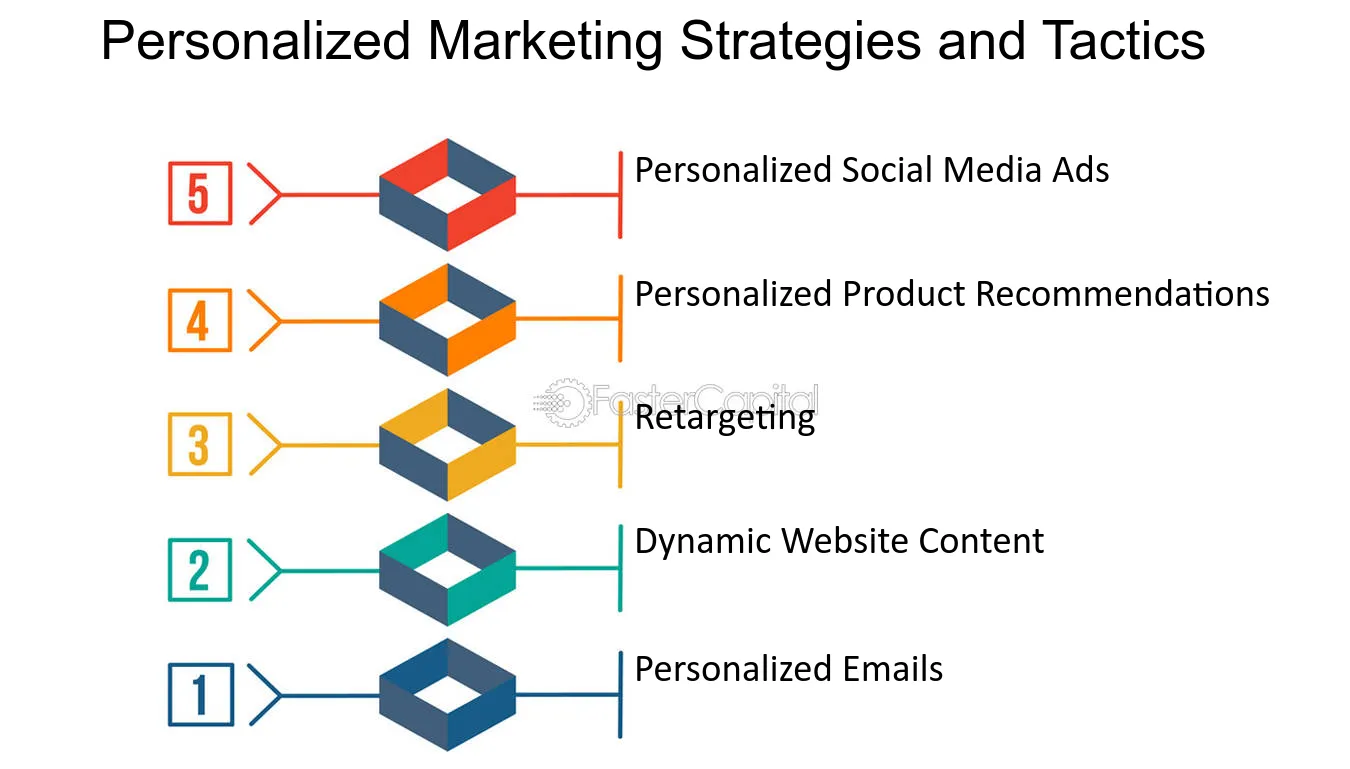
In 2024 I hope to see marketing leaders decrease their “spray-and-pray” outbound marketing and demand generation – in favor of using AI-based tools that will both harvest/enrich contact information (see below) to generate more relevant, ICP-based outreach.  The results could be an order-of-magnitude improvement in outreach response and click-through rates.

For deeper insight: 

2. Data-Driven Customer Targeting: 

Building Ideal Customer Profiles has largely resided in the area of assembling personas - and doing so has largely been qualitative research, experimentation, and a pinch of guesswork.

In 2024, I see top-of-funnel ICP creation becoming far more precise and data-driven, leveraging new AI-driven data enrichment, correlation, and analysis. This will be guided by targeting the highest lifetime-value customers, as well as those with the lowest acquisition costs.  

As the trend continues (I hope) we’ll also see a shift to augmenting existing Customer Relationship (CRM) systems with newer Customer Data Platforms (CDPs).  CDPs collect/amass more information about customers than what is simply entered by sales and marketing teams.  I see CDPs leveraging publicly-available 3rd-party data sources, social, etc.  to add to customer profiles.  The results will (a) help better understand existing customers and needs, as well as (b) help predict sources and ways to ID net new customers. 
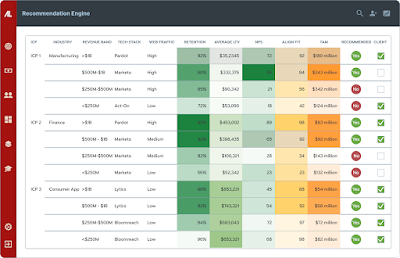
Source: Alignicp.com

For deeper insight: 

3. The Death of Lead Attribution  

In the very recent past, Lead Attribution and last-touch tracking was used to determine what resources “caused” customers to convert (and what org got the credit). In my opinion, this approach has been simplistic and short-sighted. 

In addition, cookie restrictions and web tracking limitations are making these approaches even more difficult to implement. 

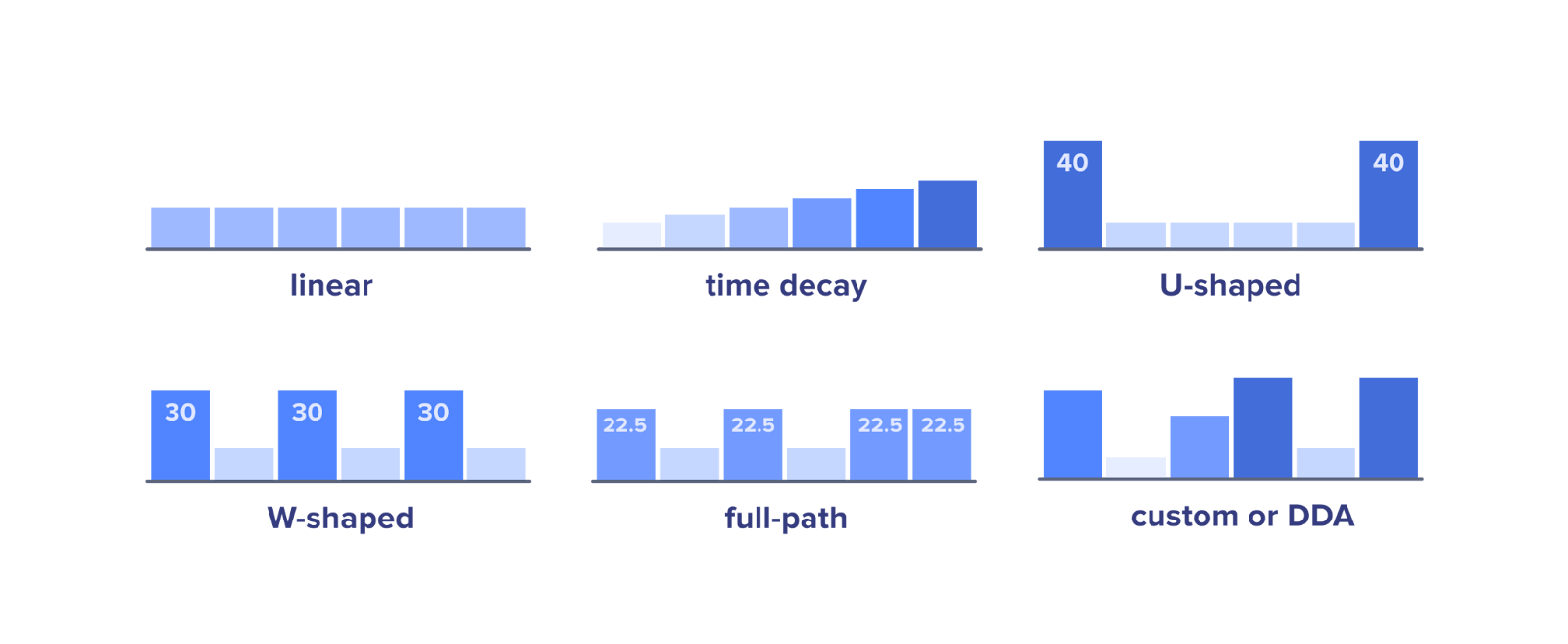
In response, marketers will begin to use more holistic (and privacy-centric) approaches to finding the sources of marketing and sales leads. Strategies like adopting first-party data collection, data enrichment tools, investing in predictive analytics, leveraging AI-driven models, and emphasizing contextual targeting will gain traction.  

Plus, advanced analytics and ML algorithms enables a deeper understanding of customer behavior and allows for more detailed attribution models that take into account various touchpoints and interactions. One of the key benefits of using ML in attribution modeling is its ability to identify the most significant touchpoints in the customer journey, even when those touchpoints may not be obvious.
For deeper insight:


Final Thought

These themes are simply observations I've made as a practitioner; please leave comments, notes and other insights so that others can learn from this! 


Sunday, October 15, 2023

First Steps to Find Product-Market Fit: Zero-In on Your ICP


Recently I spent 2 days at the Techstars FounderCon event in San Francisco. And during the previous week I participated in their “mentor madness” events, meeting 1:1 with dozens of founders.

What was clear in 80% of my meetings was an urgent need for early product founders to narrow-down their focus on their Ideal Customer Profile…. And to try to stop “selling to anyone”.

Indeed, so many founders - especially those with technical backgrounds - felt they were building a platform that would appeal to a huge swath of the market. The problem with this approach is that with a limited budget, their priority is to prove their concept… not to show scale (or even revenue). Investors and leadership need to know that there is actually a market for their product – one in which customers will be thrilled by the value it creates.

This is true for new products at established companies, not just startups.

Indeed, the classic product-market-fit metric, the “Sean Ellis Test”, needs to show ~ 40% of customers would be “very disappointed” if the product no longer existed. This isn’t a metric for how many people adopt your product – but rather one that shows sustainable product value.

The takeaway is first to find a narrow customer profile (perhaps uncomfortably narrow) that you can define, identify, target, and win. Worry about scaling later. The advantages of this rationale are:
  • Efficiency: A narrow focus makes your outreach more cost efficient
  • Data: The feedback from a narrow customer segment is statistically meaningful
  • Value Focus: you’ll find the exact value you provide to a precise type of customer
A great summary from Robert Kaminski recently illustrated this – How brand-names got their start…. With an uncomfortably-narrow initial focus:
  • PayPal owned payments for eBay sellers before they were in every online checkout.
  • Facebook owned online social networking at Harvard, before your mom (and the rest of the world) signed up.
  • Airbnb spread their concept through New York and San Francisco before they disrupted the hotel industry. (Uber did the same thing)
  • Amazon dominated the book market before they owned all e-commerce.
  • eBay owned the collector items market before they took over all online auctions.

Where to begin: Focus, Focus, Focus

Typically I see marketers at all sizes and types of companies default into a blurry, imprecise customer profile, believing that a firmographic customer definition is sufficient. But for an early-stage B2B company, there are many more ICP dimensions of focus you need to consider:

  • Firmographics: the broadest filter to use that helps narrow-down the type of businesses you are targeting. The most common basic step to define customers.
  • Psychographics: Getting to know the *buyers* and *influencers” you’ll be marketing to. Understand the language they use, the problems they’re solving, and where to find them when it comes time to market to them.
  • Jobs-to-be-Done: Describes the *specific* jobs and outcomes the buyers are trying to achieve with your product. E.g. What are the specific problems, solutions, and workflows they use? How would your product fit-in and enhance their experience?
  • Technical Indicators: Are there specific technologies or products that would bias the company into buying yours? Are there products in use that would *not* bias the customer to buy from you? What technology categories would they turn to find yours?
ICP Ideal Customer Profile - Indicator Characteristics


Next: Form a hypothesis, test, repeat!

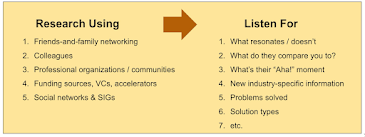
Now comes hard work… manual reaching-out to, and conversations with, individuals who’ll help you validate your ICP hypothesis. These are *not* sales calls. Start with connections, colleagues, social networks, etc. and ask relatively open-ended questions. What makes sense about your product to them? How do they describe it? What do they compare it to? Do they reach an “aha!” moment where they see value? What value is it, and what got them to that point? Try to identify as many firmographic, psychographic, JTBD, and technical indicators as you can.

This process will take weeks if not months, and you should have perhaps 50 conversations – during which time you’ll find yourself constantly refining your “pitch”, challenging your value propositions, and maybe reconsidering much of the product itself. You’ll come to realize that your initial ICP might be off (or totally wrong). But the result will be invaluable learnings that you probably didn’t even anticipate when conceiving of your product.

ICP Research
Research Approach for ICPs

My own ICP experience at a series-A big-data startup showed how many levels and iterations of ICP research, experimentation, outreach, and refocus are needed. This process took the better part of a year before clearly understanding who to initially target. And it turns out that the “traditional” firmographics (e.g. vertical industry, company size) had almost no bearing on finding an ideal customer…


Also Ask: What’s My Category?

As you do your research, you also need to uncover the *product category* you fit into. That is, how do customers think about your product, and where do they conceptually place it? This is all about letting the market *informing you* about where your product fits. And with this knowledge, you’ll better understand competitors and alternatives, as well as keywords and search terms to use.

One important thing to note: Don’t try to create a new category! (or, at least not yet). No matter how “cool” or unique your product is, categories are defined by their competition and by having a defined market. Chances are, at an early stage, you’re not defining a new category. While some products may indeed merit a new category, a challenge is that *no one* will know to ask for, or search for, a product in a category that’s new. . So go with what’s understood.

Great places to begin to discover and define your category (and associated language to use when marketing) are product review sites and industry analysts. For example, G2, Capterra and TrustRadius group products into categories for comparison. Analysts such as Gartner (the Gartner Magic Quadrant) and Forrester (the Forrester Wave), also group products by category. Follow these market-driven definitions as you bring your own product to market.


ICP in the Broader PMF Context

Now that you have a clear 1.0 ICP – which may have taken months to hone-in on – your real go-to-market work can begin: Closing your first early-adopter customers.

As you progress in your go-to-market journey and begin growth, you still should do customer research on your ICP. Why? Because (a) you’ll find that customer expectations change, (b) markets change, (c) competition changes, (d) different customer segments have different ICP requirements.

Consider embedding an “ICP Mentality” into your marketing, customer success, and sales organizations. As you mature, you’ll iterate into a “v 2.0” ICP. This is where you also begin to identify your “superfans” (high-expectation customers who’ll give you regular detailed feedback) and a regular process to poll customers and track ICPs for different solutions, verticals, etc.. And eventually, you should build a customer advisory board made up of customer advocates and high-expectation customers … choose those that will be candid, direct, honest, and representative of the various segments that you sell to.
ICP Ideal Customer Profile Maturity Model
ICP Maturity Model Stages

Embedding an ICP Mentality also serves to align your entire organization. A single, agreed-upon ICP (or set of ICPs for different products/markets) helps focus messaging, sales and even finance… and avoids that messy finger-pointing between sales and marketing (HT to Dan Sperring):
  • Marketing/Sales -
    • Agreed-upon GTM & campaign focus
    • Consistent lead qualification & prioritization
  • Sales/Finance -
    • Planning & forecasting based on ICP segment targets
  • Finance/Marketing -
    • Computation of CLTV based on ICP segments
    • Estimation retention based on ICP segments

Other thoughts? I always welcome them!

Additional ICP References


Wednesday, January 18, 2023

Announcing: Fountainhead Product Marketing


I’m happy to announce my newest professional chapter: Establishing Fountainhead Product Marketing, an advisory and consulting practice focused on serving early-to-mid stage engineering-led companies.
Fountainhead is based on leveraging product-market fit as the core model to help B2B SaaS companies organize teams and improve their marketing.

Tuesday, January 3, 2023

What are “Team APIs” and why should product marketers use them?

The API metaphor is a powerful concept when thinking about how marketing teams and adjacent orgs need to intercommunicate. Basically, your goal is to formalize your information exchanges, frequency, and formats so that you begin to build regular bridges with other important players at your company.  It's also a great metaphor for organizing standard company interactions of any kind....


Tuesday, October 18, 2022

A Product Marketing Tech Stack for B2B SaaS


I’ve always been a proponent of organizing Product Marketing using the Product/Market Fit framework – thinking about marketing as a set of inside-out components, as well outside-in components. And each component has its own set of technologies, as well as a set of outcome-based goals/metrics.


I’ve expanded on this model using a few different approaches and ultimately found it useful to organize marketing technologies as well.  Note: The products I list are only ones I’ve had direct and/or indirect work with – this is by no means a scientifically or statistically-derived list. What’s most useful (IMHO) is how to think about categorizing tools, and how those categories map onto PMM functions and organizations....


Tuesday, July 26, 2022

5 Missteps New CMOs Should Avoid at Early-Stage B2B Companies


You’ve just landed a marketing leadership role at a Series-A or -B tech company – offering a SaaS product in the B2B space. 

During the interview process you’re told how great the product is, how unique it is in the market, how it blows-away the competition, and how it fills an un-yet met need. But, if you believe it all, be prepared to fail.  

I have to openly admit to having made just about all of the missteps below at some point in my career. So, I’m sharing these personal observations from 20+ years of leading marketing, product marketing, and product management teams in a number of small (and large) Enterprise B2B software/SaaS companies.  Think of this as a Getting-Started Playbook as an early-stage hire... or for that matter, as any type of marketing leadership hire.....

.
.
.

Sunday, May 2, 2021

Rethinking The Resume: How Marketers Should Market Themselves


If your resume doesn’t market you well, then expectations
of how you’ll do marketing for an employer will be just as low.  

I’ve interviewed countless marketing (and sales) candidates. And probably reviewed 50x as many resumes. 

What has struck me is how totally bland and generic 95% of them are.  For all the work people put into writing their CVs, it’s confounding how many are downright undifferentiated.


Then I thought: “Shit, I’m trying to hire a Marketing professional…  if they can’t market themself well, then they sure won’t be good at marketing for me”.


It struck me: Could it help to offer a Marketer’s interpretation on how to write a resume? It would be based on using basic marketing principles.  Gone would be all the BS we were told about using exciting verbs, acronyms, claims about team-orientation and collaborative skills, eagerness and energy.  


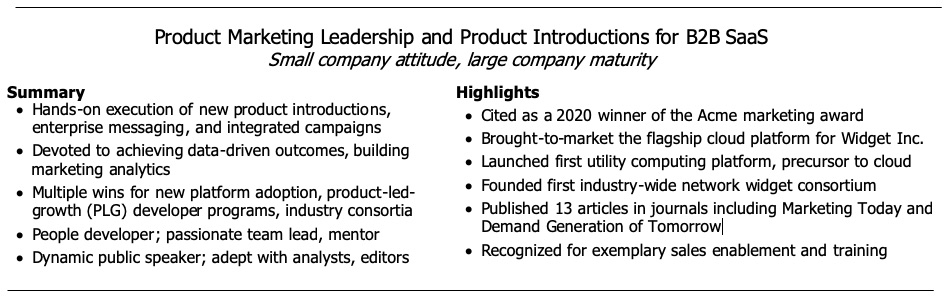
Instead, consider thinking about the CV as a “marketing data sheet” about you: You’re selling a unique, differentiated individual, with a career arc and set of achievements that will uniquely solve the hiring (and functional) need of the buyer (hiring manager). Plus, that document should use words and proof-points to catch the eye of the right buyer and pull them deeper into the details.


So I’ll propose an approach to (re)designing the CV the way a marketer would: 

  1. Positioning narrative and headline

  2. Articulate differentiation and uniqueness

  3. Focus on your buyers’ needs and persona

  4. Use proof-points and data… not claims

  5. Use keywords and think SEO


1. Positioning Narrative and Headline


Let me start at the beginning: The mindset you want to adopt when thinking about rewriting your resume is to start with the classic approach to writing a positioning statement (which you should adapt to your own situation) e.g. 

For companies in the xx category needing yy skills, <yournamehere> provides an exceptional zz record of accomplishments. Unlike the average Jane/Joe, <yournamehere> has shown they have and can deliver, and is likely to show increasing promise for you in the future… 


And if you don’t have a sense of how you want to position yourself, you’ll immediately fall into the trap of sounding generic. Frankly, I can’t stand seeing 2 things: Resumes that *don’t* have a line or two of summary, and resumes that say completely generic garbage, e.g.

Motivated marketing professional and team-player looking for a challenging opportunity with a growing company.


That approach tells the reviewer absolutely nothing.  Instead, consider using the summary as communicating the “brand” you want to give yourself, and the specializations you have, i.e. under the umbrella of your positioning: 

A proven demand generation professional specializing in business-to-business software sales for hard-to-reach SMBs


The other thing I like to see at the top of a resume - just as with a data sheet - are a few bullets summarizing Background, Skills, and/or Highlights.  Did you personally achieve something great? Win an award? Specialize in certain tools or techniques?   These bullets should be eye-catchers for the lazy/tired professional scanning dozens of resumes each day.


2. Articulate Your Differentiation and Uniqueness


Any good marketer should know that - counterintuitively - narrower focus is better than generality. Being everything to all audiences means you’ll identify with none.  The more focused your message is, the more it will resonate with your intended audience. You actually don’t want responses from *every* audience, you want a response from an intended one. Why? Because hiring managers rarely want a jack-of-all-trades with zero specializations. Rather, they look to fill a specific role/need with someone who’ll fill it well and grow with the needs of the function. 


So, as you think about how to position yourself as unique and focused, make sure that you carry through a thread that speaks specifically to what you uniquely bring.


Avoid sounding generic, or listing everything under the sun: 

  • Marketing program management

  • Product marketing for Cloud technologies

  • Demand generation, audience marketing, messaging, strategy, program management, cloud marketing


Rather, appeal to your strengths, and to the needs that a hiring manager will need:

  • Integrated marketing and campaign program management

  • Product marketing for B2B SaaS cloud-based offerings

  • Demand generation utilizing audience-based technologies, persona-based messaging, and SEO analysis


Now, you may think “Gee, this approach is too narrow for me. I’m looking in a few areas, not just a single-focus”.   That’s fine. Then you should maintain 2-3 *different* resumes that focus in distinctly different areas.  I’ll talk to more of that in the section below. 


3.  Focus on Your Buyers’ (e.g. Hiring Managers) Needs and Persona


Too many resumes are just vanilla statements that don’t target hiring managers. They’re akin to writing a product description, web page, or data sheet without a specific buyer persona(s) in mind. This pitfall (again) is like creating a general everything-to-everyone statement... but specific to none.  Remember: a hiring manager looking for a candidate profile that doesn’t speak to them will spend 12 seconds reviewing it, and then throw it aside.


Instead, approach your own positioning, language, job descriptions, and achievements in the following classic marketing manner to appeal to the buyer:


  • Their Need: Consider the role the hiring manager is trying to fill - A missing function, a new role, or an additional skill-set? Do they need  a leader, a doer, or a subject-matter expert?  Think about what YOU want to bring to the table, and “spin” your CV in that direction with words, descriptions and proof-points (across all of your previous roles) that speak directly to the need of the “buyer”. 


  • Their Persona: If you’re applying for an entry-level individual contributor role, the persona you’re speaking to is probably a departmental manager looking for a specific set of skills to add to their team. But if you’re applying for a managerial-level role, the hiring manager is likely an executive, looking for leadership and broader strategic thinking.   The message here is to write your CV keeping the buyer right persona in mind.


If you’re like most professionals, you probably have two or three skills, a few different potential roles you’d be great for, and a few different titles you’re gunning for.   So take a page from target marketing and create 2-3 *different versions* of your CV, each targeting a different need, role or position.   The classic marketing example of this is the Tylenol® brand of products, where a small number of medication formulas are actually branded and marketed as a wide variety of products (e.g. extra-strength is just more of the regular strength, which is just more than Children’s).  Focus, focus, and customize.


4. Use Proof-Points and Data… Not Claims


The most meaningful and impactful part of a data sheet or a convincing report is *proof* and *data* that the product/service performs.  Use of this approach is more common than you think… you always hear “9 out of 10 dentists recommend…”,  “cleans 90% better than the next leading brand…”  or “Kills 99.9% of germs…”   Yup, proof-points sell.


You also don’t see marketers talk about how their product merely helps…. They focus on the value of what the product *does*.   So avoid talking about how you “helped launch blah blah” or “supported the blah blah program”. Those terms are passive and meaningless.  Instead focus on what you did: 


  • Launched blah blah using an SEO campaign yielding xx% increase in new visits

  • Grew the blah blah program by yy% by scaling global outreach into zz new geographies%


You just don’t see knowledgeable marketers make empty claims or use general words - they all are specific, and show results. 


Say what you did, highlight your results, and prove the difference you made to the company. Illustrate quantitatively to show you were effective… and know how to measure your own achievements. Data is convincing. Hiring managers want that.


5. Use Keywords... and Think SEO  


More initial screening of resumes is done by machine automation than ever before. Hiring managers tell recruiters to look for specific companies, titles, skills, products and technologies.  Recruiters then literally tell resume scanning systems to search for matches and score candidates.   


So write your CV using meaningful keywords.  Repeat the words/terms that you *want* to be recognized for, and specific industry terms that a savvy hiring manager will look for.   Oh… and while you may have been told not to use abbreviations or acronyms, that’s all changed in the Tech Era.  Nobody in their right mind says they program HyperText Markup Language; you wouldn’t say you’re a specialist in Search Engine Optimization; a security would never say they work with the Open ID Connect standard.  Just say HTML, SEO and OIDC -- that’s what your hiring managers (and algorithms) are looking for. 


In Closing: 


If you can’t market yourself as a marketer, how can you expect someone to hire you for that? If you can’t sell yourself as a salesman, why would you expect to be chosen?


Take a step back from your resume, and re-think: Is it a dry historical summary of jobs, or is it a compelling illustration of accomplishments and future promise? 


Wednesday, April 7, 2021

The How (not the what) of Product-Led Growth

5 organizations and 14 metrics that make PLG work

There is an explosion of articles focusing on the popularity of the PLG growth model, analyses of company valuation, and quite a bit written about growth metrics for this new model. 

But I want to parse the problem a bit differently, focusing not only on the goals an aspiring PLG company should set at each stage of the sales cycle... but also on how to organize delivery of a successful PLG product.  IMO, these are the real keys to PLG success.

Most Important: How to *Organize* for Successful PLG Execution

I’ve found that most PLG articles stop at this point. But to be successful and designing and executing on the strategy, the company has to think and act in new ways. And that means core organizations need to be structured specifically in a PLG-related fashion.

Consider that the product itself needs to be designed so it’s more easily adopted and onboarded; that it needs to be instrumented differently so as to track speed bumps in the customer journey; that it generates triggers when it’s time to send-in the ‘big guns” to close large deals. 

At least 5 organizations need to be part of this company-wide effort, and each should be accountable to the overall PLG/DLG plan.  Leaders of these 5 organizations must choose which PLG metrics they can impact, and be willing to adjust/experiment/adapt to improve.  

Full article published on LinkedIn


Friday, January 22, 2021

Three SuperPowers Every Marketer Should Develop

Why Paranoia, Customer Intimacy, and Peripheral Vision are key skills for Product Marketing Management

If you’re going to be in Product Marketing - or in any company leadership position - I’ve found that the same 3 “superpowers” keep recurring in successful careers. These aren’t operational or functional skills per se. Rather, they are persistent perspectives that leaders with insight always keep in the back of their minds.

First, there’s always maintaining a healthy dose of Paranoia.  That is, you haven’t drunk the product Cool-Aide, that your product/company must be the best. Second, there is the requirement for customer closeness and intimacy - knowing your core buyers inside-and-out. Then finally, there is what I call Product Peripheral Vision - understanding your product/service in a greater customer and competitive context.

Embody these, and you’ll always add value to the company, to your product, and to your customers.  

1. A Super-Healthy Sense of Paranoia

Andy Grove - of Intel fame - literally wrote the book:Only the Paranoid Survive: How to Exploit the Crisis Points That Challenge Every Company.”  In this he famously pointed out that "Business success contains the seeds of its own destruction... Success breeds complacency. Complacency breeds failure. Only the paranoid survive”.  He narrowed-down this statement to 6 Forces, but in my opinion, a good PMM focuses on the following paranoia:

  • Competition - assume they’re always trying to be better than you - and perhaps they already are. Don’t be complacent or simply dismiss the competition. Take them seriously, and always question whether you’re really more compelling to customers.
  • Alternatives - your biggest disruption won’t necessarily hit you head-on. Customers always look for alternatives, including “good-enough” solutions that can invisibly displace you.  Always be on the look-out for the closest alternatives customers use… and why.
  • Differentiation - while you probably *think* you’re differentiated, you’re likely not (at least, not as much as you think).   Take a cold-hard look at how really different you are from a customer’s perspective, and push to modify your offer as well as your marketing.
  • Industry changes - while you’re focused on segment or category “A”, there’s always the possibility that a completely different industry imperative will shift customers to different categories. Be ready to adapt.

2. Super Closeness to the Customer, Customer intimacy

As a marketing leader - ensuring that your product has proper market fit with your target customers, you Must be the SuperPower expert about your customers. And you need to communicate these learnings back into the company, specifically back to marketing, product management, and sales.  

  • Know the customer at every level - Know the decision-makers vs. buyers vs. users. The tactical reasons they buy, as well as the strategic business reasons. 
  • Why they bought - You’ll need to get inside their heads regarding why they chose your product, how they evaluated it, how they use it - on a daily basis.
  • Know Alternatives - Similar to the Paranoia topic above, you’ll need to know what alternative (and competitors) they considered during the process - and *why*. What was attractive to them, how they got the names, whether they’re *still* considering the alternatives.
  • Ask the critical question - “How would you feel if you *didn’t* have this product?” The answer will be telling - indicating how well your “fit” is to the customer, how much they value the uniqueness, and how critical your product is to the customer’s outcomes. 
  • Intimacy vs. Focus - There are subtle differences between customer intimacy and customer closeness.  Ensure you develop the right insights and relationships so you can serve -- and even better -- anticipate their needs. 

3. Maintaining Super Peripheral Vision

One of the best SuperPowers you can develop as a marketer or businessperson is the ability to see out beyond the myopia of your own product, technology, and even industry segment.  Always be looking for (worrying about?)  adjacencies, routes-to-market, partnerships, and the “Whole Product” aspect of your offering. 

  • Think “Whole Product” - That is, partners, ecosystems, channels. Most B2B products simply don’t exist in a vacuum. They are bought with, or through, other technology partners, value-add ecosystems and channels. Every product exists and abuts other products and technologies.  Every decision you make has to take these realities into account.
  • Focus on indirect competition / alternatives - The notion of maintaining peripheral vision also applies to alternatives and competition.   What other distant adjacencies are (or will be) intersecting with your own market? Are any of them potential partners - before they become competition? 
  • Consider similar (but different) market plays - I always like to think about product and marketing analogies in different markets that either worked or failed… and whether those analogies apply to product /market.  Do they help reframe product positioning? Value propositions? Routes-to-market? 
Got any other suggestions on critical "Super Powers" ? let me know!


Thursday, December 10, 2020

Product/Market Fit As a Organizing Principle for PMMs


“Product-market fit means being in a good market with a product that can satisfy that market.

Marc Andreessen, co-founder and General Partner, Andreessen Horowitz, Guide to Startups


When I’m asked “What does Product Marketing do?” I respond that it’s the core role that drives product-market fit, matching the product to the right buyers. All markets are made up of buyers and sellers… and when the needs of buyers are met by the offers of sellers, there’s a transaction. For me, it’s the role of Product Marketing Management (PMM) to drive this for the company that is, to influence product development to meet the market needs, and to help find the right market buyers that need the product being offered. When both of those conditions are met (and it’s a continual process!) there’s great fit and a successful business. (Really, this is just a variation of Bid/Ask). So, PMMs are the core role rationalizing Product Management, Sales, and Go-to-Market motions. 

Sunday, August 30, 2020

Advice to the Aspiring Employee

I’ve spent the past few weeks busy evaluating team performance for our semi-annual review process. And every year, I take it more seriously because every year I realize how much more important *people* are to the company. 


I used to think this was a throw-away comment - but hiring, developing, promoting and rewarding the “A” players is the difference between a high-performing company, and all the other average players.


Anyone reading this might ask, “Well, what do you mean by an ‘A’ player? I work really hard. I have great ideas. I’ve got experience. Doesn’t that make me an ‘A’ player too? How do I get promoted?” 


Well, from a manager’s perspective, here’s the advice I give, and what I look for in “A” players - and believe most other management does too.

  1. Table-Stakes: Do your core job well. You’re expected to be competent, handle your responsibilities, know your skills, execute on-time, and keep your accountabilities on-track.  And for all of that, you’ll achieve being a solid “average” player.  There’s absolutely nothing wrong with this - unless you’re looking to grow, get a promotion, and excel at the company. But you have to start here.

  2. Next: Your willingness and ability to go above-and-beyond. This means that if/when there is a “crunch-time”, when there is an aggressive project, an emergency, a “special assignment” etc., you’re willing to put in the extra hours to get it done. These extra hours might be over a period of days -- and occasionally over weeks. But you’ve got to be willing to show your commitment to do this. It means that you’re able to identify the important projects (maybe only 1-2 a year) and rally to deliver them on time. Your management will notice, because it shows an awareness and commitment to do what needs to get done. BTW, a word of caution: This does NOT mean you are constantly working 80 hour weeks! (you’ll burn yourself out).  

  3. The hard one: Learn to push the envelope of your Job Description: Here’s the aspect of your job that signals your most “promotable” aspect: I like to think of it as “pushing the envelope” of the job. Others might call it “working at the next level above you”. Either way, it means you are thinking outside the box that’s called your job description.

    Is there an idea you have that management hasn’t thought of? An opportunity nobody’s identified yet? A strategy that hasn’t been pursued? Whatever the instance, it should be incremental to your role (but not so “blue-sky” as to be immediately dismissed).  But here’s the key: Management *loves* new ideas - and execution of those ideas - coming from employees. It means the employee is interested, motivated, ambitious. Who wouldn’t like someone like that on their team?

    One other perspective in which to hold “pushing the envelope”: It’s all about your attitude. Try this thought experiment - if you got a promotion tomorrow, what would you do differently? How would you act? What goals would you set for yourself? How would you team/partner differently? How would you communicate differently with management?  So start acting/doing all of that NOW! Promotions most frequently happen to people who are ALREADY acting and executing at the next level. 

What if you don’t know what “outside the box” means for you?  Then my recommendation is to brainstorm with your manager… or with their manager. You don’t need to have all the answers, but you should show the eagerness to inquire and discover. 


There are tons of other skills, attitudes, and attributes that’ll help you be a star. And sometimes, it’s just-plain experience that helps too. 


But if you’re wondering “how will I get that great review” or “am I promotable”, my suggestion is to first focus on the 3 points above.


Monday, February 17, 2020

Gartner MQ, Forrester Wave: A Disservice to Innovation?

Note: Read this blog more as a wakeup call to vendors than as a criticism of Industry Analysts. By inadvertently playing into analysts’ narrow definition of products and categories, vendors can become distracted from their real goal – pursuing meaningful, valuable, and unique innovation. 

Prologue
Industry analysts have an important job in the technology industry: To help customers better understand trends, technologies, and vendors, so they can make better, more confident purchasing decisions. And for vendors, analysts are helpful by providing market research, trend analysis and evaluation of products and technologies.

But in my experience, analysts also have a fine line to walk when they make vendor evaluations. Since analysts take money from both vendors and customers, they put themselves in potential conflict-of-interest positions, if not also risking bias.  This is made worse by lack of transparency in their evaluation methodologies.

The most popular – and influential – evaluation tools analysts offer are periodic product analyses and ratings. The well-known Gartner Magic Quadrant (MQ) and Forrester Wave are at the top of the list, with others such as KuppingerCole’s Leadership Compass. These reports are pervasive, with Wikipedia listing 66 different Gartner MQs – with many more unlisted.

Unintended consequence: Category myopia
A closer look at how the MQs, Waves, and other evaluation are constructed reveals massive spreadsheets that vendors are asked to complete. They largely focus on product feature comparisons, and to a lesser degree, company operations. I’ve personally helped complete countless numbers of these – and it’s often a multi-person, multi-week vendor effort.

But the spreadsheet questionnaires have an unintended consequence: They inadvertently treat each vendor product/category as a fungible, semi-generic solution to meet a limited set of problems.  Further, they often track technology categories that can quickly become outdated, even as analysts struggle to update them.

The result is that vendors are compelled to play the analyst’s game... not their own.   The unintended myopia – the forced “thinking-inside-the-box” – manifests itself this way:

  • Vendors end up spending time, R&D resources, and marketing expense to chase feature boxes that will yield them high evaluation scores.  This inadvertent “keeping up with the Jones’ ” for feature parity does an injustice to innovation they would otherwise pursue.  It is the rare visionary vendor that’s able to say “screw the features the analysts want, we want to innovate in a different direction”.  And, unfortunately, those same vendors might be penalized in the next vendor evaluation for not “checking the boxes” even though they may have a breakthrough approach to the market.
  • Customers may also be misled by these evaluations, often narrowly viewing the product sector through the narrow lens presented by the analysts.  While some customers will benefit by an apples-to-apples comparison of features, many may miss appreciating the variation in vendor options, approaches, and overall direction/strategy – things not generally reflected in simple checkbox evaluations. 

True innovators are penalized
A great set of podcasts by Christopher Lochhead focus on “legendary marketers” and innovators who re-think their products, market strategies, and ultimately create new concepts and categories.  But in the world of  standard analyst categories, innovators of new categories are penalized, because (a) they are not being considered for a MQ or wave, or (b) receive poorer ratings on the standard category ratings... even if they offer a truly revolutionary approach to solving a technology problem.


Now, to play my own devil’s advocate, I recognize the need for analysts to create some level of standardized evaluation criteria – the industry needs this. However, analyst criteria can be mistakenly held as the end-all and be-all, rather than as general guidance.  Further, most analysts fail to go the extra mile to fully explain the differentiations between vendors and products.

Note to Vendors: Analysts assess the Finite Game, not the Infinite Game
In his excellent new book The Infinite Game, Simon Sinek outlines the notion of great companies focusing on the “infinite game” – one where there is vision, constant reinvention and constant shifting of the playing field... and even shifting the definition of what it means to succeed.  This is in contrast to playing the “finite game” where the rules are defined, there is a limited set of metrics, and a singular clear goal to win.

The current mindset which is rewarded by MQs and Waves is that of the Finite Game... where vendors are encouraged play to their competition, innovate with the “check-the-box” mentality, and where customers might errantly treat vendor solutions as generic and fungible.

My candid vendor advice is this: Yes, we need to play the analyst’s game. There is absolutely a service to our customers using this approach. But proceed with caution and intelligence – There may not be not a need to “check all the boxes”, nor necessarily should you. Balance that effort against your own vision, direction and approach to differentiation. And ensure that if you opt for a powerful direction, albeit one that could weaken your evaluation, emphasize your believe/vision with the analysts.  Remember: There are lots of billion-dollar firms that aren’t leadership quadrant companies.

My advice if you’re a customer: Don’t blindly choose to put the top 3 vendors of a leadership quadrant on your short-list.  Look more deeply, and have your own set of criteria developed when selecting a vendor.   All-too-often, a vendor might have a solid offering in a given category, but ultimately fail to demonstrate the strategy and direction that will carry your company forward a few years in the future.

Coda: A note to analysts: 
I have the greatest respect for you – and for the incredible knowledge you have and advice you give.  (Even some of my own best friends are Analysts).  But please emphasize that your evaluations are standardized.  Go the extra mile to really understand and communicate

  • how vendors differentiate their products
  • where vendor visions lead and/or diverge
  • adjacent categories to the vendors’ own (or categories that overlap)
  • how the vendor’s products are either “pure-play” in the category, or how it expands the category definition. 

I look forward to your comments/feedback