Showing posts with label Predictions. Show all posts

Monday, December 18, 2023

Data-Driven B2B Marketing Themes for 2024

During 2023 there was the obvious rise of using AI (and other forms of LLMs) to assist marketing’s efficiency and effectiveness.  However, most of the uses of AI I’ve seen were in the areas of (a) content generation, and (b) CS and chatbots. 

Entering 2024, I’m hoping that we see deeper use of AI/ML to enhance the marketing domains of understanding customers, enriching marketing datasets, and better analysis of customer journeys.

In short, I believe – and hope to see – the following B2B marketing trends progress… and hope that B2B Marketing leaders begin to invest in the following: 

  • Use of Mass-Customization in Marketing
  • Turn to Data-Driven Customer Targeting
  • The Death of Traditional Lead Attribution  

I’ve also added a few resources below each observation if you’d like to look more deeply.  Please leave comments, notes and other insights so that others can learn from this! 

1. Use of Mass-Customization in Marketing: 


AI is now being applied to “mass customization” (personalization-at-scale) of content, marketing outreach, web experience, and even product experience.  As marketing departments mature from using LLMs/AI for simple content creation, they’ll find that combining AI with customer data enrichment will open the floodgates to creating even better Ideal Customer Profiles (ICP).  

AI tools are being increasingly used to enrich customer data; not just to add missing contact information and addresses, but to uncover individual customer use-cases, jobs-to-be-done, existing tech-stacks, previous purchase history, social network engagement and more. This data can be assembled for much more precise targeting, outreach, product recommendations, and of course content.
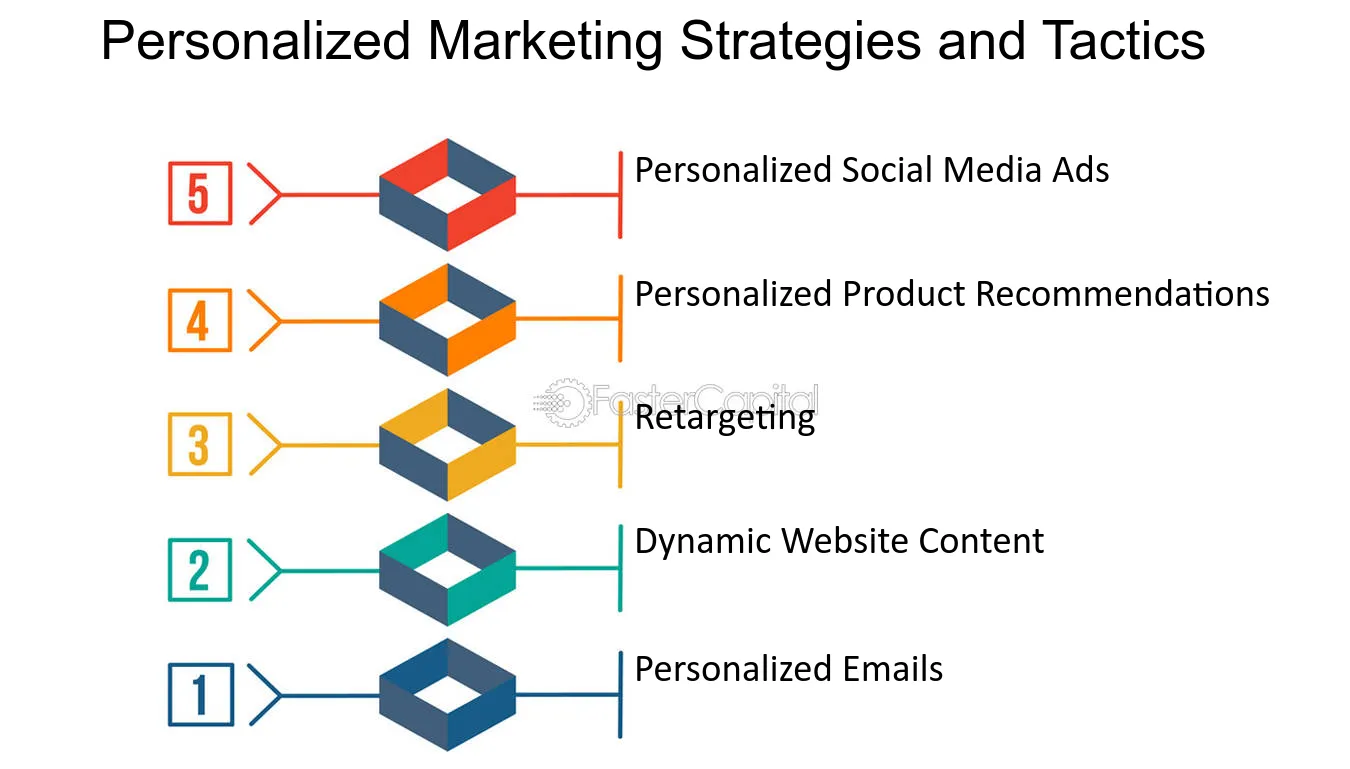
In 2024 I hope to see marketing leaders decrease their “spray-and-pray” outbound marketing and demand generation – in favor of using AI-based tools that will both harvest/enrich contact information (see below) to generate more relevant, ICP-based outreach.  The results could be an order-of-magnitude improvement in outreach response and click-through rates.

For deeper insight: 

2. Data-Driven Customer Targeting: 

Building Ideal Customer Profiles has largely resided in the area of assembling personas - and doing so has largely been qualitative research, experimentation, and a pinch of guesswork.

In 2024, I see top-of-funnel ICP creation becoming far more precise and data-driven, leveraging new AI-driven data enrichment, correlation, and analysis. This will be guided by targeting the highest lifetime-value customers, as well as those with the lowest acquisition costs.  

As the trend continues (I hope) we’ll also see a shift to augmenting existing Customer Relationship (CRM) systems with newer Customer Data Platforms (CDPs).  CDPs collect/amass more information about customers than what is simply entered by sales and marketing teams.  I see CDPs leveraging publicly-available 3rd-party data sources, social, etc.  to add to customer profiles.  The results will (a) help better understand existing customers and needs, as well as (b) help predict sources and ways to ID net new customers. 
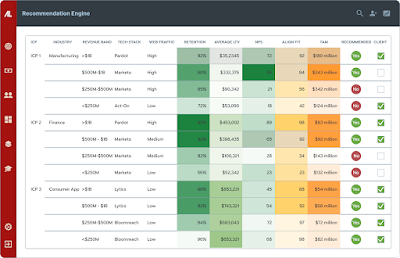
Source: Alignicp.com

For deeper insight: 

3. The Death of Lead Attribution  

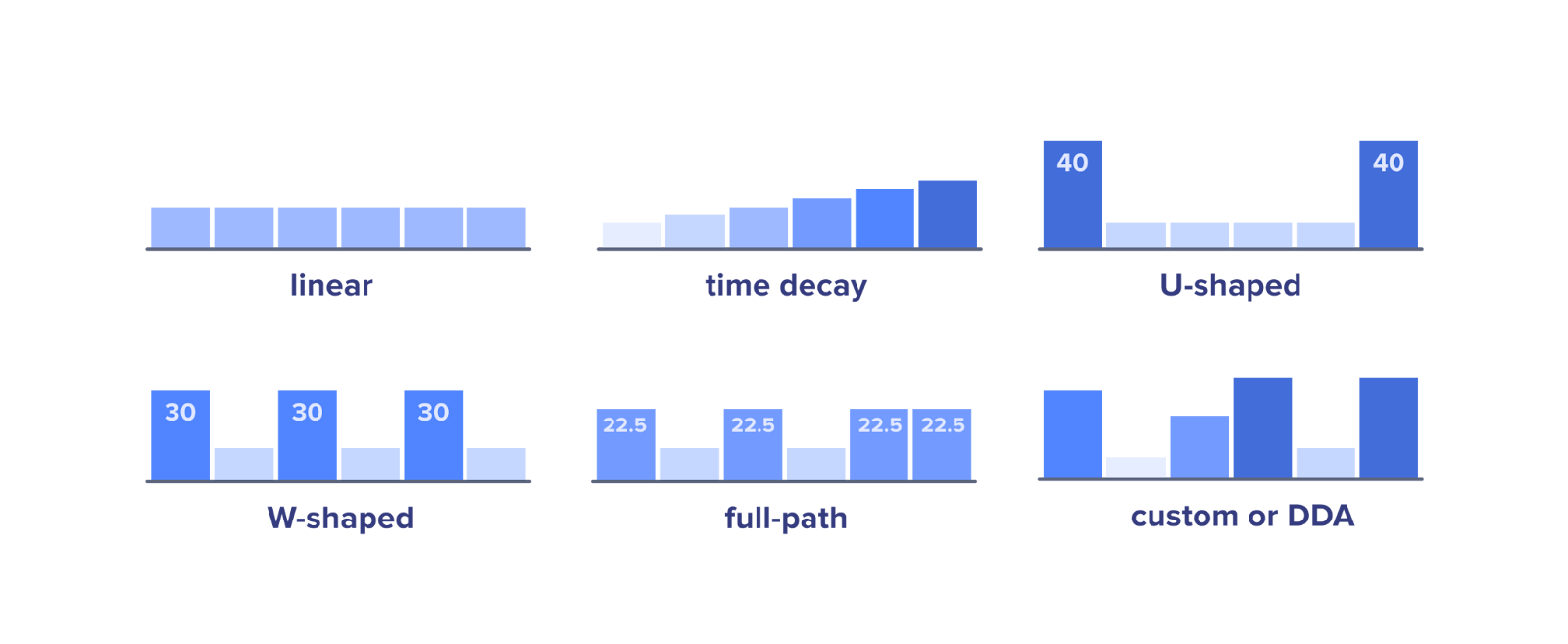
In the very recent past, Lead Attribution and last-touch tracking was used to determine what resources “caused” customers to convert (and what org got the credit). In my opinion, this approach has been simplistic and short-sighted. 

In addition, cookie restrictions and web tracking limitations are making these approaches even more difficult to implement. 

In response, marketers will begin to use more holistic (and privacy-centric) approaches to finding the sources of marketing and sales leads. Strategies like adopting first-party data collection, data enrichment tools, investing in predictive analytics, leveraging AI-driven models, and emphasizing contextual targeting will gain traction.  

Plus, advanced analytics and ML algorithms enables a deeper understanding of customer behavior and allows for more detailed attribution models that take into account various touchpoints and interactions. One of the key benefits of using ML in attribution modeling is its ability to identify the most significant touchpoints in the customer journey, even when those touchpoints may not be obvious.
For deeper insight:


Final Thought

These themes are simply observations I've made as a practitioner; please leave comments, notes and other insights so that others can learn from this! 


Wednesday, November 1, 2017

A Tale of 3 Cloud Strategies - Part III

How the major vendors are vying for hybrid cloud dominance

Over the past few years it’s been an exciting show to see the Big 3 cloud providers jockey for strategic dominance, each with a different approach. As an IT professional, it’s useful to understand each of these in context as you try to determine which horse(s) to ride and what bets to make.

To recap how I’ve been tracking some of the evolution:
  • In Part I (back in 2013) we observed AWS experimenting with expansion by reaching down into the enterprise by licensing its APIs (remember Eucalyptus?) and building a VPC (which evolved into Direct Connect). Meanwhile VMware was experimenting with growth by partnering with independent cloud service providers, a precursor to their failed vCloud Air approach – an attempt to reach from the enterprise up into the cloud. 
  • In Part II (later in 2013) I added a 3rd player to the scrum, when Microsoft introduced the concept of the Azure Pack to their Server stack, a strategy to reach down from the Cloud into the enterprise and bridging the two with a common set of APIs.
In essence, AWS, VMware and Microsoft all looked at ways to expand their presence to create easy-to-adopt hybrid cloud strategies that would lower barriers-to-adoption... and hopefully accelerate enterprises landing workloads onto their stacks.

Enter VMware Cloud Foundation: 

Recently, VMware announced Cloud Foundation, a new strategy to (in my opinion) replace vCloud Air.  In concept, this approach is not unlike Microsoft’s Azure Stack strategy.  VMware is building a common cloud workload management platform that incorporates their SDDC that will operate with both public clouds and on-premises VMware implementations... thereby lowering the barrier-to-adoption of hybrid workloads based on VMware technology.

While Cloud Foundation is similar in concept to Microsoft’s Azure Stack, the two companies took very different approaches to implementation.  Microsoft in essence took the Azure API set, and embedded it into their on-premises server software.   In contrast, VMware took their (mostly) on-premises API sets and is embedding them to public cloud provider offerings.

VMware’s approach is interesting – and potentially very successful. First, they’re cutting deals with major public cloud providers like IBM, AWS, and Azure, so they are able to embed their virtualization stack on top of these public cloud platforms.  And next, they’ll (likely) begin to work with their ~ 4,000 cloud service provider partners to do the same, enabling a pervasive set of common APIs across thousands of providers large and small.  If you buy-into the VMware view of the world (and, some say, the “vTax”) this could give you the ultimate degree of common cloud choice... and put the reach of VMware across as many clouds and on-premises infrastructures as Azure.

Snapshot: Where we are today
As I see it, we now have the following competitive landscape and strategies: 

AWS: 
  • Strategy: Abandoned licensing APIs; Now 100% invested in public cloud presence, and in building-out a dominating set of services – to make their APIs into a de facto “cloud OS”
  • Play: Focus on the single best public cloud IaaS platform and PaaS services for developers and enterprise workloads
  • Business Model: Make money from services and from running workloads
Azure:
  • Strategy: Expand from Cloud  Enterprise. Take their public cloud APIs and duplicate them on-premises within their installed base within the enterprise.  Further helps blur the line between on-premises and cloud, as-has Office365.
  • Play: Reduce/remove barriers-to-adoption of the public cloud by first encouraging API adoption on-premises
  • Business Model: Make money both from server software (traditional) as well as from cloud workloads landed on Azure.   
VMware:
  • Strategy: Expand from enterprise  Cloud. Introduced Cloud Foundation, coupled with SDDC. Initially work to deploy on major public cloud providers, then expand platform to 1000’s of cloud service providers.
  • Play: Encourage pervasiveness of the platform by expanding its reach onto public clouds and into managing heterogeneous hypervisors and containers
  • Business Model: Make money from becoming the central management software (while partners make money on workloads)
Other Players? 

There are still some players out there that are still to be reckoned with.  Namely Google Compute Cloud, as well as IBM/SoftLayer.  While I’m not yet aware of any Google GCP approach/strategy, IBM has just announced their “IBM Cloud Private” approach, based on a number of open-source technologies. This also seems to be a hybrid container/deployment management model – and we’ll look to the future to see what traction it gains. 

In summary... 

As go most major industries and technologies, it appears that industry consolidation has pared-down the major cloud players to 3-5.   So, I’ll close by pointing you of my favorite, prescient Blog back from 2006 by Greg Papadopoulos, then Sun Microsystem’s CTO – Why the world only needs 5 computers.  True Dat.

Monday, May 20, 2013

What Clouds Will Form Around Data's Gravity?

The concept of Data Gravity posits that as data accumulates (whether it be stored, analyzed, used) it tends to attract even more similar data. And as the data amasses there is less likelihood that it will be moved/migrated elsewhere.  If you're not already familiar with the concept definitely check out Dave McCrory's excellent blogs, analyses and presentations on datagravity.org

I believe this data aggregation concept can also apply to attracting computing too. As I've mentioned in It will be a data-centric (cloudy) world, there are examples today where special-purpose compute clouds are already forming around special-use data sets... sometimes intentionally, sometimes organically. One example I frequently point out is the NYSE Capital Markets Community Platform - a special-purpose cloud computing environment formed with a massive market trading data set at its core.

I am increasingly asked by service providers and enterprises alike, what other businesses and special-purpose clouds might form around data?  What new clouds (and associated business models) might we build and monetize? How can we better serve vertical market needs in the Cloud?

Forming Community Clouds - Applied (vs. Theoretical) Data Gravitational Theory

After more thinking and conversations with experts on the topic, I wanted to offer some examples and ideas that I hope trigger further exploration by cloud- and service providers. Perhaps there are (or will be) new businesses based on some of these ideas of attracting data and computing.

Financial Services Community Cloud: as I've mentioned, the NYSE CMCP has at its core a huge database of stock market history.  It's natural attractor for trading firms and hedge funds to co-locate their compute loads near this data as they test and refine trading algorithms and prediction methods. High-performance processors with low-latency connections to Wall Street don't hurt the model either.  Perhaps there are other forms of gravitational financial data (other markets?) that could attract similar compute clouds?

Photography/Imagery Community Cloud: More and more companies (Shutterfly, SmugMug, EverPic stock photography companies etc.) are in the business of warehousing photos - mostly for simple monetization. But some innovative photo data collections might take advantage of this and provide a co-located compute platform for ISVs to provide higher-level photo identification, cataloging, enhancement and even geo-tagging services.  Perhaps the compute services could take advantage of knowledge about the larger database of images that have been previously tagged or otherwise cataloged within the larger community.  [Bonus thought experiment: create a shared medical imagery cloud].

CRM and Customer Insight Community Cloud: Consider the amount of customer data located on Salesforce.com and others. Now consider the amount of consumer behavior information collected by systems like Marketto and others.  What if one of these giants begins to acquire additional firms who house complementary marketing data - and begins to build valuable "big data" around customer behavior?  Much like force.com, the customer data would attract even more marketing and consumer behavior application workloads, again attracting more data and workloads.

The Retail Community Cloud: Start watching what Walmart Labs and Nielson are doing in the Big Data and retail analytics space.  It would be but a small jump for either to create a retail cloud - centered around a huge (but perhaps anonymized) database of consumer purchasing patterns, geographies, pricing and outlets. Monetize it by allowing co-location of marketing analytics workloads from marketing firms seeking insights into better forms of micro-marketing, associative/recommendation sales, and other forms of retail analytics engines. All retail firms great-and-small would want a piece of that action.

The Energy Community Cloud: What would it be worth to amass data about energy consumption -- at the customer level -- across the country? Perhaps associate those users with industry/SIC codes, zip codes, electricity prices and/or electricity source renewabilty (or carbon footprint)?  No single utility has this data, but firms such as Enernoc monitor consumption data across the country. What if they developed a cloud that encouraged co-location of workloads and businesses which take advantage of this data - such as monitoring which businesses are really "greenest", which vertical industries are growing fastest, or where alternative energy sources would be most attractive. Add to the database information such as energy efficiency programs or overlay it with data about alternative (wind, solar, geo) energy generation. The data at the core could attract compute workloads for use by other energy, efficiency, and economic monitoring businesses.

And more clouds: As I've mentioned before,
I could see this transforming both the cloud service provider ecosystem, as well as entire industry groups. Consider new Cloud Service Provider models:  What if NOAA formed the Weather and Atmospherics Community Platform? If healthcare companies created federated Medical Records Community Platforms? If the USGS formed the World Geologic Community Platform? If other brokerages created equivalent capital markets platforms? 

Building a Community Cloud with Gravity
The next natural question I wonder is how one might go about building a community cloud or "special purpose" data repository and associated compute cloud - be it around a vertical industry or specialized data type. In my opinion there are a few necessary properties each cloud (business) would have:
  • Data sets that become more valuable as they grow and become more diverse - and of course which generate additional gravity of their own
  • Business models that monetize the data - and perhaps generate additional derivative data. (In some instances the data may need to be anonymized).
  • Co-located workloads that need to be co-located near the large (gravitational) data sets due to their frequent access 
  • Privacy, security and regulatory controls specific to the industry and/or data type and globally provided/reinforced
  • Industry-specific sales & marketing - presumably each community cloud would have appeal to specific verticals, markets or industry groups. Driving demand / awareness within these markets is of course critical.
If you know of community clouds based on data gravity, please share. In my opinion we'll see dozens of these special-purpose clouds form around data sets in the coming years.


For Further Reading:

Thursday, January 10, 2013

The Beginning of the Non-Dedicated Device World?

What makes your phone your phone? Or, for that matter, what makes your desktop, your laptop or your tablet yours? After all, millions of people own identical hardware/software configurations of iPhones, Android-based phones, tablets, laptops and other devices.

The answer lies in two defining aspects of each device: The user’s data that is locally-stored, and the user’s personalization information... More at  http://blogs.citrix.com/


Monday, November 5, 2012

The End of the Laptop-Centric World?

Is this you:  You own multiple laptops or desktop computers because you have different uses, jobs, clients or applications? 

Doesn't this seem ridiculously inefficient and wasteful - especially because we now in the "cloud era"?

Turns out there are quite elegant solutions that move us away from this "boat anchor" centric lifestyle where activity revolves around the laptop work hub.

The solutions I have in mind are not always broadly used, or for that matter, broadly known. But they are often quite simple, convenient, and even cost-advantageous.

Let me give you a hypothetical example - but based very much in reality (names have been changed to protect the innocent). And I'll share a very reasonable set of solutions, too.

Act I: The Setup
Let's take a consultant named Margo.  She runs a small firm with a handful of large corporate clients.  To accomplish her work she needs access to each client's intranet as well as a number of their secure, internal applications.  She also needs to share data with co-workers in her firm, as well as share it back to individual contacts within each client.

Each time Margo takes on a new client, they issue her firm a corporate laptop, usually equipped with VPN software and a 2-factor security app with a physical fob. Whenever Margo does remote work with a given client -- accessing the intranet, using internal apps, interacting via collaboration software, or even certain VoiP apps -- she must use the appropriate laptop.  And that's about 80% of the time.

To add to this, alongside each laptop, Margo uses a DropBox account with folders dedicated to each client. She shares these folders with her co-workers as well as client contacts within each company (and who are behind each client's firewall) as interactive project-based workspaces.

Act II: The (Troubling) Reality
Fast-forward: We have Margo with an office full of client-provided hardware. Together her firm is holding capital equipment that cost each client between $2k-$4k.  It's equipment inventory each of her clients have had to request, allocate, provision, track and maintain (and likely one day, recapture). Besides the cost and efforts to secure, the equipment is still subject to breakage, loss, theft and/or other forms of compromise. 
That's wasteful / risk-laden observation #1.
Next, we have the "DropBox problem": One day Margo realizes that she's running short of disk space on her own office tower computer. She tracks it back to the fact that her single DropBox account contains files from all of her co-workers representing the work from all of her clients... and it dawns on her that files from client A have been accessible to all other clients via the single DropBox account. She races to modify the access rights to various DropBox folders.
That's risk-laden observation #2
Finally, Margo finds herself on a business trip visiting Client A. She gets a call from Client B needing an urgent intervention. But since she isn't carrying the laptop from Client B, she's unable to help.
That's just plain silly observation 3
Act III: An Elegant Solution

All of these unfortunate scenarios are a result of a "PC Era" view of the world - where data, access and security are tied to the physical laptop. To be certain, there are absolutely scenarios where this should remain the case. But in Margo's case, the model is antiquated.  Let's move to the "Cloud Era" and see how things might be different.

Enter the concepts of "Mobile applications" and "Virtual desktops". In these cases, each of Margo's clients provides a shared (or dedicated) desktop OS behind their firewall. They might also provide a secure application streaming protocol for specific internal applications (think: SAP, accounting, web browsing, email, etc. etc.).  Both desktop and/or application gateway are made available as virtual desktops & apps via a web gateway to approved users.  All a user needs is a client device (laptop, iPad, smartphone) and a secure authentication mechanism.

So, Margo would simply carry her own personal laptop (or iPad, for example) as well as security fobs from each of her consulting clients.

Any time Margo needs access to work with a client, she connects to a gateway (think: click on an app) hosted by one of her clients, and enters her security credentials. Up pops a secure desktop belonging to one of her clients, just the way she left it the last time she accessed it.  All of her data files are there, as well as email and applications. And she'll have complete secure access to her client's corporate intranet.  In fact, she could even have multiple secure desktops from each of her clients up-and-running simultaneously on a single machine, with no security issues whatsoever.

But there's one difference: When she closes the session(s), no client data will reside on her laptop - safe and sound for her clients. And, no matter where she is, no matter what device she has (her own, a borrowed iPad, etc.) she can re-access those desktops and/or applications.  Pretty elegant.

What if Margo is "untethered"?  There's even a scenario for the untethered worker. She could install a virtual machine desktop on her laptop.  Within that secure "sandbox" would run the OS belonging to her client, with all access rights etc. Each time the device is connected to the net, the sandboxed OS (and its apps) would synchronize with her client's IT department. 

Oh - And what about that "DropBox Problem"?  With this model she (and her co-workers) can use a shared drive or service either (a) within the client's firewall, accessible whenever the virtual desktop is active, or (b) a separate shared drive brokered by a client's own gateway service.  Never would Margo risk data from one client being co-mingled with data from another.

In my opinion, the "PC era" will begin to ebb, as the concept of mobile apps and virtual workspaces begins to take hold. And as more IT departments become more comfortable with BYOD strategies and mobile work options, the more this trend will accelerate.

Here's saying goodby to the laptop-centric world.

Monday, April 23, 2012

Will The "Stack Wars" Impact the Hybrid Cloud?

It's been a busy few weeks in cloud O/S land, first with the Amazon/Eucalyptus announcement and then with Citrix/CloudStack announcement, then last week's OpenStack show in San Francisco.

The market may be starting to shake-out in terms of dominant cloud APIs, major efforts to manage/govern cloud infrastructures, and who will (or will not) influence/direct these efforts. But the end-game is far from clear.

From the cloud API perspective, there are a few likely contenders/winners here:
  • The Amazon Web Services (AWS) approach: arguably dominating the market at the moment, explicitly supported by Eucalyptus, as well as by Nebula, and CloudStack
  • The OpenStack approach, which likely will adopt some of the AWS approach, but possibly in favor of another
  • The VMware vCloud approach, arguably dominant in the enterprise space, and being partially adopted by large service providers.
  • Other dominant SP/vendor approaches such as Google and MSFT Azure
From an infrastructure management code base perspective, we also have
Note that it's important to distinguish between the cloud APIs and the infrastructure management code bases.  As pointed out in the Rightscale Blog, there will likely be multiple implementations of given APIs... and that's good because it allows for innovation around factors such as performance and underlying technologies.

The third "leverage point" of cloud management and standardization is of the virtual machine images such as the Amazon Machine Image (AMI) or the VMware VMDK.

    What this all means to the future of Hybrid Cloud Computing

    I'm looking at all of this from the perspective of the future cloud ecosystem - one where cloud services (and infrastructures) can easily interact with each other. 

    The question that got me thinking is whether hybrid cloud service and provider ecosystems will ultimately be loosely-coupled or tightly-coupled?  In other words, will there be significant consistency between "like-designed" and "like-implemented" services... or not?

    The foundation of my question consists of two scenarios I believe will be played-out:
    1. A few close-knit ecosystems, each using a single cloud API and Machine Image, creating a small number "tightly-coupled" clusters of providers.  (No one would deny that AWS/AMI will be one of the winners) In this world, it would be relatively easy to achieve portability between cloud service providers - which doesn't just mean code, but would include portability of policies, monitoring, etc. as well.

    2. An larger, fragmented ecosystem with a more "loosely-coupled" set of players.  Here we might see a number of heterogeneous APIs, Machine Images and infrastructure technologies, perhaps based on special-case uses, e.g. for community or vertical-industry cloud providers.    
    In the first Tightly-Coupled scenario, which smells more like a "standards" play, use of only a few winning APIs and Image types would make it easier to deploy consistent tools for monitoring, metering, compliance, security, availability, etc. across different providers' infrastructure, simplifying efforts for enterprise IT.  Providers might compete on efficiency of implementation, for example.

    In the second Loosely-Coupled scenario, there might be quite a number of varied implementations, Image types and APIs. This approach might be advantageous for individual special-purpose cloud uses. But it would also require that integration across providers would rest on the shoulders of the user, likely Enterprise IT.  Lots of "glue logic" would be needed to integrate the various SP services into the enterprise's own technologies and processes, and potentially even use of conversions of code from one image type to another.
     
    Are Allegiances Forming?

    I'd say so, particularly of the "Tightly-Coupled" variety. Already, Amazon has licensed its API to Eucalyptus (see James  Staten's blog "Has Amazon Solved Its Private Cloud Dilemma?" or Lydia Leong's "The Amazon/Eucalyptus Partnership"). In my opinion, we'll see even more of these API alignment agreements, perhaps after this deal has some early user successes.

    Similarly, VMware is fronting its vCloud approach and machine images to a host of aligned Service Providers.  And even Microsoft is encouraging the use of Azure APIs and technologies to create private clouds.

    As the public and service provider cloud market matures, natural "Camps" will form around them.  Ultimately, the first question that we might find ourselves asking is "Are you a Microsoft, Amazon or VMware Cloud?". 

    Kind of a modern version of the "are-you-Mac-or-PC?"

    Thursday, January 19, 2012

    It Will Be a Data-Centric (Cloudy) World

    (Or, Where Tomorrow's Clouds Will Form)

    Move Mohammed to the mountain, or the mountain to Mohammed? 

    In the context of data, applications and cloud computing, this question takes on a new perspective - and the role of Mohammed and the Mountain may soon reverse.


    In the traditional application-centric (and static infrastructure) world, the Application is the immovable "mountain". Like a magnet, the app is permanently-located, attracting to it local data stores and peripheral support apps.  Administrators dote around it like worker bees around the queen.

    But for some uses and applications this may all change - altering with it the how-and-where compute and community clouds form.

    Observation #1: Apps are becoming mobile

    With increased use of a virtualization layer, migration tools, shared storage, fat network pipes, and virtual I/O and switching, we are all now realizing that where the executable application code resides is becoming far less important. Everything is just data - and can be moved/migrated. In mature virtual environments, VMs typically move between servers because of maintenance windows, because of capacity adjustments, etc.  But when VMs move move between physical data centers (separated by many miles or more) there is often a data movement as well. But there's no denying that the application is becoming more mobile.

    We also have the emergence of large data arrays and analytics appliances that embed internal servers that speed queries and analysis. VM's typically run on top of these servers being migrated in-and-out of the arrays as workloads and queries change. Hang on to this visual... we'll come back to it later.

    Observation #2: Big Data is becoming bigger

    When we start talking about hundreds of Terabytes - or even Petabytes - of structured/unstructured "big data", moving that data becomes increasingly physically difficult. Where it's generated is generally where it stays. Think about financial stock exchanges; retail data warehouses; medical imaging; geologic or climatological data. These stores are now becoming big and immovable.

    So, enterprises are now locating these data stores within critical data centers - within which they are co-locating the applications that require frequent access to that data. Sometimes that proximity is sufficient, and sometimes the analytics may even move within the array. But any way you look at it, those data stores are becoming the center of attention, around-which the applications now congregate.

    An interesting shift. But wait, there's more...
    ·     
    Outcome: Where Tomorrow's Clouds Might Form

    So let's expand this model from enterprise data centers to public clouds. Or even to "community clouds".

    Take the example of financial exchange data - NYSE’s Capital Markets Community Platform about which I blogged last year.  Here we have a special-purpose, "community cloud" - optimized for financial institutions, wherein they can locate trading and analytics applications. (Imagine a 3-person hedge-fund startup needing infrastructure). Operationally it's fit-for-purpose, with a high performance, low-latency compute backbone, with a common security/compliance envelope. But it's got another trait: At its core is a historic data warehouse of every tick for every trade. Now that's big data.

    If you think of it, the NYSE data store has become the "Mountain" around which applications (supplied by the cloud tenants) now congregate.They run their algorithms and analytics against the local data store. The data within the community cloud has become the anchor, the magnet. The apps are moved to be near the data.... not the other way around.  Remember that data array that had embedded VMs? Well, think of this model as that array on steroids.

    So, what might this mean if you want to build a differentiated cloud computing resource - say, targeting a specific industry vertical?  It says to me that the world will shift to a data-centric model. Focus on amassing and maintaining massive high-value data, all (presumably) requiring a similar security/compliance model. And then build a business by allowing tenants access by co-locating their applications in the same cloud as the data resides.

    I could see this transforming both the cloud service provider ecosystem, as well as entire industry groups. Consider new Cloud Service Provider models:  What if NOAA formed the Weather and Atmospherics Community Platform? If healthcare companies created federated Medical Records Community Platforms? If the USGS formed the World Geologic Community Platform? If other brokerages created equivalent capital markets platforms? 

    Cloud computing is shifting lots of conceptual IT models these days. But while you're considering what Cloud makes possible for applications, spend some time wondering what data makes possible for the Cloud.

    Other References

      Monday, December 19, 2011

      Steve Jobs in 1980... and Cloud + Big Data Today

      In 1980, Steve Jobs gave a talk (YouTube) about the early days of Apple.

      It's fascinating because it describes events that lead up to the first commercially-available Apple computer, and presaged the movement toward "canned" programs (commercial software) rather than everyone writing programs themselves.

      However, around the 12:00 mark, Steve made a really incredible observation regarding the true goal of Apple (at the time) and about how to use the new level of computing power available to Apple computer users:
      "As we move into the '80's, the amount of computational power - the amount of raw horsepower - we can get into a small box for a reasonable price is staggering....   One of the things people always ask me [is] 'what we've got right now is just fine; VisiCalc runs fast enough. Some of the database stuff runs fast enough. What are we going to do with this extra awesome power?'

      "The answer to that is that we're going to put it [computational power] into applying/solving that problem again: In other words, we're going to start chewing up power specifically to help that 1:1 interaction go smoother. And specifically not to actually do the number-crunching and database management and word processing. We're actually going to apply that power specifically into removing that barrier.... 


      This statement struck me because, in essence, Steve was saying "it's not about faster, it's about easier". He was pointing to all that could be possible if the clunky interaction with the technology was relegated to the background and made invisible.

      In today's enterprise context, my interpretation of this is "What could be possible if all of that data center technology could be relegated to the background and made invisible?" In essence I thought, what if we could mask the granular time-consuming operational efforts of managing servers, I/O, applications, networking, storage, security etc. and get back to why the data center is there in the first place?  Today, IT operations for 'keeping the lights on" consumes ~ 75% of IT's budget today, and only ~ 25% is left over for innovation and serving the business.

      The goal of IT Transformation should be to "solve the problem again" and put the computational horsepower on autopilot. Let's get to the point where our interaction with the data center is the ability to ask for the resources we need, and in response, we instantly get fast, scalable, secure services.

      If we can get to the point where 25% of the cost is to keep things running, and 75% of the cost is used for innovation about the data, what would be possible for business?

      In my opinion, IT is still largely in the Dark Ages. We are obsessed with speeds and feeds, tuning and tiering. The purpose of the Data Center is the Data - manipulating and analyzing it for the business. If we found a way to direct 75% of our computational horsepower to THAT, what would be possible?

      That needs to be the goal of IT Transformation. That is why Cloud is such a critical enabler.

      Thanks once again, Steve.


      Other Resources:

      Thursday, December 15, 2011

      Predictions: What You WON'T See in IT For 2012

      While everyone is jumping in with 2012 predictions ('Tis the season) I want to impress on everyone that a dose of sobriety is in order.

      IT vendors - and even analysts - are understandably eager to see new technologies and operating models (cloud) adopted quickly. But let's acknowledge the High Tech adage: Not very much happens in 2-3 years, although massive changes occur over a decade.

      At any rate, I wanted to highlight things I believe we won't see happen in 2012. Perhaps because we're just being a bit over-eager, or perhaps other enablers have to precede them. Here goes:


      An Instant Cloud
      Despite claims from vendors, and a plethora of tools and technologies, you still won't see an "instant-on" private cloud solution in 2012. And you probably won't for years to come. I know many folks (mostly vendors) will vehemently disagree with me, but let me challenge you all with this: Cloud is an operational model, enabled by technology. Simply implementing a tool (BTW, most of which are still only tenuously integrated with each other, as well as with hardware and networking platforms) won't solve the problem for you. And definitely not for an enterprise-ready level of availability

      Building infrastructure is one thing; knowing how to operationalize it, integrate it into your enterprise, and how to re-structure your service delivery processes are very different. 

      However, I do believe that in the next 3 years or so, mainstream enterprises will come to realize that the issue is only partly technology-based. And I hope that change-management and organizational design models will mature to the level of technology models so that "turn-key" process change and skill development will accompany the product sale.

      One Dominant Public Cloud
      Despite growing use of AWS, Google and Azure, I believe that none of these will be a runaway dominant leader for 2012. Or ever.

      Although there will likely be 2-5 very large public cloud leaders who compete on economies-of-scale, I believe the invisible hand of the market will instead cultivate many more "special purpose" community clouds. These players will develop based on knowing their specific market requirements - i.e. competing on security, compliance, use habits, special-purpose applications, performance, etc.  Take for example financial markets (NYSE's Capital Markets Community Platform), Healthcare (varied provider solutions), or even Federal, State, and Local Government (varied initiatives).

      The next 2-3 years will definitely see more specific examples of these special-purpose cloud computing initiatives - and perhaps even the emergence of a few 'dominant' community clouds in selected markets. But in 2012, we won't see the community cloud market held back by the presence of large public clouds.

      Broad Use of IT Chargeback
      Financial chargeback (and showback) have been discussed for years, and are being implemented in greater numbers lately. And although I am a proponent of IT Financial Transparency, we won't see the broad-based use of chargeback unfortunately still won't go mainstream in 2012.

      In my opinion, implementing financial transparency tools are second-level initiatives. They don't make sense to implement until and unless the IT department first has other financial controls and metrics in place. And they certainly don't make sense unless IT and the lines-of-business agree on what they're trying to achieve with better IT financial transparency in the first place. Is it really cost-recovery, or merely better knowledge of variable costs and consumption?  Is it an attempt by IT to become more 'competitive' and to measure itself against external providers? Is it an effort by the CIO and CFO to gather better build-vs-buy decisions? The enterprise has to ask these questions before forging ahead with a chargeback program.

      So, while 2012 may not be the year of chargeback, it might be the year when IT begins to take a more evolved approach to measuring its variable cost, to metering consumption, and to implementing the goals and strategies it will need to begin these initiatives. Broad-based use of chargeback may still be a few years off, but I hope that IT financial maturity begins soon.

      IT is Elevated to a Strategic Business Enabler
      Unfortunately, in 2012, we'll still see the vast number of enterprise IT groups continue to report up to the CFO, to be pressured to keep-the-lights-on with less, and to simply be considered a cost center by the organization. As much as IT should be treated as a core enabler of the business, this just won't be so in 2012. It takes time.

      But a transformation of IT is taking place, slowly. Saavy CIOs are thinking of themselves as "internal SPs", and beginning to relate to partnering with lines-of-business in a formal manner. To make this transformation, IT first has to adopt new models for services consumption, operations and technology.

      In the new context of Business Enabler, IT partners with Lines-of-business to ensure that (a) services are quickly made available to support the top-line revenue needs, (b) IT works with business managers to educate them about potential new services and top-line opportunities, (c) IT adopts a 'consumerized' mindset whereby it supports an "any device" approach to endpoints, and (d) IT is as comfortable with brokering external services as it is with generating its own - doing whatever it takes to support the needs of business users.

      But for 2012, let's push IT - and the business - to begin planning for this transformation.

      Customers Catch Up to Vendor Vision
      As a long-time marketer in high-tech, I've seen the tendency of vendors to push customers to adopt the Next Big Thing. And that N.B.T. is frequently disruptive (or at least discontinuous) with respect to the "legacy" approach to doing things.

      To be sure, there are always customers who are leading-edge in their technology adoption. But the mainstream customer adopts technology *incrementally* and rarely if ever discontinuously. This is a byproduct of (a) the human tendency to mitigate risk, and (b) business' tendency to plan change - and budgets - incrementally.

      So, for 2012 - and for the foreseeable future -  this trend won't change. Hopefully vendors will be more clear about what's "vision" or what's "for early-adopters", and maintain a healthy dose of sobriety about selling high-brow discontinuity to the mainstream market.

      As this relates to Cloud computing, it's clear that more of the mainstream market is adopting virtualization, and has bought into the concept of cloud computing initiatives. But let's be clear: In 2012 the average IT infrastructure won't be completely re-built into a private cloud.  However, I believe that the majority of medium and large IT shops will all have begun their progression toward the private cloud eventuality.


      Other (prediction-related) links


      Wednesday, July 27, 2011

      IT-as-a-Service: IT Competing for Business vs. “Shadow IT”

      As I begin to sink my teeth into the realities of IT Transformation and the operational change to IT-as-a-Service (ITaaS), it’s becoming shockingly clear that adoption challenges aren't technology issues.

      Although debate continues over what cloud computing means, clarity is beginning to take shape as public/commodity cloud, private cloud, and hybrid cloud models evolve.

      So if we now know how to build clouds, where does that leave our IT operations? What of our IT organization, skill-sets and CIO’s? How does the technology map to enable lines of business? How will infrastructure change the game for the enterprise?

      IMHO, these are the questions we still must answer in order for “cloud” to be the next successful model for IT.

      Enter IT-as-a-Service

      Much the way that the internal combustion engine was the technology transformation catalyst for new forms of transportation and resulting commerce, cloud technology is transforming how information infrastructure impacts organizations and business models.  The Technology is the enabler of The Services.   But the automobile alone didn’t alter the landscape. It needed infrastructure, customization, and even rules for safe operation. Same goes for IT technology.

      EMC’s own IT department, led significantly by Jon Peirce, VP of EMC’s IT and Private Cloud Infrastructure & Services, thinks of the infrastructure relationship this way:
      IT as a Service is a delivery model leverages cloud infrastructure to enable business users to be more agile through readily-consumable IT services that have transparent prices and service levels.  While it is built on technology, ITaaS isn’t a technology.  It is an operational model that transforms our traditional approach to IT into a services-based world.
      Good timing.  Because there is another trend afoot:  The emerging external set of services – from public cloud service providers – to attempt to compete for the same attention. And dollars.

      Competing with “Shadow IT”

      John observes that IT’s days as a “monopoly” on technology are gone because
      • Users are global, mobile and social, with impatience for having information at their fingertips.  They’ll instantly use any alternative if it’s accessible. IT needs to plan for this – or have a competitive alternative
      • Access:  iPads and other edge devices are pervasive. The days of “IT-approved” access devices (the corporate-issued laptop) are numbered. Users will demand their own type/style of devices.
      • Public clouds are clamoring for developer’s attention and $.  Essentially developer with a credit card has the potential to release corporate IP to the outside.  IT needs a model to deal with this… and an attractive alternative.
      • SaaS alternatives are courting business managers.   And worse, IT isn’t necessarily informed when business managers use these services. Governance and access models need to be created, since there will always be external SaaS options.
      So, as users and LoB’s turn outside the company, this “Shadow IT” phenomenon arises : the use of external IT resources.  Appealing because of their on-demand nature, yet dangerous because of their security porosity, lack of usage governance, and lack of financial transparency/control.

      So IT finds itself in a competitive position vs. Shadow IT. 

      John then asks a question this way: If our internal line-of-business customers had a choice, would they use us (Enterprise IT)?  When IT was the only game in town, it didn’t matter what they charged or how good the service was because LoB’s had no choice.  But now there is. So we have an unavoidable imperative to be more competitive.

      Unavoidable Implications for the New IT

      As I think about IT Transformation to IT-as-a-Service-for-the-business, there are two implications that are inevitable and unavoidable.
      • IT cannot resist this transformation.  It will be forced upon them because of the use of, and competition from, Shadow IT - as well as from the increased demands from LoB.  So IT needs to be better-acquainted with the competition, their services, their SLA’s, their pricing.  Like any competitive situation, IT needs to do *external* benchmarking in all of these areas.   Because if they don’t their CFO will do it for them.
      • IT needs to think competitively.  IT orgs need to think in terms of winning the internal business by actively selling and creating demand for products (services). This is opposite from how they’ve been conditioned to behave – so IT has to develop basic business skills and even organizations to operate in a competitive business environment. These include product marketing, product management, financial management, and even competitive analysis and sales skills.
      This is an exciting time for IT. And while most are focusing on the technology, I urge you to look at the business and operational aspects of this change.  While any change can be scary at first, it also can provide a brand new set of competitive opportunities for the business.


      For more info:

      Sunday, May 29, 2011

      It's All Just Data to Me

      Now that I’ve been with EMC for a few months, my relationship to storage, computing, and networking has once again shifted. And, in the context of the cloud computing operations model, my relationship to the physical location of data - and processing of that data - has shifted too.

      My new perspective starts with Computer Science 101: Where, at its heart, computing is simply data and instructions (stored on similar media) which are combined on a device (CPU) and produce an output.

      Since computing began, this model was consistent – but as the data and instructions grew in size and abstraction, the media changed to the point where instructions (code) and data, were each stored in physically separate locations.

      Until recently the data and instructions would be transported (over the network) to individual physical CPUs (with their own sets of OS) where they would be combined and executed. And then, the resulting data generally was transported back to its place of residence.

      Servers are Just Bits

      Now, enter the Virtual Machine.  At the heart of it, it's simply another file (e.g. VMDK) – in other words, just more data.

      So in the modern virtualized data center, what we have – at the extreme – is a model where not only the data and instructions are bits… but the servers are bits too. All they require are physical CPUs to execute.

      In the ‘traditional’ model, the data and instructions were brought to where the physical servers and O/S were.  But today, with pervasive farms of generic physical servers, we have the situation where *either* the data bits can be brought to the server, or the server bits can be brought to the data.

      Some of the implications you’ve probably already thought of – such as vMotion of a VM from one physical server to another, or using a DRS-style control to re-locate VMs from failed physical compute resources elsewhere.

      But consider another situation that’s happening with increasing frequency: The need to work with “Big Data” – such as running analytics on unstructured bits that could be on the Terabyte to Petabyte scale.  Here is a case where it makes sense to send Mohamed to the mountain than the other way around… To literally re-locate the servers (which are, after all just data themselves) closer to, or co-incident with, the data.

      Or, consider a “follow-the-moon” strategy for data center energy efficiency: where the most energy-efficient (and least expensive) physical servers are chosen to handle workloads. Once again, the data (which includes the virtual server, data and instructions) is simply transported to the optimal set of physical processing resources.

      Cloud Infrastructure and Data Management

      From where I sit, the importance of data storage, data management and data portability suddenly becomes paramount. It can reasonably be argued that physical servers are now merely execution platforms for the VM data bits, and that the network is simply becoming flatter and fatter.

      So the future data center and cloud model might be thought about as a data management problem. Where and how to locate bits, back-up bits, scale bits, operate on bits.   True, this is a data-centric view of the world. But it's also a healthy perspective from which to view the renewed importance of data and its dynamics, versus the other more static components of the data center.

      Sunday, April 24, 2011

      Cloud's Transformation: The Softer Side

      After having spoken to numerous customers and vendors, it's clear to me that cloud computing's operational transformation necessarily triggers structural changes in the IT organization - as well as in the rest of the enterprise.

      Overheard at a conference late last year, an analyst I was briefing illustrated it this way: A Converged infrastructure requires a converged organization to operate it.

      I'm convinced we'll see significant internal transformation in the future - not of technology, but of people, roles, skill-sets, and organizations. As evidence, just take a look at the organizational transformation EMC's IT department has gone through in the past 3 years (HT to Chuck's Blog)

      Consider this:
      • The Role of the CIO: Today the CIO is orchestrator of technologies, if not a technologist him/herself. Governance of the technologies/vendors is perhaps secondary because "keeping the lights on" is such a dominating task. In the future, the role will shift from technologist to where the CIO (and IT overall) will become a service portfolio and governance manager... Regardless of whether the services are generated internally or externally.  Implication: CIO's will need new skills, policies, processes.
      • IT Organizations: Referring again to Chuck's blog (and excellent illustrations therein) the IT organization will shift from siloed / distinct organizations to a set of unified service organizations leveraging a common services infrastructure. Implication: change management, goal changes, departmental funding changes.
      • Individual Skill-sets: Today's IT skills (esp. in larger organizations) are specialized around applications, servers, networking, backup, etc. each which aligns with the organizational structures, above.  However, in the future many of these functions will either become more automated and/or combine with (be embedded within) other service management functions. Implication: new skills training, certifications, processes.
      • Supporting Services:  As IT transforms, so will adjacent organizations and services - like finance, lines-of-business, legal/compliance, vendor/partner management.  How IT is measured and accounted-for, related-to as a business partner, and how it dovetails with external partners/providers will necessarily shift.  Implication: need for change management and new organizational design.
      Looking forward, if these transformations occur even at a modest level, I would expect too see other broader-scale industry-wide changes in these and related areas.
      1. CIO roles will shift to governance & vendor management (perhaps even modeling supply-chain management)
      2. Organizational & change-management resources (firms facilitating change specific to IT transformation) will be in higher demand
      3. IT skills development will re-invent itself; new training and certifications (e.g. cloud architect) will become the norm. Fewer special-purpose technologists will be needed, in favor of a new breed of "converged" technologists
      4. Entirely new categories for job recruitment will emerge to find and place this new talent
      5. IT financial management skills development, training etc. will be in further demand as IT shifts from being a high-dollar capital expense to becoming an on-demand business resource/enabler.
       In the future I'll continue to reflect and blog about what I'm hearing in the market. But we should all be keenly aware of the non-technical impacts of the IT technology shift.

      And, if you know of examples today, do share!

      Monday, February 1, 2010

      Hosting & Cloud Computing market index: Update

      This month's updates to my original index indicate that the hosting market - and particularly those companies that are in the cloud hosting market - are doing quite well at holding their own against the falling NASDAQ index. Although the NASDAQ component was down ~ $7, my broad hosting component was down less than $1, while my cloud computing component was actually up ~ $7.

      One other point of note: Apparently Merriman Curhan Ford also believed that coverage of this space was now warranted:
      "We believe Cloud Computing represents a fundamental shift with regards to how IT organizations manage and source data center computing resources.  Companies such as Terremark, Rackspace, SAVVIS and NaviSite are at the forefront of this development," said Alex Kurtz, senior vice president and technology equity research analyst of Merriman Curhan Ford.  "Our core differentiator in covering this space is leveraging our expertise within our existing coverage of IT systems vendors, who are competing for the same IT budget dollar and impacted by the same macro trends as a Terremark or a Rackspace."

      Tuesday, January 26, 2010

      If you think Converged Infrastructure & Fabrics are niche, guess again

      A few weeks ago, I Tweeted about an analyst conversation where it was looking like the market for Fabric Computing / Unified Computing would be growing rapidly in the foreseeable future.

      Another analyst friend of mine quickly commented back – sarcastically – that the market was sure to be in the billions of dollars.

      I was feeling a little unsure about this market until a few weeks later when I was shown a technology report from Thomas Weisel Partners. Although the market definition for converged infrastructure (also known as Unified Computing) was still forming, TWP felt that sales of Converged Infrastructure solutions could rise as high as $15 billion by the end of 2014.  Billion with a “b”?  Right-on…

      Then there is a report by Gartner Research on fabric-based computing… which estimated that by the end of 2012, roughly 30% of the world’s top 2000 companies would have some form of fabric-based computing architecture. (Under the heading of “fabric” falls Unified Computing as well as Converged Infrastructure).

      So, why is the market (for fabric computing, converged infrastructure, unified computing) still considered so new in the market, yet forecast to be so booming in 2-4 years?

      First of all, what we’re talking about here are systems like Cisco UCS, Egenera PAN Manager, HP VirtualConnect, IBM Open Fabric Manager, and a few others. At the heart of each system is technology (sometimes HW, sometimes SW, sometimes mixed) that virtualizes I/O and leverages converged networking.

      And why are vendors all chasing this approach? For a number of reasons --
      1. It’s incredibly complementary to virtualization: in the same way that the hypervisor changed how SW is abstracted, provisioned, managed and migrated, Converged Infrastructure changes how IO/networking/connectivity is assembled and managed. This gives vendors a valuable set of new offerings, and can tie management of infrastructure to management of VMs – yielding end-to-end abstraction of the entire data center. Roughly as much $ is spent managing infrastructure as it is managing software… to the TAM is huge here.
      2. It changes how availability is delivered: By manipulating IO addressing, networking and connectivity, Converged Infrastructure Management can re-provision failed hardware – either in the form of physical servers, or indeed, entire environments. Thus, Converged Infrastructure has the potential to displace a big chunk of traditional clustering software… (nearly a $ billion, if you follow IDC’s estimates)
      3. It changes how networks are physically wired and managed: Converged Infrastructure uses fewer IO components (either a single LOM or a single CNA), converged network protocols, fewer cables, and generally fewer switches. This yields a lower CapEx investment, and a commensurate lower OpEx to manage. The opportunity to sell alternative approaches to each of these technologies is immense.
      4. Converged Infrastructure is highly complementary to shared storage: the pervasiveness of SAN storage is a major enabler of a more virtual/flexible data center. As physical/virtual servers move, migrate and scale, storage simply follows.  An increasing ratio of servers – especially blades – are being shipped with HBAs, indicating that SAN use is on the upswing.
      As to evidence that this market is shaping-up, we need only look to the magnitude of investment that Cisco, Egenera, HP, IBM – and even Emulex and Qlogic – are pouring into this market. Methinks we’ll see the hockey-stick shortly.

      Monday, January 4, 2010

      Hosting & Cloud Computing market index: Update

      Last month I proposed that another way to measure adoption of cloud computing (or, at least, expectations of adoption) was to look at the stock market performance of a bundle of publicly-traded service provider companies.

      Since then, I've expanded the list, and carried the range back 24 months.

      The total list (the "broad hosting index") consists of: Digital Realty Trust, DuPont Fabros, Equinix, Internap, Iomart, Macquarie Telecom, Navisite, Rackspace, Savvis, Switch & Data, Telecity, and Terremark.  I also baselined my "virtual" fund against the NASDAQ index. I created another virtual fund (a subset list of the above) consisting of Equinix, Navisite, Rackspace, Savvis and Terremark - representing service providers with substantial businesses in the Cloud hosting space as well.


      Here are some interesting observations of the value change of US$100 invested equally across each index:

      Since Jan 2008:
      • Nasdaq:  + ~14%
      • Broad Hosting index: + ~90%
      • Cloud Subset: + ~50%
      But, I also looked at the change since the market bottomed-out in March of 2009. Since then, the picture is a tad different:
      • Nasdaq: + ~ 55%
      • Broad Hosting index:  + ~135%
      • Cloud Subset:  +~ 115%
      These numbers tell me that the performance (or at least, expectations of performance) in the hosting space far exceeds the broader NASDAQ technology sector.  Interestingly, the "cloud index" under-performs the broader index. No explanation here other than the fact that we're dealing here with a statistically low number of companies, and a few "high performers" in the broader index seem to be lifting it above the cloud index.

      I'll plan on updating this periodically. Comments, additions, etc. welcome!

      Wednesday, December 16, 2009

      Hosting & Cloud Computing: Numbers Don't Lie

      There's lots of chatter in the market today regarding the value of using outside data centers, hosting services and cloud computing.  But listening to pundits/analysts trying to objectively predict true value left me hollow.

      While I'm not an investment professional, I do know that the stock market doesn't lie.... so instead, I thought I'd look at a bundle of stocks from publicly-traded data center companies in the data center space, and compare against a market benchmark.

      I chose companies on publicly-traded markets in both the US as well as in Europe. My criteria were somewhat subjective, but basically the companies had to have a primary business operating data centers. I also excluded Telcos because it is difficult to separate their carrier revenues relative to hosting revenues. So, my initial "virtual fund" consists of 12 companies: Digital Realty Trust; DuPont Fabros; Equinix; Internap; Iomart; Macquarie Telecom; Navisite; Rackspace; Savvis; Switch & Data; Telecity; Terremark.


      I also took a 5-company subset of these public companies that had significant offerings in the cloud computing space (Equinix; Navisite; Rackspace; Savvis; Terremark). I labeled this "virtual fund" a cloud-only index.

      The chart at right is my best attempt to (a) tabulate historic end-of-month closing price of each stock; (b) calculate month-to-month percentage gains for each; (c) create "virtual funds" where $100 would be invested equally across each vehicle (initially $8.33 in each of the 12 hosting stocks, and initially $20 in each of the 5 cloud-related stocks). The benchmark I used is the Nasdaq index, also assuming an initial $100 investment.

      Not surprisingly (for me, anyway) both "indexes" are outperforming the Nasdaq -- perhaps proving the thesis that datacenter operation and application outsourcing is indeed a growth market (or at least a speculative growth market?) as compared to the general technology market. What would be equally useful (but not an analysis I've done) is to chart gross revenues for the Index companies. This would be a telling barometer of actual business.

      I'll continue to update this index at the end of each month. Comments, additions and suggestions welcome!

      Tuesday, December 8, 2009

      Emergence of Fabric as an IT Management Enabler

      Last week I attended Gartner's annual Data Center Conference in Las Vegas. Four days packed with presentations and networking (of the social kind). Lots of talk about cloud computing, IT operations, virtualization and more.

      Surprisingly a number of sessions directly referenced compute Fabrics -- including "The Future of Server Platforms" (Andy Butler), "Blade Servers and Fabrics - Evolution or Revolution" (Jeff Hewitt), and "Integrated Infrastructure Strengths and Challenges" (Paquet, Dawson, Haight, Zaffros). All very substantive analyses of what fabrics _are_... but very little discussion of why they're _important_. In fact, Compute fabrics might just be the next big thing after OS virtualization.

      Think of it this way: Fabric Computing is the componentization and abstraction of infrastructure (such as CPU, Memory, Network and Storage). These components can then be logically re-configured as-needed. This is very much analogous to how OS virtualization componentizes and abstracts OS and application software stacks.

      However, the focus by most fabric-related vendors thus far is simply on the most fundamental level of fabric computing, which is simply virtualizing I/O and using a converged network. This is the same initial level of sophistication when the industry believed that OS visualization was only about the hypervisor. Rather, we need to take a longer view of fabric computing and think about higher-level value we create by manipulating the infrastructure similar to how we manipulate VMs. A number of heady thinkers supporting the concept of Infrastructure 2.0 are already beginning to crack some of these revolutionary issues.

      Enter: Fabric as an Enabler


      If we think of "fabric computing" as abstraction and orchestration of IT components, then there is a logical progression of what gets abstracted, and then, what services can be constructed via logically manipulating the pieces:

      1. Virtualizing I/O and converging the transport
      This is just the first step, not the destination. Virtualizing I/O means no more stateful NICs and HBAs on the server; rather, the I/O presents itself to the OS as any number of configurable devices/ports, and I/O + data flow over a single physical wire. Transport can be Ethernet, FCoE, Infiniband, or others. In this manner, the network connectivity state of the physical server can be simplified and changed nearly instantaneously.
      2. Virtual networking
      The next step is to define in software the converged network, its switching, and even network devices such as load balancers. The result is a "wire-once" physical network topology, but with an infinitely reconfigurable logical topology. This permits physically flatter networks. Provisioning of the network, VLANs, IP load balancing, etc. can all be simplified and accomplished via software as well.
      3. Unified (or Converged) Computing
      Now things get interesting: Now that we can manipulate the server's I/O state and its network connections, we can couple that with creating software-based profiles of complete server configurations -- literally defining the server, its I/O, networking, storage connections, and even what software boots on it. (Software being either a virtual host, or a traditional native OS). Having defined the entire server profile in software, we can even define the entire environment's profile.
      Defining servers and environments in software allows us to provide (1) High Availability: With a hardware failure, we can simply re-provision a server configuration to another server in seconds -- whether or not that server was running a VM host, or a native OS. (2) Disaster Recovery: we can re-constitute an environment of server profiles, including all of their networking, ports, addresses, etc., even if that environment hosts VMs and native OS's.
       4. Unified Management
      To achieve the ultimate in an agile IT environment, there's one remaining step: To orchestrate the management of infrastructure with the management of workloads. I think of this as an ideal Infrastructure-as-a-Service -- physical infrastructure that adapts to the needs of workloads, scaling up/out as conditions warrant, and providing workload-agnostic HA and DR.  From an IT agility perspective, we would now be able to abstract nearly all components of a modern data center, and logically combine them on-the-fly as business demands require.
      Getting back to the Gartner conference, I now realize one very big missing link -- while Gartner has been promoting their Real-Time Infrastructure (RTI) model now for some time, they have yet to link it to the coming revolution that will be enabled by fabric computing.  Maybe we'll see some hint of this next year.

      Thursday, November 19, 2009

      Infrastructure Virtualization: The Next Logical Step

      2010 will be an interesting year for virtualization - but not from the perspective you're probably thinking. It will be the year of the virtual infrastructure, not of the virtual machine.
      Yes, the O/S virtualization market is maturing as it transforms how servers and applications are managed. The major vendors all offer hypervisors and management to accomplish server consolidation, live migration, HA, lifecycle management, lab management, and more. And they're even offering higher-level tools for DR and cloud computing... Read more on VMBlog.com

      Tuesday, October 27, 2009

      Infrastructure 2.0 – A Virtual Analogy

      Is OS virtualization an end in itself? Is it both necessary and sufficient for all things Cloud and IaaS? Is it the panacea IT Operations has been looking for? From where I see it, abstracting the OS is certainly a great start, but it’s actually only 50% of the goal.

      To a degree, OS virtualization is the “shiny metal object” de jure in that it’s captivating everyone’s attention. It is of course very valuable, and is causing an important inflection point in datacenter operations and economics. But there is a less-visible, less sexy side to datacenter operations and economics that lies “below” the CPU in the stack...

      Read more on the Infrastructure 2.0 Blog