Showing posts with label Business Models. Show all posts

Tuesday, October 18, 2022

A Product Marketing Tech Stack for B2B SaaS


I’ve always been a proponent of organizing Product Marketing using the Product/Market Fit framework – thinking about marketing as a set of inside-out components, as well outside-in components. And each component has its own set of technologies, as well as a set of outcome-based goals/metrics.


I’ve expanded on this model using a few different approaches and ultimately found it useful to organize marketing technologies as well.  Note: The products I list are only ones I’ve had direct and/or indirect work with – this is by no means a scientifically or statistically-derived list. What’s most useful (IMHO) is how to think about categorizing tools, and how those categories map onto PMM functions and organizations....


Wednesday, April 7, 2021

The How (not the what) of Product-Led Growth

5 organizations and 14 metrics that make PLG work

There is an explosion of articles focusing on the popularity of the PLG growth model, analyses of company valuation, and quite a bit written about growth metrics for this new model. 

But I want to parse the problem a bit differently, focusing not only on the goals an aspiring PLG company should set at each stage of the sales cycle... but also on how to organize delivery of a successful PLG product.  IMO, these are the real keys to PLG success.

Most Important: How to *Organize* for Successful PLG Execution

I’ve found that most PLG articles stop at this point. But to be successful and designing and executing on the strategy, the company has to think and act in new ways. And that means core organizations need to be structured specifically in a PLG-related fashion.

Consider that the product itself needs to be designed so it’s more easily adopted and onboarded; that it needs to be instrumented differently so as to track speed bumps in the customer journey; that it generates triggers when it’s time to send-in the ‘big guns” to close large deals. 

At least 5 organizations need to be part of this company-wide effort, and each should be accountable to the overall PLG/DLG plan.  Leaders of these 5 organizations must choose which PLG metrics they can impact, and be willing to adjust/experiment/adapt to improve.  

Full article published on LinkedIn


Monday, November 20, 2017

Trying to Market a Horizontal Technology? Think Again.

Why marketers fail to focus on industry-specific buyers


I was recently speaking with 2 CEOs of leading-edge technology companies about how they go-to-market. One is a brilliant open-source software firm, the other a groundbreaking virtual networking startup. 

When I asked them what their industry marketing approach would be, each essentially said “I don't need that – we have a horizontal technology.”

My reaction was one of surprise. Were their technologies applicable cross-industry? Yes. Will the companies continue to grow? Absolutely.  But after years of my own leading product- and corporate marketing teams, I’ve found that it will take longer for each company to reach their full potential and market penetration if they don’t first adjust their go-to-market approach to industry-focused buyers.  I’ve blogged about this in the past as it applied to Service Providers, and how they can also use Verticalization to reap increased profits.


Avoiding technology marketing gaffes

Speaking as a (recovering) technologist I can say that engineers and technical leaders are unbelievably proud of their accomplishments... so proud in fact, that to them, their technologies ought to speak for themselves. 

The problem is, most customers aren’t buying technologies... they’re shopping for solutions to needs that they have in their business. 

The 4 biggest Go-to-Market errors I typically see are

  • “Build it and they will come” - A dangerous tech mentality that really only succeeds in rare, industry-wide transformations. How many great ideas have you seen flop?
  • “It’s good for everyone” – Ironically, this is a myopic view. Beware of the fact that while the idea probably good for everyone, it’s probably not great for anyone. Actual (or perceived) focus on segments is critical.
  • “The technology speaks for itself” – This might be true. But the issue is that humans search for (and buy) solutions to problems, not for technologies
  • “Just see how it works” – Perhaps illustrating functionality helps in the buying process (inside the “marketing funnel”) is cool. But talking about how a technology works high in the funnel doesn’t accomplish helping get the initial attention from a prospective buyer.

Instead, think about how buyers think
The takeaway is that buyers rarely look for a generic technology... and even when they do, they want to know (and see) how it’s applied to their specific market, industry, or company size.  They want to be assured that it’s the right solution, and one that’s been successfully tailored to other companies just like theirs.

  • Buyers think about solutions specific to their immediate needs and their problems. And each buyer thinks (often justifiably) that their problem is unique to their type of business.  So solutions and descriptions have to be tailored to sounding industry-unique.
  • Buyers identify with, search for, and buy, solutions that align with their title, industry and company type. So your solution personas need to appeal to these specific attributes and use these specific keywords
  • Most buyer agents prefer solutions that appear to be fit-for-use and/or ready-to-use, rather than generic “engines” that might imply wasteful customization.  So it’s critical to illustrate how “finished-goods” the solution is for each industry solution.

What to do now – Even for the most “horizontal” technology

  1. Know your customers and know your buyers
    understand the keywords they use in their industry, what terms resonate with them, especially terms that are industry-specific.   Also, understand the specific problems they’re solving for... Even a small tweak to your “horizontal” solution description that uses terminology in the selected industry or specific persona will get an added resonance with a buyer. 

  2. Emphasize industry-specificity

    Every industry has unique language and terminology – so use them. Plus, most industries have specific forms of legal constraints, compliance requirements, and/or security approaches.   Learn these and explain – in industry terms – how your horizontal technology maps to each on, individually.  You may need to hire someone from these industries to help you understand them and craft unique messages.

  3. Highlight use-cases!

    Not every buyer can envision how your technology applies to them, how critical it might be, or how valuable it is. Make sure you illustrate a broad set of use-cases that highlight individual industries. And once again, ensure you’re using industry-specific terminology, value propositions, and personas as you tell the use-case stories.

  4. You can differentiate with your channel
    
If you sell indirectly (via resellers, system integrators or distributors) often your channel partners can take your technology and adapt it to specific markets, buyers or geographies. This is often a win-win relationship: You get a differentiated product that’s adapted for a market or use-case, and your partners get an opportunity to add value and increase revenue.
  5. Other creative ways to differentiate

    There are surprisingly simple ways you can differentiate a basic technology in the market such that it has greater appeal to specific audiences.   For example, consider how you might address a small/medium/large customer – perhaps with slightly reduced functionality and associated pricing for smaller or entry-level customers.
  6. Organize your customers by industry
    
Every time you get a new customer “success story”, make sure you categorize it in an industry category. Rest assure, when buyers come to your website, they’ll instantly gravitate to verticals they play in... and even want to see what competitors of theirs have done with your products.

Back to where we began...
I’ve taken a shot at using my own advice – and applying it to the two CEO examples that I experienced earlier. I hope you find these interesting and thought-provoking for your own products:

Vertical marketing advice for the Open-Source firm....

  • Can re-categorize their ~ 400 public customers by vertical - and making the list searchable
  • Illustrate integrations with major industry-specific enterprise apps in ways that resonate with buyers of those products; Also, partner tightly with those app vendors.
  • Emphasize vertical industry use-cases (i.e. they already cite Banking) and how each industry is each deriving value differently from the product
  • Attend and/or secure speaking opportunities at core vertical-industry trade events where they have solid use cases and success stories
  • Team with value-add technology partners who further customize the open-source platform.

Vertical marketing advice for the Networking technology firm

  • Create a content marketing initiative focusing on solutions and use cases, not just on “how it works”
  • Assess and expand upon ROI and benefit analyses that are specific to different industries – in their terms and cost/benefit models
  • Differentiate the offering with alternative pricing models, such as dedicated instances vs. peak load “burst” instances 
  • Build off of the vertical messages that the adjacent competitors use, illustrating why this new technology is better for each industry.

Thursday, October 19, 2017

Cultivating a New Tech Category

9 Things every marketer should know before they introduce a new technology

At some point in their career, most technologists think they have the “next big thing”, a product or technology that stands out uniquely from anything else on the market. In fact, it’s so great that it deserves to be a new category in-and-of itself.

Now, if you’re a reasonably-seasoned marketer, your initial response to this is “They first need to properly price and position the technology so that it solves a well-defined problem, or creates a new valuable capability that customers will pay for”.

That would be true if the product was in a well-understood, mature market. But it’s far from sufficient when the technology or category is new or nascent.

Maturing a new market category and building an ability to execute

The problem technologists face is that most potential customers approach buying-into the product the way Gartner Research sees their “Magic Quadrant” – (a) is the revolutionary have a “Completeness-of-vision”?  [often Yes] and (b) do they embrace a reasonable “Ability to execute” [often No]

Why “No”?  Because most often, customers shy away from purchasing products in a vacuum. Rather, they demand a “Whole Product” – one in a category that’s mature, well-understood, and ultimately poses minimal risk of long-term adoption.

Besides good messaging, how should product marketing, market development, and alliances organizations help build a mature market category?  And, how can they accelerate the journey to “Ability to Execute”?

Top Market Category Development Initiatives

1.     You need the competition
Look... nobody will believe you if you claim there’s no competition. Rarely is it ever true. If you want to ensure a mature market category – one where customers believe the technology is worthwhile, will someday be mainstreamed, and represents a relatively low-risk option – then customers will expect and demand competitors. So, don’t hesitate to include mention others in adjacent markets, or companies that are just nipping at your heels.

2.     Encourage healthy Analyst awareness & coverage
Some of the top influencers in the tech market are industry analysts. Find out who the individual analysts are that cover adjacent spaces to your new category and educate, educate, educate. This process won’t result in instantaneous reports, but is critically important nonetheless. If analyst organizations don’t first recognize your category, they won’t assess it or follow it. And that means that buyers – who follow the analyst’s evaluations – won’t buy into it.   You know you’ve reached your goal when analysts formally cover the category with ratings, Magic Quadrants, and competitive evaluations.

3.     Ensure a known/understood product and pricing model
Mature markets have known (and often, expected) pricing models.  If your category’s approach is different or unusual, consider changing it to a more industry-standard style.  Otherwise, you may need to wait until other competitors in the space offer similar pricing approaches so that customers see it as the “standard” for the category.

4.     Cultivate a Developer following
For most technologies, you’ll absolutely require a community of developers, admins, and/or architects to adopt your platform, APIs, architecture, etc.   Their expectation is that you’ll publish information, examples, and best-practices and even free testbeds – to get them that information essentially free-of-charge as they learn/adopt your technology.  Make sure you create an enthusiastic following of developers, local user groups, and even ISVs, and liberally nurture this critical population of customer/buyer influencers.

5.     Cultivate an ecosystem of ISVs and 3rd-parties
Similar to cultivating a developer following, the notion of offering a “whole product” requires that you also work with partners, software vendors, service providers, or any other company that directly (or indirectly) adds-value to your technology.  (They’re always there. If you have trouble identifying them, look harder... or ask your customers).  You should consider investing in an ISV and/or alliances program, where you’re actively helping promote your value-add partners to your customers. Remember, if you have a robust ecosystem of partners, your customers will immediately recognize it, and further trust in your new technology category.

6.     Develop the right terminology, and work it into the industry vernacular
Customers won’t buy-into your new category if nobody’s talking about it.  You’ll need to invest in very intentional content marketing, social marketing, hashtag use, SEO seeding, conference speaking opportunities etc. to begin to get your market category terms in use.  Choose the terms judiciously, and only use 1-2 lest you dilute their use.  Wherever possible, also work with influencers near the space (analysts, editors, tweeps, etc.) and engage them in conversation where they begin to use your terminology

7.     Cultivate the new topic at trade shows and conferences
This is not about exhibiting at conferences.  Rather, it’s that you really know your category is mature when entire industry conferences are based on it. But in the meantime, you should focus on getting your new topic inserted into conferences on adjacent topics/technologies by submitting speaker abstracts, and by encouraging customers of yours to do the same.  If you know of complementary companies (or even competition) in the space, then also consider approaching conference promoters to create a small “neighborhood” of like-minded technologies within the larger exhibition floor. That will help develop customer awareness of the new category.

8.     Pursue industry awards
It never hurts to get mentioned in industry awards, or even in those “best new xxx” or “coolest vendors in xxx” surveys.  Search for who’s conducting awards and surveys, and make sure you are on the short list of those getting considered (remember: you don’t need to win... just getting an honorary mention is OK). And don’t forget to have your customers and partners nominate you, too.  The more your technology category gets mentioned and considered, the closer you are to getting in the mainstream.

9.     Hype that customer momentum!
True for all forms of marketing, the best seller/marketer to customers is another customer. Focus on developing great customer stories that illustrate your outcome/benefit (not how “cool” your technology is). Ensure these stories contrast your new category against the “old” ways of doing things. And get the customers to directly endorse the technology/category/segment.  Their peers will always take notice, and have greater confidence in the new sector/category.

As always, I'm interested in your thoughts, reactions, additions. Part of the magic here is bringing new and innovative ideas to the table. Please have at it. 


Monday, October 9, 2017

The New Way We'll Start our Digital Day

This post originally published on Citrix Blogs


The desktop-centric world is dead. Here’s why — and how — it will be replaced.

When industries shift very slowly, sometimes the most significant changes go completely unnoticed. For example, consider how the notion of the “desktop is your workspace” is pretty much becoming irrelevant (if you disagree, read on).
The point here is that cloud services, SaaS apps, and browser-based services are now really your new “workspace.” You don’t really need your desktop at all. In fact, even your desktop productivity tools, like MS Office, are now in the cloud (Office 365) and even desktops themselves (XenDesktop Essentials) can be accessed over the web.

Now, if you’re in corporate IT, this evolution toward disaggregated services is leading you toward a ton of problems: multiple user logins, manual service onboarding, inconsistent security across different service providers, and, basically, loss-of-control over what apps users/employees work with. More often the problem is being referenced as cloud service sprawl.
As the desktop-centric model dissolves, there is a new model ready to take its place: the digital workspace. This will fast become the way that IT aggregates, assembles, secures and delivers unified workspace environments in this brave new cloud services world.

How we got here

The world used to be desktop-centric
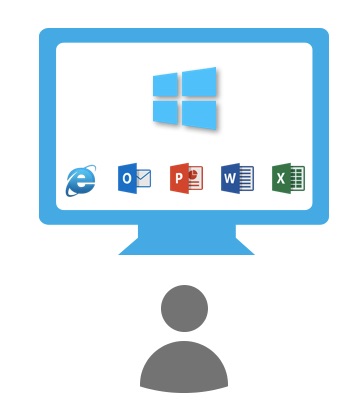
For decades, workers started their “digital day” with their PCs or Macs — mostly using applications and productivity tools. The Integration model was whatever was installed locally; the Security model was whatever they had protected with their PC password.  Maybe they used a browser, but 99% of the time, it was to consume information from the web. And it worked… for a while.

digital-day-1-pc-only
Then, we became browser-centric

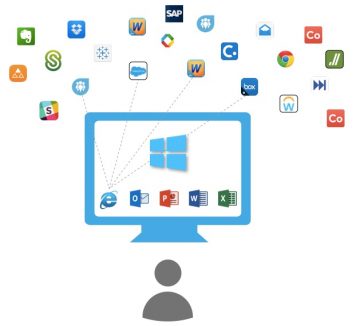
Over time, more of our work lives were spent with browser-based applications (think SalesForce, WorkDay, SAP). Gradually, the success of cloud-delivered SaaS apps — which were soon available as apps on our phones, too — began to dominate our work days. Plus, lots of useful apps, such as Evernote and DropBox, were organically adopted by employees, creating “Shadow IT” problems within companies. Thus began the first true phase of cloud sprawl, where the digital work environment became disaggregated. Worse yet, some services had different browser requirements, users had multiple logins, and IT had little-to-no insight into who had access to what. Even still, more and more of our time was being spent “outside the desktop” using externally sourced services. 

digital-day-2-browser

Today, nearly everything resides outside your desktop

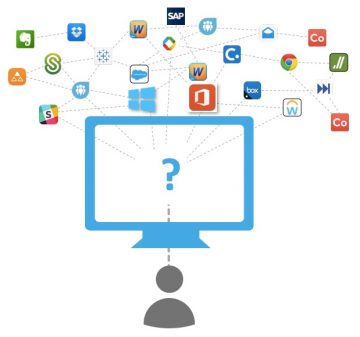
Fast-forward to today. The vast majority of apps you use are either browser-based, fully web-based apps, or full mobile apps (particularly true when you think about how you use apps on your cell phone). The only things, really, that workers use that are “native” to the PC or Mac are productivity tools like Microsoft Office (unless you’re a digital native, you probably eschew that in favor of Google docs, yet another external service.) In fact, even Microsoft Office is being disaggregated from the PC desktop, with the prevalent use of Office 365.

So, we have to ask ourselves two questions: (a) is the desktop (as a “container” of apps) relevant anymore, and (b) if not, what becomes the new access and aggregation point for a worker’s apps and data?
digital-day-2-5-disaggregated

IT – and users – need a new way to aggregate, secure, access, and deliver cloud services


Let’s assume we had never started with a desktop PC at all and that all of your necessary work applications were just a mix of on-premises apps, browser-based apps, mobile apps and cloud/SaaS services.
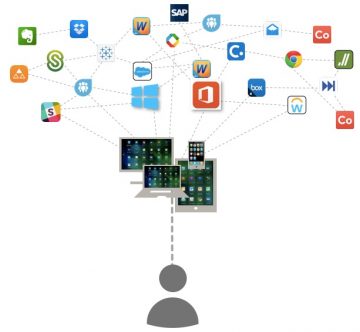
We’d want our IT departments to have a way to onboard and aggregate each service into a curated and controlled “workspace” environment. Each employee would have workspace of their own — one with a single login, with policies that controlled which apps they had access to, end even workflow tools between apps and coworkers. Even better, we’d want the workspace to ensure that apps with native UIs, browser UIs, and even device-dependent UIs would all be available consistently on any device. Best of all, we’d want this controlled “space” to follow workers around on their devices, whether they were using their laptop, a borrowed tablet, their personal phone, or any device of their choosing.

digital-day-3-sdw


The digital workspace is real, and it’s now: Where you’ll start your “digital day”

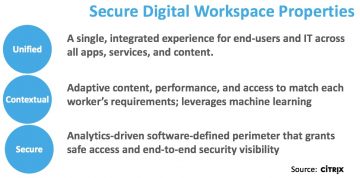
The relatively new notion of the “secure digital workspace” is increasingly the way workers will access the resources they need, and how IT will aggregate, secure, and deliver all applications, regardless of where they’re generated or which personal devices are being used for access.
And it will be contextual and personal — you’ll have it available on all of your devices, and it will know if you’re using a secure device, if you’re on a secure network, and even whether you’re in a secure location. This means that you might not have full access rights to certain apps based on where you are or what network you’re on, or the system may change the method of delivery to ensure better security. It might even notice you’re simultaneously logged into two devices in two countries and raise a security flag.

For workers, this approach will simplify how they get to all the apps and data they need to be productive, and will make it possible to easily collaborate with coworkers, contractors, partners, and customers. And it will ensure consistency by bringing disparate applications and data into a user-centric, context-aware environment. Finally, it will optimize their experience, performance and security across any device, platform or network — regardless of the platform for which the original app may have been designed.

digital-day-sdw-properties

For corporate IT, it will help them restore control over their employee’s digital environment because a secure digital workspace ensures better, more consistent control over on-boarding, aggregating, and managing access across hybrid cloud services, regardless of their source. And overall, this unified approach reduces risk for companies because the entire workspace is surrounded by a “Secure-Digital Perimeter” across infrastructure, apps, delivery networks, and devices.

If this sounds interesting, I encourage you to look into the possibilities, such as using the Citrix workspace to aggregate, secure, access, and deliver this new world of possibilities to workers near you.

Tuesday, October 29, 2013

A Tale of Three Cloud Strategies (Upgraded from Two)


Earlier in March I penned a blog titled A Tale of Two Cloud Strategies and observed the two opposing cloud strategies of VMware vs. AWS. VMware, with its strength in the enterprise, building presence in the public cloud -- and AWS with de facto dominance in the public cloud, working inroads into the enterprise.

In my closing paragraph I noted
These will be extraordinary strategies to observe over time. We all know that even the most dominating companies/technologies eventually meet their match (or their disruption).  Both VMware and AWS have appeared at times to be unstoppable. As they converge, it will surely be a battle of gladiators.  Unless (or until) of course, third, fourth and dark-horse players disrupt the party. As they always do. 
And, sure enough, here comes the Number Three - and predictable - gladiator.

Enter: Microsoft Azure - and Windows Server 

Azure has been gaining ground (and functionality) steadily.  Earlier in the year Azure GM Steven Martin hyped that 50% of the F500 companies were now using the service. And just the other day, Microsoft reported 103% growth quarter (includes Office 365). But that's not the real story IMO.

The company has also released (with a new name) the Windows Azure Pack. When used with Windows Server and System Center, it allows enterprises and service providers to generate Azure services -- using Azure APIs. Furthermore, it simplifies creating hybrid services between the data center and Azure, including capacity expansion, fail-over and DR.

Trojan horse? No - simply a clever strategy.  They are lowering (and nearly eliminating) the barriers to adoption of the public cloud by introducing it as a service extension of Windows you already own. And this way, any enterprise or service provider can go public/private/hybrid on their own timetable.

It's Now a Three-Horse Race. Do I hear Four?

VMware, AWS and Microsoft are off to the races for dominance of the hybrid cloud. Will there be a fourth?  And, will the market segment into 3 preferences? Or, will users demand greater interoperability and fight lock-in.

Stay tuned until our next episode...

Tuesday, August 20, 2013

Service Definition for Hosted Desktops – Where to Begin

Managed service providers know they want to offer exemplary customer-focused hosted services including apps and hosted desktops. But these firms (players ranging from niche players to global Telcos) also allstruggle with the same questions: What are the right services to lead with? What customer sizes should I pursue in what markets? Does market geography matter? How and when should I expand my services offers?....  

[Continued on blogs.citrix.com] 

Wednesday, June 5, 2013

Differentiate or Die: Why MSPs and Hosters Need to Change their Game


I admit, I’ve borrowed the title from an excellent presentation given by Dr. Joseph Williams, Managing Director, Microsoft WW SaaS Channel. He gave a presentation at the recent Microsoft Hosting Summit, and the point was this: 
The hosting market is crowded and includes huge players such as Microsoft itself. If you want to maintain a healthy hosted services business, don’t chase the same commodity offerings...