Showing posts with label CIO conversations. Show all posts

Tuesday, May 1, 2018

4 Warning Signs an Integration Wall is Approaching


The Integration and API Management markets are growing,  expanding in both popularity and use.  Enterprise App integration will surpass $33b by 2020, and other markets like iPaaS and Data Integration are growing at double-digit CAGRs.  Enablers, such as  containers and serverless technologies are only accelerating the move toward increased disaggregation of applications.


All seems rosy. And it mostly is.

But with the explosive growth of APIs and endpoints, traditional centralized tools like ESBs will become unsuitable, and simple low-code snap-together tools won’t scale to address the broader scope.  We’re potentially about to hit an “integration wall” at high speed.

Consider the following four warning signs – some technical, some process – that I find are beginning to plague the integration market:


1. Waterfall Development for integration is hitting a wall. 
Although most code development has shifted to an Agile Development model, the same can’t be said for Integration tools. As the quantity and diversity of endpoints increases, and as Integration projects become more diverse and complex, use of the waterfall model is beginning to slow down integration projects.  And with a future where there will be billions of Integratable endpoints, it’s obvious that an Agile Development model for integration will need to become the norm.

2. Existing tools and programming languages aren’t optimized for Integration-at-scale.
Enterprises that currently use low-code, snap-together, centralized integration technologies (including iPaaS) will not be optimized for orchestrating, integrating, observing and governing the expansion of constantly-changing endpoints. Nor are traditional centralized approaches (think: EDI and older ESBs) prepared to handle increasing endpoint scale or diversity.  Many of these existing tools are well-adapted for Line-of-Business or Citizen Integrators of relatively small-scale implementations but are far from well adapted for more complex integration-at-scale projects.

3. Current programming languages are not optimized for Integration. 
With languages like Java/Spring or JavaScript/Node, developers can engineer flow, but must take responsibility for solving the hard problems of integration. With these languages, developers have to write their own integration logic or use bolt-on frameworks.  Clearly a new programming paradigm will be needed long term.

4. The Exploding Endpoint Problem is very real.
As I referenced above, IT is ill-prepared to address the oncoming wave of service disaggregation, the diverse types of APIs, differing sources of service endpoints, challenges from Big Data, and multiple approaches to serverless IT. The industry is about to hit a scale and diversity wall. To wit,
 • 917 apps in use per enterprise (Netscope, 2016) 
 • 893-1206 average cloud services used per employee (Kleiner Perkins, April 2017)
 • 19,000 APIs as-of January 2018 (Programmable Web, 2018) 

And if you don’t believe those numbers, Matt Eastwood of IDC recently pointed out that the number of containerized services has expanding well beyond where VMs ever were.  Yep, billions of programmable endpoints aren’t kid’s stuff.

Where does this leave us?

A new approach to addressing the future of integrating thousands – or millions – of endpoints could lie in a new programming language, Ballerina.

Ballerina is a simple programming language whose syntax and runtime have been optimized for the hard problems of integration.  Its focus is integration – bringing concepts, ideas and tools of distributed system integration into the language.  Based on the concepts of interactions within sequence diagrams, Ballerina has built-in support for common integration patterns and connectors, including distributed transactions, compensation and circuit breakers. And it supports JSON and XML, making it simple and effective to build robust integration across distributed network endpoints.

So, watch this space for future developments. And in the meantime, beware of the approaching wall.

Monday, November 20, 2017

Trying to Market a Horizontal Technology? Think Again.

Why marketers fail to focus on industry-specific buyers


I was recently speaking with 2 CEOs of leading-edge technology companies about how they go-to-market. One is a brilliant open-source software firm, the other a groundbreaking virtual networking startup. 

When I asked them what their industry marketing approach would be, each essentially said “I don't need that – we have a horizontal technology.”

My reaction was one of surprise. Were their technologies applicable cross-industry? Yes. Will the companies continue to grow? Absolutely.  But after years of my own leading product- and corporate marketing teams, I’ve found that it will take longer for each company to reach their full potential and market penetration if they don’t first adjust their go-to-market approach to industry-focused buyers.  I’ve blogged about this in the past as it applied to Service Providers, and how they can also use Verticalization to reap increased profits.


Avoiding technology marketing gaffes

Speaking as a (recovering) technologist I can say that engineers and technical leaders are unbelievably proud of their accomplishments... so proud in fact, that to them, their technologies ought to speak for themselves. 

The problem is, most customers aren’t buying technologies... they’re shopping for solutions to needs that they have in their business. 

The 4 biggest Go-to-Market errors I typically see are

  • “Build it and they will come” - A dangerous tech mentality that really only succeeds in rare, industry-wide transformations. How many great ideas have you seen flop?
  • “It’s good for everyone” – Ironically, this is a myopic view. Beware of the fact that while the idea probably good for everyone, it’s probably not great for anyone. Actual (or perceived) focus on segments is critical.
  • “The technology speaks for itself” – This might be true. But the issue is that humans search for (and buy) solutions to problems, not for technologies
  • “Just see how it works” – Perhaps illustrating functionality helps in the buying process (inside the “marketing funnel”) is cool. But talking about how a technology works high in the funnel doesn’t accomplish helping get the initial attention from a prospective buyer.

Instead, think about how buyers think
The takeaway is that buyers rarely look for a generic technology... and even when they do, they want to know (and see) how it’s applied to their specific market, industry, or company size.  They want to be assured that it’s the right solution, and one that’s been successfully tailored to other companies just like theirs.

  • Buyers think about solutions specific to their immediate needs and their problems. And each buyer thinks (often justifiably) that their problem is unique to their type of business.  So solutions and descriptions have to be tailored to sounding industry-unique.
  • Buyers identify with, search for, and buy, solutions that align with their title, industry and company type. So your solution personas need to appeal to these specific attributes and use these specific keywords
  • Most buyer agents prefer solutions that appear to be fit-for-use and/or ready-to-use, rather than generic “engines” that might imply wasteful customization.  So it’s critical to illustrate how “finished-goods” the solution is for each industry solution.

What to do now – Even for the most “horizontal” technology

  1. Know your customers and know your buyers
    understand the keywords they use in their industry, what terms resonate with them, especially terms that are industry-specific.   Also, understand the specific problems they’re solving for... Even a small tweak to your “horizontal” solution description that uses terminology in the selected industry or specific persona will get an added resonance with a buyer. 

  2. Emphasize industry-specificity

    Every industry has unique language and terminology – so use them. Plus, most industries have specific forms of legal constraints, compliance requirements, and/or security approaches.   Learn these and explain – in industry terms – how your horizontal technology maps to each on, individually.  You may need to hire someone from these industries to help you understand them and craft unique messages.

  3. Highlight use-cases!

    Not every buyer can envision how your technology applies to them, how critical it might be, or how valuable it is. Make sure you illustrate a broad set of use-cases that highlight individual industries. And once again, ensure you’re using industry-specific terminology, value propositions, and personas as you tell the use-case stories.

  4. You can differentiate with your channel
    
If you sell indirectly (via resellers, system integrators or distributors) often your channel partners can take your technology and adapt it to specific markets, buyers or geographies. This is often a win-win relationship: You get a differentiated product that’s adapted for a market or use-case, and your partners get an opportunity to add value and increase revenue.
  5. Other creative ways to differentiate

    There are surprisingly simple ways you can differentiate a basic technology in the market such that it has greater appeal to specific audiences.   For example, consider how you might address a small/medium/large customer – perhaps with slightly reduced functionality and associated pricing for smaller or entry-level customers.
  6. Organize your customers by industry
    
Every time you get a new customer “success story”, make sure you categorize it in an industry category. Rest assure, when buyers come to your website, they’ll instantly gravitate to verticals they play in... and even want to see what competitors of theirs have done with your products.

Back to where we began...
I’ve taken a shot at using my own advice – and applying it to the two CEO examples that I experienced earlier. I hope you find these interesting and thought-provoking for your own products:

Vertical marketing advice for the Open-Source firm....

  • Can re-categorize their ~ 400 public customers by vertical - and making the list searchable
  • Illustrate integrations with major industry-specific enterprise apps in ways that resonate with buyers of those products; Also, partner tightly with those app vendors.
  • Emphasize vertical industry use-cases (i.e. they already cite Banking) and how each industry is each deriving value differently from the product
  • Attend and/or secure speaking opportunities at core vertical-industry trade events where they have solid use cases and success stories
  • Team with value-add technology partners who further customize the open-source platform.

Vertical marketing advice for the Networking technology firm

  • Create a content marketing initiative focusing on solutions and use cases, not just on “how it works”
  • Assess and expand upon ROI and benefit analyses that are specific to different industries – in their terms and cost/benefit models
  • Differentiate the offering with alternative pricing models, such as dedicated instances vs. peak load “burst” instances 
  • Build off of the vertical messages that the adjacent competitors use, illustrating why this new technology is better for each industry.

Monday, October 9, 2017

The New Way We'll Start our Digital Day

This post originally published on Citrix Blogs


The desktop-centric world is dead. Here’s why — and how — it will be replaced.

When industries shift very slowly, sometimes the most significant changes go completely unnoticed. For example, consider how the notion of the “desktop is your workspace” is pretty much becoming irrelevant (if you disagree, read on).
The point here is that cloud services, SaaS apps, and browser-based services are now really your new “workspace.” You don’t really need your desktop at all. In fact, even your desktop productivity tools, like MS Office, are now in the cloud (Office 365) and even desktops themselves (XenDesktop Essentials) can be accessed over the web.

Now, if you’re in corporate IT, this evolution toward disaggregated services is leading you toward a ton of problems: multiple user logins, manual service onboarding, inconsistent security across different service providers, and, basically, loss-of-control over what apps users/employees work with. More often the problem is being referenced as cloud service sprawl.
As the desktop-centric model dissolves, there is a new model ready to take its place: the digital workspace. This will fast become the way that IT aggregates, assembles, secures and delivers unified workspace environments in this brave new cloud services world.

How we got here

The world used to be desktop-centric
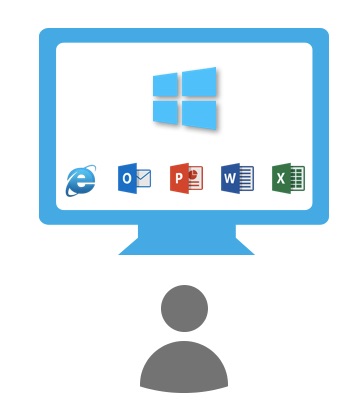
For decades, workers started their “digital day” with their PCs or Macs — mostly using applications and productivity tools. The Integration model was whatever was installed locally; the Security model was whatever they had protected with their PC password.  Maybe they used a browser, but 99% of the time, it was to consume information from the web. And it worked… for a while.

digital-day-1-pc-only
Then, we became browser-centric

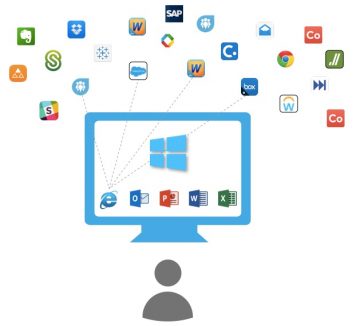
Over time, more of our work lives were spent with browser-based applications (think SalesForce, WorkDay, SAP). Gradually, the success of cloud-delivered SaaS apps — which were soon available as apps on our phones, too — began to dominate our work days. Plus, lots of useful apps, such as Evernote and DropBox, were organically adopted by employees, creating “Shadow IT” problems within companies. Thus began the first true phase of cloud sprawl, where the digital work environment became disaggregated. Worse yet, some services had different browser requirements, users had multiple logins, and IT had little-to-no insight into who had access to what. Even still, more and more of our time was being spent “outside the desktop” using externally sourced services. 

digital-day-2-browser

Today, nearly everything resides outside your desktop

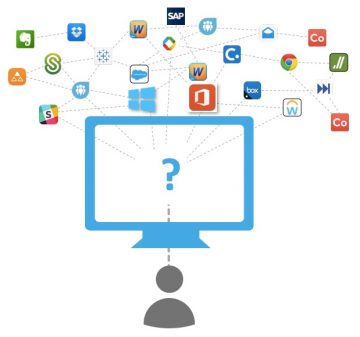
Fast-forward to today. The vast majority of apps you use are either browser-based, fully web-based apps, or full mobile apps (particularly true when you think about how you use apps on your cell phone). The only things, really, that workers use that are “native” to the PC or Mac are productivity tools like Microsoft Office (unless you’re a digital native, you probably eschew that in favor of Google docs, yet another external service.) In fact, even Microsoft Office is being disaggregated from the PC desktop, with the prevalent use of Office 365.

So, we have to ask ourselves two questions: (a) is the desktop (as a “container” of apps) relevant anymore, and (b) if not, what becomes the new access and aggregation point for a worker’s apps and data?
digital-day-2-5-disaggregated

IT – and users – need a new way to aggregate, secure, access, and deliver cloud services


Let’s assume we had never started with a desktop PC at all and that all of your necessary work applications were just a mix of on-premises apps, browser-based apps, mobile apps and cloud/SaaS services.
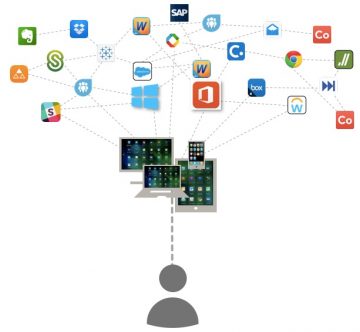
We’d want our IT departments to have a way to onboard and aggregate each service into a curated and controlled “workspace” environment. Each employee would have workspace of their own — one with a single login, with policies that controlled which apps they had access to, end even workflow tools between apps and coworkers. Even better, we’d want the workspace to ensure that apps with native UIs, browser UIs, and even device-dependent UIs would all be available consistently on any device. Best of all, we’d want this controlled “space” to follow workers around on their devices, whether they were using their laptop, a borrowed tablet, their personal phone, or any device of their choosing.

digital-day-3-sdw


The digital workspace is real, and it’s now: Where you’ll start your “digital day”

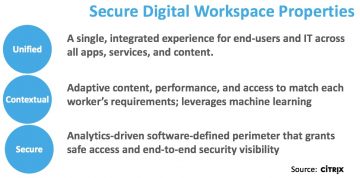
The relatively new notion of the “secure digital workspace” is increasingly the way workers will access the resources they need, and how IT will aggregate, secure, and deliver all applications, regardless of where they’re generated or which personal devices are being used for access.
And it will be contextual and personal — you’ll have it available on all of your devices, and it will know if you’re using a secure device, if you’re on a secure network, and even whether you’re in a secure location. This means that you might not have full access rights to certain apps based on where you are or what network you’re on, or the system may change the method of delivery to ensure better security. It might even notice you’re simultaneously logged into two devices in two countries and raise a security flag.

For workers, this approach will simplify how they get to all the apps and data they need to be productive, and will make it possible to easily collaborate with coworkers, contractors, partners, and customers. And it will ensure consistency by bringing disparate applications and data into a user-centric, context-aware environment. Finally, it will optimize their experience, performance and security across any device, platform or network — regardless of the platform for which the original app may have been designed.

digital-day-sdw-properties

For corporate IT, it will help them restore control over their employee’s digital environment because a secure digital workspace ensures better, more consistent control over on-boarding, aggregating, and managing access across hybrid cloud services, regardless of their source. And overall, this unified approach reduces risk for companies because the entire workspace is surrounded by a “Secure-Digital Perimeter” across infrastructure, apps, delivery networks, and devices.

If this sounds interesting, I encourage you to look into the possibilities, such as using the Citrix workspace to aggregate, secure, access, and deliver this new world of possibilities to workers near you.

Transforming CIOs into IT Supply Chain Managers

A version of this post was originally published to Citrix Blogs

How Citrix Cloud services are adding to IT’s business value
The role of the CIO – indeed for of all of IT – is changing. Jobs that used to be tactical engineering and integration of technology are morphing into strategic positions that instead integrate external services. As I’ve observed in the past, CIOs are transforming IT supply chain managers, and it’s happening in the digital workspace market now more than ever.
This is one of the basic assumptions we made when developing Citrix Cloud. Unlike monolithic IaaS or PaaS clouds, Citrix Cloud is designed to be a services integration and management platform. It focuses on simplifying the integration across a number of infrastructure and workspace services, each of which may reside in different locations and/or clouds. The result is a new IT integration platform that focuses on providing business (not technology) outcomes.
While thinking about this in the context of Citrix Cloud, I’ve noticed a number of generalizable principles across a number use cases, as well as some specific principles for creating secure mobile workspaces:
General Principles – for IT supply chain integration

  1. Assemble, don’t build – Now more than ever, IT must ask itself the classic buy-versus-build question: Should they be in the business of building/operating any software at all? If so, what compelling business or competitive need (i.e. data sovereignty, security) is driving the decision? If a driver does not exist, , IT needs to let vendors operate noncritical services.
  1. Consume services, don’t generate applications – IT should be adopting a consumption model for services, not be in the business of running applications. Their time should be spent on higher-value activities like integration and workflow for services, not creating the services themselves.
  1. Think hybrid first, think SaaS first – no single cloud or outsourcing approach fits all. Any modern strategy for service management and outsourcing has to assume hybrid cloud and has to assume multiple SaaS providers. Like any other vendor strategy, IT has to assume changes will happen over time, and therefore keep vendor options open.
  1. IT’s job is to focus on business outcomes, not technology – Today, IT outcomes must be additive to the business – not simply play a support role. In the past, IT often focused on cost reduction, but today they should be more focused on strategic enablement of the business. So, when thinking about sourcing and integrating services, the aim should be to enable lines-of-business — not to shave expenses.
  1. Enable assembly of core services – For the average information worker, a digital workspace is comprised of different services that may be sourced from different locations, e.g. desktops, applications, storage, device control, access control. The core of any workspace supply chain ought to consist of most/all of these.   Some may inherently be SaaS cloud services — others might be local. It all depends upon constraints such as security, compliance, technology “bench strength,” and of course economics.
  1. Anticipate the need for multiple services and multiple workspaces – The average information worker may use many applications and services, and each worker type may well require different amounts and combinations of these. Therefore, anticipate integrating dozens if not hundreds of apps into different families of workspaces – one for each worker type.
  1. Enable choice – As a supply chain manager, IT will need to ensure that vendor choice is preserved. This principle extends beyond where SaaS services are sourced from, and continues on to where IaaS resources reside as well. You’ll want to maintain control of where data, IP, and other sensitive information resides. For example, locking-into using a single cloud for service execution may not give you the long-term flexibility you’ll need or require.
  1. Evaluate technology on driving value up and less on driving cost down – As a strategic enabler, the IT supply chain manager should understand line-of-business needs today and anticipate them for tomorrow. For example, rather than focusing on driving cost out of managing desktop hardware, IT needs to focus more energy on driving in more value – such as making desktop access more mobile, more accessible, and more secure. Focus on assemblingin value-add services such as file synch and share, mobility applications and/or unified communications.
  1. Don’t Forget: your chief outcome must be employee productivity – In the end, IT’s goal should enable workers to do their jobs better. Focus on productivity, user satisfaction, flexibility. Tools like Citrix Cloud are designed around these principles:
  • Speed – responding to employee needs or competitive pressures
  • Simplicity – the ease of selecting and instantly integrating new services or capabilities
  • Choice – the ability to source services from any cloud

Specific Principles – for workspace integration
In building a workspace supply chain, we here at Citrix applied these principles to developed tools to help companies leverage them. The following design principles for Workspace Cloud extended the four above principles into a platform that’s fast, simple and flexible to use:
How Citrix Helps
Citrix Cloud is more than a new delivery mechanism for Citrix technologies. It’s a platform that helps IT speed and simplify high-value service assembly.  In the coming months, you’ll see Citrix add even more service types — increasing the breadth of control IT will have when delivering high-quality workspace services that will absolutely delight your employees.

Thursday, February 6, 2014

Managed Services Providers Agree: Build a Vertical Market DaaS Focus

A few weeks ago I had the privilege of speaking with a number of our Citrix Service Providers at Citrix Summit in Orlando.

There is no doubt in my mind that the Managed Services industry is shifting… away from commodity services (dedicated servers, websites, Exchange mailboxes) and toward more holistic, higher-value hosting and outsourcing services.

The evidence I cite is both from a Service Provider panel I facilitated, as well as from assessing the winners of the recent Citrix CSP Awards.

Heard at the Panel

My first set of data points came from a panel I ran covering the importance of choosing a vertical industry focus. On it I had the honor to sit with Frank Butler, CEO of Proxios, John Alston, CEO of ClubDrive Systems, Byron Patrick of Simplified Innovations, and Ted Eisley of Microsoft.

Whether the founder's intent was to focus on a vertical from the start, or whether they organically developed their vertical foci, the panel agreed that choosing one or more vertical markets was good for business.  It made marketing and prospecting easier. It allowed for a more replicatable set of offers. It enabled them to re-use line-of-business applications more frequently. And it enabled them to charge healthy premiums on their services because they were delivering such specific value.  Indeed, my Differentiate or Die theory was alive and well!

Some data points I took away from our discussion:
  • Living your business helps business come to you: One benefit of tenacious focus on a market is that "the business comes to you" Byron Patrick is so focused on the CPA market that he attends all of the professional networking and development meetings in his geography. Both he and his company are know quantities in the industry. He's the de-factor "go-to-guy" And that makes business developing (dare we call it marketing) all that much easier.

  • A low price is not (necessarily) the goal: All panelists agreed that competing on price was not their goal. Doing so is a race to the bottom. Rather, they competed on service and overall value. And surprisingly, when asked about prices for the DaaS offerings, many said they can easily charge in excess of $100/seat/month, sometimes more than twice that -- assuming that the value they provided (i.e. line-of-business applications, bundled services, etc.) was commensurate.
  • Knowing the market means knowing customer assessments:  Another great question from the audience had to do with how much customer assessment was needed to "size-up" an opportunity and arrive at price for migration and on-going DaaS service. And a nearly unanimous response from the panel was that, once you've done a few similar vertical engagements, understanding the gotchas and pit-falls gets a lot easier.
  • Speaking the vernacular simplifies marketing: Each CEO focused on a different market. But each knew that market and could speak the language of the buyer, as well as the language of the user. They knew the compliance and regulatory factors. They knew the top vertical apps. They knew how to speak to the issues and concerns of the customer in each market. Now that's not something you can fake. It only comes with focus and experience.
Seen at the Awards

The other set of data points I reference is from the Citrix Service Provider Awards ceremony.

The winning Service provider for Marketing Excellence, MindShift, won on the basis of their comprehensive approach to accurately messaging their services to the specific business goals of their audience.  But all entrants and semi-finalists outlined focus. Focus on specific markets, use types, applications, and sometimes even technology.  

As I'd heard in the panel, the Awards finalists all started with an intentional DaaS service definition, that evolved over time to meet the needs of one or more specific markets.

And by doing so, the successful Service Providers have consistently seen double-digit seat growth annually.


Got a question? Comment? I'd love to hear your input.

Monday, May 13, 2013

A Tour of Switch's SuperNAP

I have to admit that I was prepared to be underwhelmed when I toured the Switch SuperNap in Las Vegas. After all, how impressive can a co-location facility be?  Just slab, cooling, ping, pipe and power.  Right?

With thanks to Mark Thiele (EVP Data Center Technologies) and Jason Mendenhal (EVP Cloud), I was able to spend some quality time in-and-around the facility (even inside one of the AC units) and got an education that mega data centers are much more than a structure to house servers.

First - let me give you some amazing first-impressions: Switch's SuperNAP is all about design and function. The structure, the architecture, the even the color scheme is all for a purpose - to communicate attention to detail. And while it might cost a bit more to color-code pipes and conduits, label every piece of equipment, architect custom lighting, or build with industrial design principles, it's clear that every item in the entire structure is there (and highlighted) for an intentional purpose.

And now for some observations and learnings:

Energy Efficiency
In all of the talk about energy efficiency, the SuperNAP averages a PUE  around 1.24 during the year. That means overall Switch's ability to minimize energy loss and to maximize cooling efficiency is extraordinary compared to most competitors... less than 25% of the total facility power is used for "overhead" operations, while the majority goes directly to the servers and equipment. That's a relatively rare feat these days, with the industry average of 2.9, and only 20% of data centers scoring better than 2.0 according to a Digital Realty Trust survey reported by the Data Center Journal.

Cooling Options
Arguably the breakthrough for the design of the datacenter is Rob Roy's breakthrough thinking about cooling. Traditional data centers take a "diffusive" approach to cooling equipment. That is, they place AC units throughout the data center, diffuse cool air (via raised floor) over everything, and allow the hot air from the servers to re-mix with the cooler ambient air.

But if you think about it, server racks should really be viewed as radiators (think about the radiator in your car). To achieve the best heat transfer efficiency, pull cool air directly through the radiator, and channel it directly back to the cooling device. And that's what switch does with their T-scif  (Thermal separate compartment in Facility). Cool ambient air is pulled through the server racks and channeled directly into a hot-air plenum. there is no mixing of the hot air w/cool. Think of this as hot-aisle/cold-aisle containment taken to the extreme.

Data Center Density
The notion of density makes sense along many dimensions. First, more server manufacturers are designing equipment as inherently dense - a packed Cisco UCS or Dell Blade enclosure can potentially pull 7kW or more. And there may be 4 or more of these units in a rack enclosure.... that means a given rack might consume as much as 15-25kw. (The SuperNAP is designed to support about 1.5kW/square foot, easily enough to handle a packed cabinet). But the beauty of density also helps with creating a larger heat differential aiding in heat transfer efficiency.

Supporting power and cooling density ultimately helps Switch because it means that a given customers needs less space - which equates to $ savings. Yet density also helps Switch due to the obvious efficiencies.

Co-Located Compute
Very early in the tour Jason pointed out the advantages of customers and partners co-locating their equipment within the SuperNAP.   With the physics of bandwidth and latency hard-at-work, it became clear that certain customers had an advantage to co-locate their private cloud infrastructure in the same data center as their public cloud partners (or other service provider customers). Apparently there were many examples of this co-located hybrid cloud approach at the SuperNAP. 

Co-Located Networking
The SuperNAP is literally a nexus of multiple Network Access Points - that's the NAP part - originally built by Enron. (In fact, it was pretty cool literally seeing the conduits come up out of the floor with the fibers inside!)  This fact provides users with advantages such as network redundancy as well as the ability for Switch to broker bandwidth at wholesale prices. They market this as the Combined Ordering Retail Ecosystem (CORE).

Physical Security and Disaster Preparedness
It wouldn't be complete if I didn't mention the physical security that Switch provides... something slightly out of "24".   While it's not appropriate to share details, suffice it to say that entry onto the campus, into the building, and around/within the cages was closely and carefully monitored and guarded.  The facility itself is secured in multiple zones, as-are the tenant areas.

But the other security blanket Switch offers is back-up power and cooling. Should there be an outage from the local utility, cooling is literally designed to "flywheel" for enough time for generators to kick-in.  And there is sufficient fuel on-site (and sources off-site) to maintain operations through even the fiercest unforseen disaster.

Example: Content Hosting and Distribution
Without naming names, a major content streaming company chose Switch for nearly all of the reasons above.  But what I found particularly  fascinating and compelling is that they even co-located their physical broadcast operations at the SuperNAP.  Picture aisles of million-dollar storage arrays pumping-out movies and live TV shows 24x7 across the country. Co-located is the nerve-center -- not unlike NASA mission control -- that monitors performance and delivery country-wide. Why Locate at Switch? Besides all of the efficiency and security aspects, access to nationwide backbone networks ensures maximum video performance.

Going forward, Switch will be more than doubling its capacity in the next year or so, building into new expanded facilities. And from the sound of it, much of the space is already spoken for.

Who says the data center isn't important? I certainly wasn't underwhelmed by this visit.


For More Information

Sunday, August 26, 2012

The Rise of the Cloud Service Bus

In my recent GigaOm guest blog, I posited that the advent of hosted cloud services (particularly PaaS and SaaS) will slowly morph the role of the CIO into that of an IT Supply Chain Manager.

Technologically, I believe this move to a "Buy-and-Integrate" mentality (vs. a "Build-Everything" mentality) will open the door to a new class of products to assist with services integration. And, if you agree that the importance of leveraging external services will be elevated for the CIO, then I believe a significant enabling technology will be a rebirth of the need for a robust "service integration bus".

Why?  As I mention in my blog, enterprises integrating external services require:
 - Identity and access management for each provider
 - Data compliance, legal and regulatory audit access across each provider
 - Security compliance systems
 - Provisioning, including capacity forecasting
 - Performance (e.g. SLA) monitoring
 - Cost and budget tracking (i.e. for billing, showback and/or chargeback)
 - Disaster Recovery / Redundant service sources where needed
Some would call the above integration functions "Glue Logic." Indeed in the past, many of these functions were hand-integrated across the few external services that were leveraged, and custom-engineered into each internally engineered stack. But time is changing the model. With more turnkey services  sourced from cloud (IaaS/PaaS/SaaS) providers, the need for a more efficient integration function will escalate. Integration will need to be standardized and replicable, scalable and responsive to the business' needs.
You may recall one component integration approach has been the Enterprise Service Bus, primarily associated with SOA leveraging SOAP protocols. This Integration Bus was originally to orchestrate access and workflow between component services within the enterprise. (By the way, Microsoft offers a great overview of ESBs - albeit BizTalk centric - here on MSDN).

I believe that the "2.0" Integration Bus will be one which brokers higher-level services generated from external, public cloud providers - not just internal component services. And it will use more generalized interactions than SOAP, since the providers and their environments will be less standardized.

To this end, there are some great current/upcoming thoughts suggested by Mike Ponta of the notion of a "Cloud ESB", and can't wait to hear more.  A quick survey of the market also yielded what looks to be potentially promising integration technology coming out of Mulesoft called their CloudHub.

Conceptually, the "mashed-up" service was the 1.0 version of this integration concept. But as enterprise IT begins to regularly tap and integrate multiple external services, the 2.x integration busses will need a more structured, standardized and rapid approach to integration.

I can't wait to see what else the market will generate. Stay tuned.

Other resources/Blogs:


Wednesday, August 1, 2012

Enablers for Transformed IT - Placing My Bets

It's an odd time of the year to be making predictions. But recent conversations with start-ups, CEOs, CIOs and others have suggested areas in Enterprise IT that I  bet will be "hot" over the near/medium term.

Some of the areas are "Sexy" (high on the Hype Cycle) - and others are not. But in my opinion all are worth betting on. They are all interrelated and all are critical enablers to the goal of a transformed IT ecosystem.

Already Sexy: Integrated Cloud Infrastructure Management
Of course you expected this one... But the betting opportunity isn't exactly what you think.

There are currently hoards of point-products professing "cloud management" - including the OpenStack/Cloudstack alternatives - but surprisingly, these still lack in providing a comprehensive solution that a reasonably sophisticated SP or CIO needs to buy.

In other words, I don't just mean a product that offers an automated virtualization (server, storage, networking) layer.... No: The real opportunity I expect to see here is an integrated comprehensive solution, that includes security, compliance, monitoring, financial metering, end-user provisioning portals, etc.  The winners in the space will either integrate these features too, or offer a pre-integrated bundle of best-of-breed point-products. And it's going to happen soon.

Not Yet Sexy: The Integration Bus
If you believe that most of IT's infrastructure is "going cloud" and that many 3rd-party services will be SaaS, then the role of the CIO will begin to shift from being a technologist (who builds things from ground-up) to being a Supply-Chain manager (who integrates multiple services from multiple sources).

To execute on its new role in the enterprise, IT will therefore become an integration point for internally- and externally-generated services. It will need to provide core identity, compliance, data exchange, security, and access infrastructure to properly "broker" all of these diverse services, providers and APIs.

It seems to me that the notion of an integration bus will become crucial. Such a bus will provide the "glue logic" between all services, and avoids tedious hand-coded integration points. In many ways this bus is a core intersection point between the internal and external cloud - the hybrid nexus, if you will.

Remember, it's not enough to have a service in a cloud. There will be a huge need for coordinating the interactions into/out-of (and between) cloud-sourced services. The need for such a service bus will quickly elevate to that of a critical IT enabler. A good bet to take.

Getting Sexy: IT Business Management
Building on the concept of IT as a "supply chain manager" is the concept of IT as a Service Provider to the business. This is sometimes termed IT-as-a-Service, where IT begins to run itself as a "business". While it may not literally have a profit motive, it will be forced to become functionally competitive with external services, to market itself, and to price itself competitively.

As I've written before, in order to think like a business, one critical enabler is to know fixed and variable costs, as well as cost allocations and cost sensitivities.

Thus, the segments known as IT Financial Management (ITFM), IT Business Management (ITBM) and/or Technology Business Management (TBM) will necessarily have to expand in importance.  This segment looks at the granular cost basis of infrastructure (including cloud service costs) and assembles a composite cost structure at the application and even service level. This permits IT to understand cost sources, provide decision support and forecasting for infrastructure changes, and provide a "bill of IT" showback/chargeback to internal service customers.  All critical in the new Transformed view of IT.

Too Sexy: Big Data Business Models

Careful here... I'm not speaking about Big Data infrastructure or analytics products per se. I'm referring to the business models that will soon be based on mashing-up and analyzing large quantities of structured/unstructured data to uncover new revenue opportunities.

As I recently mentioned, data-based business models will begin to complement existing product/service based businesses.  While adoption of Big Data technology is already penetrating the infrastructure market, the real opportunity is when it penetrates the lines-of-business people such as marketers, sales, and business development.

Companies that employ marketing professionals paired with "data scientists" are the ones to watch. The new business opportunities presented by the promise of cracking big data will be the driving force behind the infrastructure and technology purchases.

When will this transition happen?  I predict when companies begin to hire "Big Data product managers" and team them with BizDev and data scientists. Now that's disruptive and sexy.


Thursday, October 20, 2011

IT Leadership: Two Days with Leading CIOs

I'm writing this at Logan airport as I fly home after two full days in Boston, attending EMC’s IT Leadership Council. At it, senior EMC staff were able to spend nearly two full days with a room full of IT leaders from some of the world’s largest and most respected companies.

What made the time unique was the quality of interactions as well as heady topics. EMC’s own leaders and practitioners interacted with our leading customers about  IT Transformation, IT as a Service, managing IT change, and cloud computing futures.  But the conversations were rarely about technology, and did not touch on product at all. Rather, they focused on challenges facing IT today and on IT’s renewed role to support the business.

This was the first time EMC has attempted something so ambitious with such a senior audience. And the results were fantastic -
  • For our customers: EMC was able to share our experience in transforming our own IT, helping to validate many of their approaches. Our customers got to interact directly with our internal consultants and practitioners, and exchange views on best practices, pitfalls and works-in-progress.  And I believe we also transformed our customer’s view of EMC's knowledge and capabilities as an enterprise vendor/partner.
  • For EMC: We had a unique chance to get out of the “weeds” of technical details, and to focus on the high-level business drivers that are really facing (and affecting) our customers. This was a chance to hear the unfiltered voices of the customers first-hand, for two days. Our thanks to them cannot be overstated.
It’s hard to summarize all of the themes from all of the sessions – including dozens of breakouts on various topics – but follows are my personal takeaways and “high points” from many individual and group conversations:

IT transformation isn’t about technology: Almost everyone was in agreement on this. The technology problems can be solved for. But the real barriers to IT reinventing itself lie in the area of new operational and organizational models, evolving roles and skills, and new financial models. Often-heard was “My technology is ready. My people are not”.

IT leader’s focus: To support business agility:
Yes, IT agility and infrastructure agility were still points of conversation. But more important was providing business agility – the ability to help lines-of-business be more productive, more profitable and more competitive. Linking the business case between cloud, IT investment and LoB top-line is becoming an increasingly important strategic conversation for the enterprise.

IT will compete for business: This theme was becoming more prevalent. Users are turning to external service and cloud providers because of pricing and/or convenience. Sometimes termed “shadow IT”, internal IT now has to think of itself as having to “win the business” from lines-of-business. It has to reinvent itself as a competitive internal Service Provider (and/or service broker) to the business. IT is now rarely the only game in town.

Public Cloud isn’t (always) the panacea: There were more than a few customers – mainly banks, government contractors and the like – for whom the public cloud is simply a non-starter, usually due to regulations and compliance needs. But private cloud remained appealing. They were eager to learn more about private clouds and the IT transformation needed to make them productive.

IT must move away from a “hero” culture: IT heroes used to embody all of the organization’s tribal knowledge, and could parachute into a problem and solve it at any time of the day or night. But this SWAT culture has to make way for the “new guard”, consisting of IT staffs trained as generalists, who can work with increasing levels standardization, automation and shared infrastructure. Many practitioners agreed that entirely new staff rewards systems needed to replace those that awarded those with superhero powers.

Marketing? In IT? As IT shifts to becoming an internal service provider that competes for business, it’s also faced with acting like a business unit – replete with marketing functions. And these are skills that are somewhat alien to the organization. They include outbound marketing: publicizing and actively marketing their services to business units to drive demand, and inbound marketing: working alongside customers to identify needs and requirements for future product/service development.

Financial transparency more important than ever: To compete, to forecast, and to model, IT has to know its per-unit costs, whether or not chargeback/showback is implemented.  Knowing capital, operational and incremental costs helps the organization make better buy-versus-build decisions, and allows the rest of the enterprise to make similar decisions about how/where to apply infrastructure. And most important, if/when IT chooses to price services, they do so with detailed information. 

 
Overall, IT is having “new and unfamiliar” conversations: IT is talking with lines-of business regarding business agility. They are learning about inbound and outbound marketing skills. They are discussing competing against consumer service - and/or brokering them. They are being asked to support any and all employee-provided devices. They’re entertaining buy vs. build for application services.  They are being asked to meet or exceed demand for services… rather than to limit them. And they’re shifting from structured data and heavyweight GUIs to unstructured data using throw-away apps.


Much debate was had over whether IT is going through a Transformation or an Evolution. My answer? Evolution takes an awfully long time.

Event Agenda


Tuesday, October 18, 2011

Practitioner’s View: IT Transformation and GreenPages’ Solutions Architect

Last week I had the chance to speak with EMC Velocity Partner GreenPages – specifically with Trevor Williamson, their director of Solutions Architecture. Trevor regularly speaks with CIO’s from Enterprises and SMBs about cloud computing and IT transformation. He has a refreshingly balanced perspective on technology… and on its impact on business. Follows are some paraphrases from our conversation late last week.

Lots of Talk About Cloud But…

Not surprisingly, Trevor noted that 80% of his customers are talking about cloud computing (who isn’t?) but only really 20% are doing something about it. 

Why: He’s noticed lots of reasons – having to do with resistance to change, the demographics of IT leadership, and more.  Trevor’s analogy was to that of an automobile:  Traditional IT looks like a basic car with a basic engine and basic drive train. Yeah, it basically keeps running for ever. But if you wanted to change something, good luck.  There wasn’t much room for upgrading without changing the whole thing.   Next, enter virtualization… akin to a car with Fuel Injection. It’s an upgrade – and the engine will run more efficiently. But in the very grand scheme of things, it’s still a point-solution (although quite valuable). Now finally, enter the concepts of automation and Cloud Computing: where the car’s components become completely different and independent – no piston engine, an electric drive train, etc.  So it’s much easier to upgrade components without needing to alter others.  Simply increasing the battery gives better range. Changing the electric motors gives better performance. Changing the engine might speed battery recharge.  But components now operate more distinctly and can be optimized independently.

On IT Finance, and Why It Might Be the Key to Change

Trevor also had a terribly pragmatic perspective on a simple but ingrained factor holding-back IT’s efficiency.   In the traditional (read: old) IT financial model, the IT Project Number was the key to all implementations.  Any change to a specific system got charged to that number. And the dollar size of that number got watched under a microscope.  However, bounding the infrastructure’s financial model with a single project number reinforced the technological stove-pipe-ness of the assets themselves. The financial model did not allow for any sharing of assets between systems – because each new asset of course had to be assigned to a single project number. So, one result was the wasteful sizing of each silo - and resulting horrific utilization of each silo.  Ergo, Capital inefficiency became a necessary result of a limited financial model.

Enter: Shared infrastructure that can meter incremental IT usage, and cost-accounting that can keep track of (and assign) incremental costs.  With these two tools, IT could now implement a shared (and, needless to say, virtualized) infrastructure. The improvement in utilization, and resulting improvement in capital efficiency, was and is a boon to IT.

So, Who Calls the Play?

When an IT department decides to go down the path of a private cloud, who makes the call?

Well, there are usually two models Trevor and GreenPages frequently see – either top-down (by decree), or organic (bottoms-up). More often-than-not, Trevor believes most initial deployments are bottoms-up. The typically the initial application is internal to IT, such as QA/Dev/Test – also because these use case customer needs are very dynamic and fast-moving.  Giving the engineers a self-service portal and ability to spin-up tons of cookie-cutter environments is a great fit and a great win.  And doing so internal to IT (in contrast to line-of-business apps) minimizes the number of approvers… also speeding along the project.

Most initial bottoms-up automation and cloud initiatives are relatively new implementations, *not* system refreshes – which surprised me. But for good reason: Refreshes usually involve a cross-application and cross-domain initiative. Which means more approvers and multiple teams.

Now, there are times of course when IT leadership “decrees” building a private cloud – and mostly the impetus is either to reduce costs, or to cater to the LoBs who are looking for agility that will result in making more money.  But when these initiatives are by leadership decree, they’re usually bigger (and slower) than their internal organic cousins.  In fact, the top-down initiatives are usually corporate-scale, even to the point where they’re ‘branded’ and ‘marketed’ cross-org.  But reading between the lines, all of the hoopla doesn’t make the top-down initiatives any faster than the internal approach.

Is building an Internal Cloud Bad (for IT Jobs)?

Trevor gets this question a lot. He’s not yet seen an instance where virtualizing and automating infrastructure has meant a reduction in jobs. Instead, he’s found more the case that it’s good for the *existing* jobs.  Building a private cloud helps IT personnel climb out of day-to-day fray, and frees-up their time for more interesting, higher-value work for the company.   We both noted that IT should be focused on extracting value from company data and partnering with the lines-of-business…. Rather than “keeping the lights on” laboring as a monotonous workhorse.

And Finally…. On Keeping IT Competitive

“Why does business go around IT?” I asked. Trevor was pretty firm on this one: Only when IT can get out of its own way and move at “market speed” will internal customers will choose them. He sees lots of use of external services by lines-of-business, and lots of IT organizations racing to keep up with them.

How to achieve market speed? Part of the answer is re-engineering IT as an internal service provider / service broker. IT must think of itself as a service bureau, right down to marketing its services to users in the enterprise. From an infrastructure perspective, IT also has to become more agile. It has to “stop plugging holes with humans” and start by leveraging automation as part of its DNA. Lots of point systems can be automated, e.g. provisioning OS, virtualization platforms, I/O, networking. And only then can Orchestration be layered across those automated systems to attain the speed and agility needed. Take it a step at a time, with the goal being competitive and customer-focused.

Monday, October 10, 2011

A Leading Indicator of "Consumerized IT"?

Let me start with a game: Try to guess the type of customer I met with last week...
  • Roughly 5,000 users with ~ 25% annual turnover
  • Pressured to support multiple user-provided devices (Smart phones, iPads, etc.)
  • Significant "Shadow IT" (e.g. users turning to external web services w/out IT's knowledge)
  • Inquiring into a VDI environment to increase manageability, reduce costs
  • Increasingly huge storage needs, esp. for video (on-demand media, surveillance, etc.) 
Give up?  Well, this customer was a High School district, with thousands of students and hundreds of faculty. And they shocked me with their challenges, ones which I assumed only large enterprises had.  I have to admit I was pretty surprised at their level of sophistication - and their vision.

And then it dawned on me: These guys actually more of a "leading indicator" than most their commercial enterprise cousins.  Their internal customers are nearly all Millennials, arguably leading users of consumer technology, and sometimes the most demanding. The student base requires support for "any device, any time", and doesn't hesitate to use external commercial services rather than IT (think: kids using DropBox, Evernote, Mobile Me, etc.). Also, users (students) without their own personal "smart" devices will typically log into multiple alternative devices a number of times each day, requiring virtual display and authentication technologies.

So, think about it: These students - and their appetite for "consumerized" technologies, will be your workforce of tomorrow.

What that high school IT department is facing is what most IT will be facing during the next few years. So consider carefully who (and what) you'll need to support in the coming years. And consider the organizational, technological, and governance transitions you'll need to implement as well.

In a recent Forrester Research report, "Shifting from Rules to Guardrails" there are some good observations of how IT (and the CIO) have to transform from being technologists to becoming brokers, vendor managers, and providers of technology governance:
"We see a blurring boundary between business and IT. The rise of self-service technologies, driven by empowered employees, provides new opportunities for IT to improve business responsiveness by enabling greater autonomy... To do this successfully, IT must evolve new governance approaches that empower the business with guardrails and education, reserving strict technology control for only the most critical technology assets. For many, this will be a radical change.
So, my lesson was that the places to look for Leading Indicators of IT transformation aren't necessarily the analysts and brainiac IT leaders... Instead, perhaps I should focus more on the needs of the 9th grade entering class.

I hope to stay in touch with the IT staff at the school district, and see what priorities (and solutions) they see emerging in the coming months.  As I exited the meeting, one of the IT leaders took me aside and also mentioned that IT has also experienced - not surprisingly - hacker break-ins as well.  As I said, perhaps the youngsters are where to look...


Other Resources

Monday, September 19, 2011

Documenting IT Transformation Since 2005

If you haven't looked at how EMC's IT department has transformed itself over the years, you should - it's amazingly illustrative. Our CIO, Sanjay Mirchandani is visible and articulate. Our VP of infrastructure, Jon Peirce, is equally eloquent about how IT is transforming - and was a major force behind EMC's recently dedicated state-of-the-art Datacenter. And of course Chuck Hollis has been doing an amazing job of chronicling the meaning of IT transformation, consumption models and organizational changes.

First, show me the money

But where does that leave us regarding exactly what we achieved? What metrics illustrate the real benefits of all this work? Well, it turns out that EMC IT has been documenting their process since about 2005.  While not all data points are completely audited, they tell a powerful story.

In the conceptual 3-phase "Journey to Your Cloud" we speak about the trend toward increased virtualization - and how it's applied. In Phase I, IT virtualizes "internal" IT-owned apps saving primarily on cost. In Phase II, IT virtualizes production applications, benefiting primarily quality-of-service and availability. And in Phase III, IT is operated as a service, primarily improving overall business agility.

But along a pragmatic journey, the benefits occur gradually, sometimes in parallel.

EMC's IT group has been virtualizing its infrastructure - and documenting the results - since 2005. At right, the chart depicts how virtualization toward a cloud infrastructure undeniably results in improved infrastructure economics AND improved IT agility. And their trend continues.

The other benefit from virtualization is the ability to re-construct an environment should failure occur. This impact on quality of service is available anywhere virtualization is present - so you'd expect the pervasiveness of Highly-Available environments to roughly track the degree to which virtualization is implemented.

Sure enough, as EMC virtualizes its entire infrastructure (and we're not entirely there yet) we're pushing nearly 97% of applications with High Availability.

Finally, as IT infrastructure is virtualized and consolidated, utilization rises, and (presumably) physical data center space required (not to mention power) is reduced.The EMC IT group's statistics clearly show this trend as well.

In fact, EMC's recently-christened data center is not larger than our existing data center (as it was mainly developed to economize on power cost, and to create a physically-distanced site from EMC's HQ) so there is still lots of room to grow.

In the coming months, EMC, our IT department, and our consulting arm, will be continually elaborating on our own journey through transforming our IT... not just the technology, but the organizational models, operational models, consumption models, and more.

I personally have to say that the degree of rigor that Sanjay & team have put into this transformation is impressive. They have a very clear vision of where they want to be with respect to enabling the EMC business, as well as setting a clear example of what is possible for EMC customers.

Other References

Tuesday, September 13, 2011

An Image Makeover for IT

Wow. I just have to share notes about a meeting today - one that might have been unthinkable a year or so ago.

I've been working closely with EMC's CIO and internal IT groups lately, helping understand how they're delivering IT as a Service. EMC's IT is going through a major transformation, where it's becoming more competitive, more business-centric, more like an internal Service Provider.

What blew me away was a conversation I was invited into because I was in marketing. Could I help? IT wanted to begin  investigating how to market its on-demand/ITaaS services internally to EMC lines-of-business. We discussed audience segmentation, how IT would like to be perceived (read: Brand Essence), and the services/value IT provides to assist the business.What should a marketing and roll-out plan look like? Graphic designs? Should IT instead be called BT (Business Technology)? How would the value of Service Manager roles be highlighted?

The discussion - while well from over - I believe is a harbinger for the "new" IT, where IT provides value and competitive advantage to other lines-of-business, where it acts like a strategic partner/vendor, and competes for business. It's so much more than technology.

We agreed that another harbinger of change was when the CIO spends more time with the CMO, rather than with the CFO. And I can attest to being present to one such meeting.

So, in the process of IT elevating its value-add, IT will enhance how it caters to the business. It will actively promote its new service orientation, its new operating model, its new mindset.

And I am more than happy to help.

Related

Wednesday, July 13, 2011

A Morning With State Government... Talking IT Transformation

Think your enterprise is challenged as it struggles to move toward IT-as-a-Service and a shared IT services model?   It seems that state and local governments are also trailblazing as well.

Earlier this week I had the honor of spending a morning in EMC's Executive Briefing Center with various members of a state legislature - and members of their IT staff - looking to learn more about their investment in a Vblock, and how it could enable a shared services infrastructure that could save them $ millions while upping services to citizenry.

This was not a technical crowd in the least. These were state representatives with constituencies who cared about things like better services and lower-cost government. But they wanted to know that they'd chosen the right horse, the right technology.

But what was fascinating was nobody wanted to drill into the technology... or even really get educated about it.  Rather, they were simply acutely aware of the opportunity to save money while upping service.  They knew that government agency data centers were siloed. They realized how long it took to deliver new IT services.  They acknowledged how un-integrated inter-departmental state data was. But they all wanted to be part of the solution, to get the rest of the legislature to a point of appreciating the opportunity before them.

The notes I took might sound familiar:
  • Where do we start?  VDI sounds like a shoe-in. But after that, which departments, offices and data centers should become part of the shared-services model? [What workload migration and ROI model should they adopt?]
  • If we do end up saving money, there's the risk that the savings will be taken away from us - how do we ensure it's plowed-back into innovating and creating higher-level services? [How to meter IT costs? What higher-level services could be proposed to the lines-of-business? How to facilitate IT educating departmental management in what new opportunities are available?]
  • Every office and department feels like they have a "special IT need" that only their own data center can provide. Is that really true? [How to illustrate the versatility of a cloud environment? How to guarantee differentiated SLA's?]
  • With a shared infrastructure, how do we ensure that sensitive information (e.g. the Highway Patrol department) is kept secure from prying eyes of other parts of IT... and indeed, other parts of the state government? [How to illustrate multi-tenancy? security? auditability?]
  • How can we ultimately simplify the government experience for citizens? e.g. Reduce paperwork for driver's licensing? Work permitting? Unemployment applications?  [How to go about merging and analyzing structured and semi-structured data from diverse sources?]
While this was not the forum to solve the problems, by the end of the morning we were all happy to have the issues laid-out on the table for discussion.  And to have educated the policy-makers and users that they can in fact operate their state government IT as a 21st century infrastructure.

The other good news is that this state is not the first to make this transition. A very good initial resource, for example, is from the Center for Digital Government - their paper on IT-as-a-Service for State and Local Government which gives a number of very good examples of state governments taking the right steps for the right rationales.   There is also an excellent paper published by the US Department of the Interior and their IT Transformation plan.

Stay tuned on more of what IT Transformation makes possible, and how to migrate to a service-based IT organization.... ITaaS.