Showing posts with label IT Transformation. Show all posts

Thursday, February 1, 2018

The CIO as a Cloud Supply Chain Manager

Transforming IT from engineers and builders... to assemblers and integrators

Preface
About 5 years ago, I wrote a GigaOm article, The CIO as the IT Supply Chain Manager. The focus was how cloud services would transform how CIOs shifted from Technology Builders to become Service Assemblers. This concept is now more relevant than ever – with 30+ vendors offering API management products, Integration Platforms as a Service (iPaaS), Serverless functions and containerized microservices.  Let’s look at how technology is helping CIOs in this transition...

Setting the stage
If you’ve been a CIO for more than 10 years, you’ve probably thought of yourself as a builder of technology. You’ve had oversight of app development, built custom databases, managed director and identity systems, and hired scads of coders. 

But the CIO as a software engineer and builder of technology is changing.

Let’s consider enterprise application evolution. Over time, monolithic applications made way to special-purpose apps... which then made way to third-party SaaS apps. This evolution afforded IT with higher-value and better fit-for-purpose infrastructure, while allowing for broader choice to use different app sources and vendors. Indeed, the number of SaaS apps being consumed by enterprises is exploding, with the average midsized company consuming 20+ SaaS apps

However, today we’re now seeing the SaaS apps beginning to yield to component web services, public APIs, and even micro-services.  We’re also seeing companies beginning to front-end their existing services with internally published APIs, so that they can be consumed like external micro-services.

But these changes are challenging IT teams with the need to integrate the cloud services, APIs and workflows, so that the services work seamlessly with the business.

But all of this comes with new challenges that require a new CIO mindset and set of capabilities.

Enter: The Transformational CIO

As Tim Crawford recently pointed out, the job of the CIO is going through a transformation. CIOs are becoming more central to the business, more critical to strategic agility, more essential to competitive advantage. 

To achieve those goals, IT departments are now looking at how they need to use and consume services, whether they’re internal apps, external SaaS providers, data sources, public API-generated microservices, and even IoT-generated event streams. And, more CIOs are taking inventory of their internal apps, disaggregating them, and internally publishing their APIs and event streams so app services can be more readily consumed by other apps.... becoming service creators themselves.

The driving force behind these changes are simple: large, monolithic apps – and even large SaaS app suites – are difficult to modify.  So, when a business need requires a new function, supplier integration, app integration, data source, etc., IT has to be able to respond quickly.

Act II: Integrating the Cloud Supply Chain

The new mindset for IT requires them to think as integrators of resources... whether internal, external (public cloud, SaaS, etc.) and a hybrid of both. This is the “IT Supply Chain”.

If the CIO is successful, the result is a monolithic-app-to-API-and-service-centric transformation that yields a new set of capabilities for IT as well as for the business: 
  • Standardization: Curated and managed APIs make service use (and re-use) simpler. 
  • Technology agility: Assembly, workflow and orchestration of service components helps IT add/adjust its capabilities and portfolio more quickly
  • Business agility: By adjusting technology quickly, IT can enable the business with new revenue-generating, competitive, and strategic services sooner than the competition. 
Take, for example, a marketing-driven company that typically consumes a dozen or more web services for different functions such as demand generation, operations, customer communications, and web development. There are nearly 100 services to choose from and integrate, and few if any the company will want to natively develop. 
Credit: Storm Ventures

However, if the CIO views their role as a supply chain manager of these services, they can provide their company – in short order – with a sophisticated, integrated set of services that are customized to their needs. And agile enough to change should business conditions change too.

The advent of cloud services, public APIs, and integration/programming platforms will transform how CIOs operate. And in turn, these new supply chain-oriented CIOs will drive a new advent of change in their organizations.

Monday, October 9, 2017

The New Way We'll Start our Digital Day

This post originally published on Citrix Blogs


The desktop-centric world is dead. Here’s why — and how — it will be replaced.

When industries shift very slowly, sometimes the most significant changes go completely unnoticed. For example, consider how the notion of the “desktop is your workspace” is pretty much becoming irrelevant (if you disagree, read on).
The point here is that cloud services, SaaS apps, and browser-based services are now really your new “workspace.” You don’t really need your desktop at all. In fact, even your desktop productivity tools, like MS Office, are now in the cloud (Office 365) and even desktops themselves (XenDesktop Essentials) can be accessed over the web.

Now, if you’re in corporate IT, this evolution toward disaggregated services is leading you toward a ton of problems: multiple user logins, manual service onboarding, inconsistent security across different service providers, and, basically, loss-of-control over what apps users/employees work with. More often the problem is being referenced as cloud service sprawl.
As the desktop-centric model dissolves, there is a new model ready to take its place: the digital workspace. This will fast become the way that IT aggregates, assembles, secures and delivers unified workspace environments in this brave new cloud services world.

How we got here

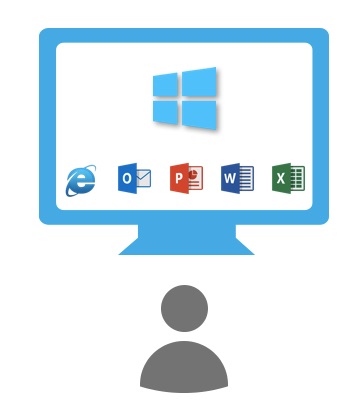
The world used to be desktop-centric
For decades, workers started their “digital day” with their PCs or Macs — mostly using applications and productivity tools. The Integration model was whatever was installed locally; the Security model was whatever they had protected with their PC password.  Maybe they used a browser, but 99% of the time, it was to consume information from the web. And it worked… for a while.

digital-day-1-pc-only
Then, we became browser-centric

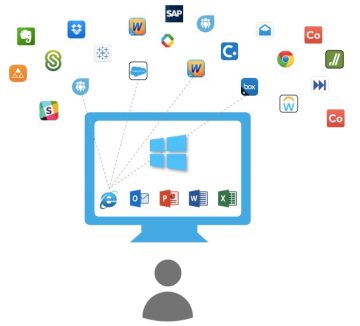
Over time, more of our work lives were spent with browser-based applications (think SalesForce, WorkDay, SAP). Gradually, the success of cloud-delivered SaaS apps — which were soon available as apps on our phones, too — began to dominate our work days. Plus, lots of useful apps, such as Evernote and DropBox, were organically adopted by employees, creating “Shadow IT” problems within companies. Thus began the first true phase of cloud sprawl, where the digital work environment became disaggregated. Worse yet, some services had different browser requirements, users had multiple logins, and IT had little-to-no insight into who had access to what. Even still, more and more of our time was being spent “outside the desktop” using externally sourced services. 

digital-day-2-browser

Today, nearly everything resides outside your desktop

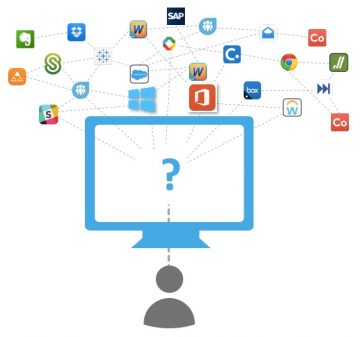
Fast-forward to today. The vast majority of apps you use are either browser-based, fully web-based apps, or full mobile apps (particularly true when you think about how you use apps on your cell phone). The only things, really, that workers use that are “native” to the PC or Mac are productivity tools like Microsoft Office (unless you’re a digital native, you probably eschew that in favor of Google docs, yet another external service.) In fact, even Microsoft Office is being disaggregated from the PC desktop, with the prevalent use of Office 365.

So, we have to ask ourselves two questions: (a) is the desktop (as a “container” of apps) relevant anymore, and (b) if not, what becomes the new access and aggregation point for a worker’s apps and data?
digital-day-2-5-disaggregated

IT – and users – need a new way to aggregate, secure, access, and deliver cloud services


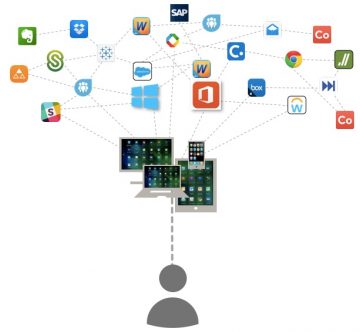
Let’s assume we had never started with a desktop PC at all and that all of your necessary work applications were just a mix of on-premises apps, browser-based apps, mobile apps and cloud/SaaS services.
We’d want our IT departments to have a way to onboard and aggregate each service into a curated and controlled “workspace” environment. Each employee would have workspace of their own — one with a single login, with policies that controlled which apps they had access to, end even workflow tools between apps and coworkers. Even better, we’d want the workspace to ensure that apps with native UIs, browser UIs, and even device-dependent UIs would all be available consistently on any device. Best of all, we’d want this controlled “space” to follow workers around on their devices, whether they were using their laptop, a borrowed tablet, their personal phone, or any device of their choosing.

digital-day-3-sdw


The digital workspace is real, and it’s now: Where you’ll start your “digital day”

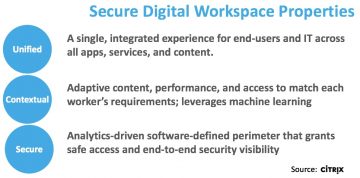
The relatively new notion of the “secure digital workspace” is increasingly the way workers will access the resources they need, and how IT will aggregate, secure, and deliver all applications, regardless of where they’re generated or which personal devices are being used for access.
And it will be contextual and personal — you’ll have it available on all of your devices, and it will know if you’re using a secure device, if you’re on a secure network, and even whether you’re in a secure location. This means that you might not have full access rights to certain apps based on where you are or what network you’re on, or the system may change the method of delivery to ensure better security. It might even notice you’re simultaneously logged into two devices in two countries and raise a security flag.

For workers, this approach will simplify how they get to all the apps and data they need to be productive, and will make it possible to easily collaborate with coworkers, contractors, partners, and customers. And it will ensure consistency by bringing disparate applications and data into a user-centric, context-aware environment. Finally, it will optimize their experience, performance and security across any device, platform or network — regardless of the platform for which the original app may have been designed.

digital-day-sdw-properties

For corporate IT, it will help them restore control over their employee’s digital environment because a secure digital workspace ensures better, more consistent control over on-boarding, aggregating, and managing access across hybrid cloud services, regardless of their source. And overall, this unified approach reduces risk for companies because the entire workspace is surrounded by a “Secure-Digital Perimeter” across infrastructure, apps, delivery networks, and devices.

If this sounds interesting, I encourage you to look into the possibilities, such as using the Citrix workspace to aggregate, secure, access, and deliver this new world of possibilities to workers near you.

Sunday, August 26, 2012

The Rise of the Cloud Service Bus

In my recent GigaOm guest blog, I posited that the advent of hosted cloud services (particularly PaaS and SaaS) will slowly morph the role of the CIO into that of an IT Supply Chain Manager.

Technologically, I believe this move to a "Buy-and-Integrate" mentality (vs. a "Build-Everything" mentality) will open the door to a new class of products to assist with services integration. And, if you agree that the importance of leveraging external services will be elevated for the CIO, then I believe a significant enabling technology will be a rebirth of the need for a robust "service integration bus".

Why?  As I mention in my blog, enterprises integrating external services require:
 - Identity and access management for each provider
 - Data compliance, legal and regulatory audit access across each provider
 - Security compliance systems
 - Provisioning, including capacity forecasting
 - Performance (e.g. SLA) monitoring
 - Cost and budget tracking (i.e. for billing, showback and/or chargeback)
 - Disaster Recovery / Redundant service sources where needed
Some would call the above integration functions "Glue Logic." Indeed in the past, many of these functions were hand-integrated across the few external services that were leveraged, and custom-engineered into each internally engineered stack. But time is changing the model. With more turnkey services  sourced from cloud (IaaS/PaaS/SaaS) providers, the need for a more efficient integration function will escalate. Integration will need to be standardized and replicable, scalable and responsive to the business' needs.
You may recall one component integration approach has been the Enterprise Service Bus, primarily associated with SOA leveraging SOAP protocols. This Integration Bus was originally to orchestrate access and workflow between component services within the enterprise. (By the way, Microsoft offers a great overview of ESBs - albeit BizTalk centric - here on MSDN).

I believe that the "2.0" Integration Bus will be one which brokers higher-level services generated from external, public cloud providers - not just internal component services. And it will use more generalized interactions than SOAP, since the providers and their environments will be less standardized.

To this end, there are some great current/upcoming thoughts suggested by Mike Ponta of the notion of a "Cloud ESB", and can't wait to hear more.  A quick survey of the market also yielded what looks to be potentially promising integration technology coming out of Mulesoft called their CloudHub.

Conceptually, the "mashed-up" service was the 1.0 version of this integration concept. But as enterprise IT begins to regularly tap and integrate multiple external services, the 2.x integration busses will need a more structured, standardized and rapid approach to integration.

I can't wait to see what else the market will generate. Stay tuned.

Other resources/Blogs:


Wednesday, August 1, 2012

Enablers for Transformed IT - Placing My Bets

It's an odd time of the year to be making predictions. But recent conversations with start-ups, CEOs, CIOs and others have suggested areas in Enterprise IT that I  bet will be "hot" over the near/medium term.

Some of the areas are "Sexy" (high on the Hype Cycle) - and others are not. But in my opinion all are worth betting on. They are all interrelated and all are critical enablers to the goal of a transformed IT ecosystem.

Already Sexy: Integrated Cloud Infrastructure Management
Of course you expected this one... But the betting opportunity isn't exactly what you think.

There are currently hoards of point-products professing "cloud management" - including the OpenStack/Cloudstack alternatives - but surprisingly, these still lack in providing a comprehensive solution that a reasonably sophisticated SP or CIO needs to buy.

In other words, I don't just mean a product that offers an automated virtualization (server, storage, networking) layer.... No: The real opportunity I expect to see here is an integrated comprehensive solution, that includes security, compliance, monitoring, financial metering, end-user provisioning portals, etc.  The winners in the space will either integrate these features too, or offer a pre-integrated bundle of best-of-breed point-products. And it's going to happen soon.

Not Yet Sexy: The Integration Bus
If you believe that most of IT's infrastructure is "going cloud" and that many 3rd-party services will be SaaS, then the role of the CIO will begin to shift from being a technologist (who builds things from ground-up) to being a Supply-Chain manager (who integrates multiple services from multiple sources).

To execute on its new role in the enterprise, IT will therefore become an integration point for internally- and externally-generated services. It will need to provide core identity, compliance, data exchange, security, and access infrastructure to properly "broker" all of these diverse services, providers and APIs.

It seems to me that the notion of an integration bus will become crucial. Such a bus will provide the "glue logic" between all services, and avoids tedious hand-coded integration points. In many ways this bus is a core intersection point between the internal and external cloud - the hybrid nexus, if you will.

Remember, it's not enough to have a service in a cloud. There will be a huge need for coordinating the interactions into/out-of (and between) cloud-sourced services. The need for such a service bus will quickly elevate to that of a critical IT enabler. A good bet to take.

Getting Sexy: IT Business Management
Building on the concept of IT as a "supply chain manager" is the concept of IT as a Service Provider to the business. This is sometimes termed IT-as-a-Service, where IT begins to run itself as a "business". While it may not literally have a profit motive, it will be forced to become functionally competitive with external services, to market itself, and to price itself competitively.

As I've written before, in order to think like a business, one critical enabler is to know fixed and variable costs, as well as cost allocations and cost sensitivities.

Thus, the segments known as IT Financial Management (ITFM), IT Business Management (ITBM) and/or Technology Business Management (TBM) will necessarily have to expand in importance.  This segment looks at the granular cost basis of infrastructure (including cloud service costs) and assembles a composite cost structure at the application and even service level. This permits IT to understand cost sources, provide decision support and forecasting for infrastructure changes, and provide a "bill of IT" showback/chargeback to internal service customers.  All critical in the new Transformed view of IT.

Too Sexy: Big Data Business Models

Careful here... I'm not speaking about Big Data infrastructure or analytics products per se. I'm referring to the business models that will soon be based on mashing-up and analyzing large quantities of structured/unstructured data to uncover new revenue opportunities.

As I recently mentioned, data-based business models will begin to complement existing product/service based businesses.  While adoption of Big Data technology is already penetrating the infrastructure market, the real opportunity is when it penetrates the lines-of-business people such as marketers, sales, and business development.

Companies that employ marketing professionals paired with "data scientists" are the ones to watch. The new business opportunities presented by the promise of cracking big data will be the driving force behind the infrastructure and technology purchases.

When will this transition happen?  I predict when companies begin to hire "Big Data product managers" and team them with BizDev and data scientists. Now that's disruptive and sexy.


Tuesday, February 21, 2012

IT-as-a-Service: Resources and Pointers

IT-as-a-Service. Possibly another buzzword that may reach the peak of hype and then fade away in a millisecond. But even if so, this new concept will persist by some other name.

Unlike IaaS, PaaS, SaaS, etc. ITaaS isn't a technology model. It's a new mind-set and approach to delivering enterprise IT services - where IT operates and competes for "business" as-would a service provider.And, like a commercial SP entity, it actually tries to encourage service consumption, rather than discourage it.

This is in contrast to the stereotypical IT department that runs a bottleneck help-desk, issues locked-down equipment, charges the enterprise with a flat operating "tax", and is organized along purely technological lines.

This "new" IT thinks more like a business - not that it needs to deliver a profit per se, but that it's more customer (line-of-business) focused, understands its costs, and "competes" against alternatives that users now have outside the enterprise (a.ka. Shadow IT). The new IT thinks Self-Service provisioning, Choice Computing (BYoD), monitors variable costs and unit consumption, and is organized to deliver services, not technologies. 

ITaaS Model - Components and Pointers

When IT begins thinking about becoming an "internal" service provider, there are 3 conceptual models that need to shift - (a) how services are generated and consumed, (b) a shift in how technology is leveraged, and (c) a change in operations and organization.

Where can you find the most authoritative information about ITaaS?  I'd like to believe that EMC is leading the way with, among others, our own IT Department.  But resources abound on the topic...  I've begun to collect useful pointers from many points of view. And, from time-to-time, I will update this list with additional pointers, insights and success stories.

ITaaS Overview
Don't take my word for it. Others are beginning to write about ITaaS, its benefits, its positive impact on business agility, and about where to start your plan:
IT Leadership
If the enterprise is to undertake the ITaaS transformation, then senior IT leadership - as well as line-of-business leadership - has to be 100% behind it.  But the traditional CIO-as-Technologist model necessarily has to give way to CIO-as-businessman.  Running IT like a business means complementing technology with knowledge of how the enterprise's core business runs, IT financial management, IT organizational transformation, and even IT services-supply-chain management.

IT Financial Transparency
A key characteristic of transformation to ITaaS is the ability to understand the costs of delivering individual services, and thus be able to allocate and price them appropriately. Once variable IT costs are understood, measured, and shared with the business, IT has a higher stake in ensuring that services are delivered and priced efficiently and transparently.  And, by creating and assigning per-unit costs to services, IT can more efficiently match supply with consumption. Ultimately, improved IT financial transparency ensures more accurate decisions made both by IT and lines of business.
 Reinventing the IT Consumption Model
In a transformed IT environment, the goal is to drive an increase in service consumption by the business. The shift also includes IT viewing its business model as a profit center rather than a cost center, with more of a commercial mindset.  To accomplish this, IT must change its operating model to simplify access to services, and to facilitate delivery of services – regardless of whether they are internally or externally generated. And, if IT is to become this ‘broker’ of services, it must develop a customer-centric supply-chain approach to delivery of services that the business demands, no matter their origin.

Transforming Organization, Roles, Skills
As the IT organization transforms itself to become more like a service provider to the enterprise, internal IT skills, roles, and even the entire organizational structure will necessarily change. Traditional technology specialization areas will make way for more general, services-centric roles. Skills will shift from specialists who craft technology stacks, to generalists who manage holistic systems that produce user-centric services.  Service product managers (both in-bound and out-bound) will also be in demand to maintain value alignment with line of business users.
Success Stories
IT-as-a-Service is still new, and most companies who have embarked on the transformation are still mid-stream. But a few are making their journeys public. Here are a few I've found.
Analyst Perspectives
Industry analysts are beginning to adopt the "Run IT like a business" perspective, and even the ITaaS label. Here are some pointers (some reports require Analyst website logins/subscriptions)


    Monday, February 13, 2012

    My IT is Ready. My People Are Not.

    By now you may know that I buy into the enterprise approach where cloud computing and its operational model are enablers for something bigger: The transformation to IT-as-a-Service. That's when internal IT acts, operates and competes like an internal SP.

    But I've come to realize that such transformation is more of a skills and operational model shift than a technology shift (although technology is clearly an enabler). As was often mentioned at a recent CIO event I attended, "My technology is ready. My people are not" 

    This topic of talent, training and organization appears to be consistently glossed-over. But recently at EMC and with customers, I'm seeing the beginnings of a sea change in the industry.


    Early Indicators of Change

    My first sense of the need for change arose from a 2010 conversation with an analyst about using converged infrastructure. They made the observation that "to use a converged infrastructure to its fullest, you need a converged organization."  This got me thinking: when the boundaries between compute, storage and network begin to blur, so must the boundaries between traditional IT organizations. The advent of cloud computing (more specifically, IaaS and PaaS) highlights a similar issue.

    Slowly, the 'unit of management' in the data center is shifting away from the isolated IT component, and is moving toward the application service.  IT management is having to treat the infrastructure more holistically, more horizontally. With more automated provisioning, virtualization and elastic capacity, orchestration across all components is becoming a requirement. Similarly, the skills of IT Ops personnel need to be more integrated - individuals simply need more cross-specialization knowledge and training to ensure that services are delivered quickly and efficiently.

    My next sense of the breadth of change came when I joined EMC and saw what Sanjay Mirchandani (EMC's CIO) saw in transformation to IT-as-a-Service.  To him, cloud computing and infrastructure automation were merely enablers for IT organizations to become more of strategic enablers to the business, more of internal service bureaus, driving consumption of their services, and operating overall like a business itself. Toward this end, EMC-IT has been documenting its change now for a number of years. But, because this shift involved so much more than just technology, I began to realize that the skills and roles within "traditional" IT would become woefully inadequate in a number of years.

    In the transformed world of IT (and IT-as-a-Service) the organization needs to develop horizontal groups to manage broad platform architecture and management, as well as roles that 'broker' those services to the lines of business (service managers) and maintain alignment to the needs of users. There may even be roles that loosely align with 'sales and marketing' that help drive awareness and consumption of IT services - concepts that will surely seem foreign to any CIO.

    What's Next... and How To Prepare Your People

    When recently reading an article in Forbes I observed that others were noticing these needs (and opportunities) for IT skills of the future as well:
    "As a result of the shift to cloud, there is growing demand for professionals and managers that are more focused on business development than they are in application development. There will be greater opportunities for enterprise architects, and some offshoots will include cloud architects, cloud capacity planners, cloud service managers and business solutions consultants. Jobs being created may not always bear the term “cloud” in their titles, but cloud will form the core of their job descriptions.
    What caught me here was not all new roles will be technology-focused. Service managers and business solutions consultants - for example - will be client-focused. Think of that: Roles that exist solely to understand the line-of-business operating units, develop services (not technologies) to meet their needs, and help drive demand for those services. (See related post on A Marketing Lesson for IT )

    So if you believe the tenet that skills and roles will play a more critical role in the transformation of IT, then where does one start?  Here at EMC, I was pleasantly surprised to see that our own HR department is right on top of the problem.  Our IT HR director in fact was taking the lead in describing what change lay ahead.  In a recent communication of hers she noted
    "...we are in the midst of a process to build on our current skills to foster the ITaaS model, taking deliberate steps to fill any gaps by providing plenty of training and support. Last quarter, we assessed the skill level of each employee against a set of key competencies needed for their particular functions under ITaaS to determine what added training/support they need. In some cases, the skills we’ll be drawing on are very different than the typical IT focus. New areas of required expertise include things like product management and development, communications, marketing, negotiation and influence skills, and financial acumen.
    "Our prime focus in Human Resources is employee development and preparing employees for what our future IT organization will look like. This is part of our life-long learning and development program....  We are going to help [our people] gain new skills and provide them with the tools they need. A key part of the journey will involve learning to think like a service provider rather than the internal agency we are used to being. It will require a shift in our cultural mindset from discouraging business IT demand to actually selling and marketing IT services.
    Wow. IT shifting its mindset to selling and marketing...  That our HR group is this intimately involved in the transformation of the business I found exciting and enlightening. And as I looked further, I realized that we (and others, I'm sure) are beginning to take steps to prepare for this transition. EMC for example, recently Announced Cloud Architect and Data Center Architect certification tracks including expert-level tracks (and Brochure PDF )

    In many ways, existing hosting and public cloud service providers already know much of this; their business depends on good customer service, meeting requirements, and driving consumption (demand). Enterprise IT now simply has to learn from them - and adopt this new mindset.

    Where to start? Begin thinking about how the following job skills and orgs might play a role in advancing IT's strategic importance in the organization
    • New Consumption models - There is a need to simplify and drive how services are consumed. This is a 2-part process. Technically, there is the migration toward self-service catalogs. But there is also the marketing aspect that drives awareness and demand for these services - IT needs to think "commercially" - attract demand, and make access to it as frictionless as possible.
    • New Operational models: Architecturally and operationally, more of IT will become "horizontally" oriented, along the lines of business services and along the lines of customers. New orchestration-style tools and processes will be needed - implying the need for skills to manage them properly.
    • New Marketing roles: Yes, marketing.  To drive consumption, IT has to expose more of its services to more potential business users... and do so competitively. That is, IT needs not only to think about what the business needs, but what their next alternative (outside of the IT organization) is, and ensure that IT is the vendor of choice.  More about marketing IT here.
    • New Finance roles:  Implementing IT cost transparency doesn’t just require financial data, though that is what most people think about when they hear the term. It also depends on information about hosting, applications, infrastructure, licensing and maintenance, and other things that let us associate costs to services. Clearly these roles are net-new to IT
    • New Business relationships: Partnering with, and aligning to the business is about more than just providing basic IT services and helpdesk. It means working alongside line-of-business planning to understand what drives their top-line business, what is at the core of their competitive advantage, and what business agility can add to these. Dedicated roles - which are steeped in both business and technology skills - need to be acquired and assigned to individual business units.
    Other Resources:


      Monday, December 19, 2011

      Steve Jobs in 1980... and Cloud + Big Data Today

      In 1980, Steve Jobs gave a talk (YouTube) about the early days of Apple.

      It's fascinating because it describes events that lead up to the first commercially-available Apple computer, and presaged the movement toward "canned" programs (commercial software) rather than everyone writing programs themselves.

      However, around the 12:00 mark, Steve made a really incredible observation regarding the true goal of Apple (at the time) and about how to use the new level of computing power available to Apple computer users:
      "As we move into the '80's, the amount of computational power - the amount of raw horsepower - we can get into a small box for a reasonable price is staggering....   One of the things people always ask me [is] 'what we've got right now is just fine; VisiCalc runs fast enough. Some of the database stuff runs fast enough. What are we going to do with this extra awesome power?'

      "The answer to that is that we're going to put it [computational power] into applying/solving that problem again: In other words, we're going to start chewing up power specifically to help that 1:1 interaction go smoother. And specifically not to actually do the number-crunching and database management and word processing. We're actually going to apply that power specifically into removing that barrier.... 


      This statement struck me because, in essence, Steve was saying "it's not about faster, it's about easier". He was pointing to all that could be possible if the clunky interaction with the technology was relegated to the background and made invisible.

      In today's enterprise context, my interpretation of this is "What could be possible if all of that data center technology could be relegated to the background and made invisible?" In essence I thought, what if we could mask the granular time-consuming operational efforts of managing servers, I/O, applications, networking, storage, security etc. and get back to why the data center is there in the first place?  Today, IT operations for 'keeping the lights on" consumes ~ 75% of IT's budget today, and only ~ 25% is left over for innovation and serving the business.

      The goal of IT Transformation should be to "solve the problem again" and put the computational horsepower on autopilot. Let's get to the point where our interaction with the data center is the ability to ask for the resources we need, and in response, we instantly get fast, scalable, secure services.

      If we can get to the point where 25% of the cost is to keep things running, and 75% of the cost is used for innovation about the data, what would be possible for business?

      In my opinion, IT is still largely in the Dark Ages. We are obsessed with speeds and feeds, tuning and tiering. The purpose of the Data Center is the Data - manipulating and analyzing it for the business. If we found a way to direct 75% of our computational horsepower to THAT, what would be possible?

      That needs to be the goal of IT Transformation. That is why Cloud is such a critical enabler.

      Thanks once again, Steve.


      Other Resources:

      Tuesday, November 8, 2011

      A Marketing Lesson For IT

      In an earlier post of mine, "An Image Makeover for IT" I shared about a surprising meeting I'd had with our IT department -- where they were looking to learn how to better market their services within the company. I felt that this was a harbinger for the "New IT", and I think I was right...

      Then last week I was given a draft Data Sheet by EMC's IT department.Whoa, you say. A Data Sheet? Isn't IT supposed to operate down there in the bowels of the data center keeping the "lights on"?

      As you know, EMC's IT group has been progressive, from their virtualization initiative to building an internal Private Cloud for the company, to organizing for success, to marketing themselves as if they were a competitive service provider. Which is just the way more IT groups will have to think.

      Why would IT Want To Market Themselves?
      If IT is to think more "competitively" then they need to organize and act competitively, including driving demand/consumption for their services. This isn't about internal politics (validating their annual budget) but rather about driving awareness, demand, and preference for their services. Because IT's new competition is "shadow IT", the advancing commercialization of IT. More simple-to-use, aggressively priced external services are being offered to users who are accustomed to the convenience.  So IT finds itself having to do the same.

      And there is the education component too... because while the enterprise consumer might want to compare internal vs. external services purely based on price (think: AWS, DropBox, MobileMe), IT has to show that there are hidden costs to these: Risk exposure, inability to prove compliance, cost of securing data, etc. etc. So IT turning to traditional marketing devices isn't all that odd in the final analysis.

      A Data Sheet for IT...
      Back to the Data Sheet I received. The IT dept did their homework - Like all good product marketing summaries, it included components to project leadership and to drive demand:
      • Service components: In this case, it is an IaaS style service, replete with the value proposition. It defined the service, the pain-points it alleviates, and why internal EMC engineers should consider using it.
      • Overall Value: IT also did a great job of illustrating the *total value* of the service - not just economic value, but the value of agility (time-to-provision) and convenience.
      • Value of Risk Avoidance: Some marketers like to market to the paranoid... in this case, IT illustrated the risks of not using an IT-sourced service.Security, compliance, SLAs, etc.
      • Competitive comparison: In particular, I like the fact that the internal private-cloud based service full-up cost was compared to that of popular public cloud providers. It illustrated that the actual cost of external services isn't always just the bare-bones hourly cost on your credit card...
      • Availability roadmap: I also like the fact that IT set expectations with its customers. What's available now, and what new services/features will be available when.
      • And a little bit of Esprit de Corps:Yep, good old pride in what the company is doing, and how the IT department is helping drive the top-line business. 
      ...And Enabled By New Roles, New Skills
      If IT is to succeed as a "competitive" provider to the enterprise, simply publishing a Data Sheet is just one deliverable in a larger story. The organization needs to think, act, and hire like an internal service provider - and ask itself "How do successful SP's drive business demand?"

      The process begins with a cultural and leadership shift to a desire to act not as an internal (monopolistic) cost center, and more like a competitive business catering to the varying demands of its internal customers. This is a CIO-level decision, often done in partnership with LoB's and even with the CMO.

      And who executes on this new approach? What new functions need to sediment into IT? Well, it's not about technology skills anymore. Rather, IT will need to acquire traditional business and marketing skills. A few suggestions:
      • Develop In-bound and out-bound Marketing: This refers to classical Inbound product management (listens externally to customer needs, and helps determine product features, plans, pricing - and classical product marketing, helping drive external awareness, preference and demand. In both cases here, Inbound/outbound functions work as closely with internal lines-of-business to understand their needs, roadmaps and futures.
      • Initiate client "relationship management": Somewhat akin to a "sales" function, these individuals are assigned to sit closely-aligned with business users of IT, and work closely with in-bound product management. These folks detect leading indicators  of how IT can better serve the business, and look for ways to add value either with competitive technology, services or analysis.
      • Include Pricing and Financial Management: Pricing and costing of services is a shift away from tallying-up gross capital and operational expenses, with a move instead towards activity-based costing. The ability to discern the true usage-based cost of an IT service means that the organization can better align supply with demand, and make better buy-vs-build decisions. This "financial transparency" allows the CIO, CFO, and Lines-of-Business to make better overall decisions regarding using IT to support the enterprise.
      If IT is to be competitive, it has to act competitive. Marketing of IT is far from the only shift that needs to be done - and arguably, it probably follows shifts in IT technology and IT operations. But marketing IT is nonetheless an illustrative example of what is to come with a larger IT transformation initiative.

      Wednesday, November 2, 2011

      Act Now! Top Opportunities for IT Transformation Services...

      It's become obvious of late that cloud computing is not a technology end-in-itself, but rather an enabler of broader IT  transformation. I've heard it from CIOs, CTOs, and even EMC's own IT department. All said, it's clear that IT transformation affects the entire organization - its consumption model, operations, organization, finance and more.It's not just about products anymore.

      IMO there is a massive opportunity for leading change-management organizations to work with IT organizations to help them assess and execute this transition. Technology alone will not make IT more competitive.

      So I'm a bit shocked that this era isn't a windfall for services providers who will help shepherd IT organizations through the change management process. It should be. To me this seems like thre's a huge investment opportunity to develop service practices. And, it's a huge opportunity for IT organizations to take pause and assess what their structure, operational model and business model will be a few short years from now. And how they plan to get there.

      Follows are a few observations - and opportunities - I've made in the hope that a rising tide lifts all ships:

      No Show Offs?

      Where are the services providers, consultants and change-management professionals at trade events?

      Given the tons of IT, cloud, and tech related trade shows, I'm continually amazed at how 99% of floor exhibitors are hardware or software firms. The show managers occasionally include special floor sections for "cloud" or "security" and such, but never for services providers or consultants who would assist the attendees in implementing the technology and change management needed to leverage technology.

      I'd like to see an "IT Transformation Services" section in the large shows (i.e. VMworld, Cloud**, etc.) including consultants, organizational design firms, HR firms, IT training and talent management organizations, certification boards. etc. This would be where firms could hawk their services and compete for the non-product enablers for the CIO. Show producers ought to offer incentives to capture these firms and the value they provide.

      I'd also like to see more intentionally-produced tracks at the shows that talk about real-world IT transformation successes... without inclusion of product or technology. Topics?  Financial transparency. Organizational design. Service-oriented design. Line-of-business customer focus.

      Where Are the Big Guys?

      Next, why aren't Accenture, Deloitte, CSC, Cap Gemini, Accenture etc blazing the IT change management trails? Perhaps they have IT change management practices. But I read next-to-nothing from these folks regarding philosophy, approach or successes. I'd like to know more about what they're doing and/or planning.

      From where I sit, most System Integrators and management consultants either have 'low-level' practices where they thrown technologists at a problem, or high-level management consultants who produce reports and strategies. I'd like to see the middle-ground, with practices that work with the CIO and their lieutenants, to assess what type of transformation(s) would make the IT organization most valuable to the lines of business.

      Where are the books, keynotes, articles and methodologies developed to show-off the IP I *hope* these folks are developing? 

      And What of Professional Certifications?

      No, not technology certifications; I mean IT Skill certs. Cloud Architect. Cloud Engineer. IT Services/Product Management. IT Marketing (inbound, outbound). IT Business Liaison. IT Financial Services Management. Not all of these are traditional IT roles, but they will be in demand shortly as IT re-tools itself to act and operate as the equivalent of an internal Service Provider.

      And while we're at it, I'd *love* to see more business and MBA programs offer technology leadership and change management for CIO's style coursework.  Technology leaders will no longer need to be technologists themselves.


      And in closing...

      At EMC's recent IT Leadership council, it was clear to attendees that Transformation of the IT org was not about the technology anymore. It was about skills, roles, organizations, culture.

      I am continually impressed by what EMC's IT department has done in most if not all of these domains. And I know that our own EMC Consulting arm has deep bench strength in this area. And as a company, we're going so far as to offer professional certifications in these emerging domains.

      But as I said above, a rising tide lifts all ships.... I'd like to see broader activity in all of these areas from partners and competitors alike. The best way to make the new cloud computing paradigm successful is to make the IT departments successful in their transition. So, where is the help?

      Post-Blog Updates
      • Recent announcement from Deloitte for Cloud Service Providers 

      Tuesday, October 18, 2011

      Practitioner’s View: IT Transformation and GreenPages’ Solutions Architect

      Last week I had the chance to speak with EMC Velocity Partner GreenPages – specifically with Trevor Williamson, their director of Solutions Architecture. Trevor regularly speaks with CIO’s from Enterprises and SMBs about cloud computing and IT transformation. He has a refreshingly balanced perspective on technology… and on its impact on business. Follows are some paraphrases from our conversation late last week.

      Lots of Talk About Cloud But…

      Not surprisingly, Trevor noted that 80% of his customers are talking about cloud computing (who isn’t?) but only really 20% are doing something about it. 

      Why: He’s noticed lots of reasons – having to do with resistance to change, the demographics of IT leadership, and more.  Trevor’s analogy was to that of an automobile:  Traditional IT looks like a basic car with a basic engine and basic drive train. Yeah, it basically keeps running for ever. But if you wanted to change something, good luck.  There wasn’t much room for upgrading without changing the whole thing.   Next, enter virtualization… akin to a car with Fuel Injection. It’s an upgrade – and the engine will run more efficiently. But in the very grand scheme of things, it’s still a point-solution (although quite valuable). Now finally, enter the concepts of automation and Cloud Computing: where the car’s components become completely different and independent – no piston engine, an electric drive train, etc.  So it’s much easier to upgrade components without needing to alter others.  Simply increasing the battery gives better range. Changing the electric motors gives better performance. Changing the engine might speed battery recharge.  But components now operate more distinctly and can be optimized independently.

      On IT Finance, and Why It Might Be the Key to Change

      Trevor also had a terribly pragmatic perspective on a simple but ingrained factor holding-back IT’s efficiency.   In the traditional (read: old) IT financial model, the IT Project Number was the key to all implementations.  Any change to a specific system got charged to that number. And the dollar size of that number got watched under a microscope.  However, bounding the infrastructure’s financial model with a single project number reinforced the technological stove-pipe-ness of the assets themselves. The financial model did not allow for any sharing of assets between systems – because each new asset of course had to be assigned to a single project number. So, one result was the wasteful sizing of each silo - and resulting horrific utilization of each silo.  Ergo, Capital inefficiency became a necessary result of a limited financial model.

      Enter: Shared infrastructure that can meter incremental IT usage, and cost-accounting that can keep track of (and assign) incremental costs.  With these two tools, IT could now implement a shared (and, needless to say, virtualized) infrastructure. The improvement in utilization, and resulting improvement in capital efficiency, was and is a boon to IT.

      So, Who Calls the Play?

      When an IT department decides to go down the path of a private cloud, who makes the call?

      Well, there are usually two models Trevor and GreenPages frequently see – either top-down (by decree), or organic (bottoms-up). More often-than-not, Trevor believes most initial deployments are bottoms-up. The typically the initial application is internal to IT, such as QA/Dev/Test – also because these use case customer needs are very dynamic and fast-moving.  Giving the engineers a self-service portal and ability to spin-up tons of cookie-cutter environments is a great fit and a great win.  And doing so internal to IT (in contrast to line-of-business apps) minimizes the number of approvers… also speeding along the project.

      Most initial bottoms-up automation and cloud initiatives are relatively new implementations, *not* system refreshes – which surprised me. But for good reason: Refreshes usually involve a cross-application and cross-domain initiative. Which means more approvers and multiple teams.

      Now, there are times of course when IT leadership “decrees” building a private cloud – and mostly the impetus is either to reduce costs, or to cater to the LoBs who are looking for agility that will result in making more money.  But when these initiatives are by leadership decree, they’re usually bigger (and slower) than their internal organic cousins.  In fact, the top-down initiatives are usually corporate-scale, even to the point where they’re ‘branded’ and ‘marketed’ cross-org.  But reading between the lines, all of the hoopla doesn’t make the top-down initiatives any faster than the internal approach.

      Is building an Internal Cloud Bad (for IT Jobs)?

      Trevor gets this question a lot. He’s not yet seen an instance where virtualizing and automating infrastructure has meant a reduction in jobs. Instead, he’s found more the case that it’s good for the *existing* jobs.  Building a private cloud helps IT personnel climb out of day-to-day fray, and frees-up their time for more interesting, higher-value work for the company.   We both noted that IT should be focused on extracting value from company data and partnering with the lines-of-business…. Rather than “keeping the lights on” laboring as a monotonous workhorse.

      And Finally…. On Keeping IT Competitive

      “Why does business go around IT?” I asked. Trevor was pretty firm on this one: Only when IT can get out of its own way and move at “market speed” will internal customers will choose them. He sees lots of use of external services by lines-of-business, and lots of IT organizations racing to keep up with them.

      How to achieve market speed? Part of the answer is re-engineering IT as an internal service provider / service broker. IT must think of itself as a service bureau, right down to marketing its services to users in the enterprise. From an infrastructure perspective, IT also has to become more agile. It has to “stop plugging holes with humans” and start by leveraging automation as part of its DNA. Lots of point systems can be automated, e.g. provisioning OS, virtualization platforms, I/O, networking. And only then can Orchestration be layered across those automated systems to attain the speed and agility needed. Take it a step at a time, with the goal being competitive and customer-focused.

      Monday, October 10, 2011

      A Leading Indicator of "Consumerized IT"?

      Let me start with a game: Try to guess the type of customer I met with last week...
      • Roughly 5,000 users with ~ 25% annual turnover
      • Pressured to support multiple user-provided devices (Smart phones, iPads, etc.)
      • Significant "Shadow IT" (e.g. users turning to external web services w/out IT's knowledge)
      • Inquiring into a VDI environment to increase manageability, reduce costs
      • Increasingly huge storage needs, esp. for video (on-demand media, surveillance, etc.) 
      Give up?  Well, this customer was a High School district, with thousands of students and hundreds of faculty. And they shocked me with their challenges, ones which I assumed only large enterprises had.  I have to admit I was pretty surprised at their level of sophistication - and their vision.

      And then it dawned on me: These guys actually more of a "leading indicator" than most their commercial enterprise cousins.  Their internal customers are nearly all Millennials, arguably leading users of consumer technology, and sometimes the most demanding. The student base requires support for "any device, any time", and doesn't hesitate to use external commercial services rather than IT (think: kids using DropBox, Evernote, Mobile Me, etc.). Also, users (students) without their own personal "smart" devices will typically log into multiple alternative devices a number of times each day, requiring virtual display and authentication technologies.

      So, think about it: These students - and their appetite for "consumerized" technologies, will be your workforce of tomorrow.

      What that high school IT department is facing is what most IT will be facing during the next few years. So consider carefully who (and what) you'll need to support in the coming years. And consider the organizational, technological, and governance transitions you'll need to implement as well.

      In a recent Forrester Research report, "Shifting from Rules to Guardrails" there are some good observations of how IT (and the CIO) have to transform from being technologists to becoming brokers, vendor managers, and providers of technology governance:
      "We see a blurring boundary between business and IT. The rise of self-service technologies, driven by empowered employees, provides new opportunities for IT to improve business responsiveness by enabling greater autonomy... To do this successfully, IT must evolve new governance approaches that empower the business with guardrails and education, reserving strict technology control for only the most critical technology assets. For many, this will be a radical change.
      So, my lesson was that the places to look for Leading Indicators of IT transformation aren't necessarily the analysts and brainiac IT leaders... Instead, perhaps I should focus more on the needs of the 9th grade entering class.

      I hope to stay in touch with the IT staff at the school district, and see what priorities (and solutions) they see emerging in the coming months.  As I exited the meeting, one of the IT leaders took me aside and also mentioned that IT has also experienced - not surprisingly - hacker break-ins as well.  As I said, perhaps the youngsters are where to look...


      Other Resources

      Monday, September 19, 2011

      Documenting IT Transformation Since 2005

      If you haven't looked at how EMC's IT department has transformed itself over the years, you should - it's amazingly illustrative. Our CIO, Sanjay Mirchandani is visible and articulate. Our VP of infrastructure, Jon Peirce, is equally eloquent about how IT is transforming - and was a major force behind EMC's recently dedicated state-of-the-art Datacenter. And of course Chuck Hollis has been doing an amazing job of chronicling the meaning of IT transformation, consumption models and organizational changes.

      First, show me the money

      But where does that leave us regarding exactly what we achieved? What metrics illustrate the real benefits of all this work? Well, it turns out that EMC IT has been documenting their process since about 2005.  While not all data points are completely audited, they tell a powerful story.

      In the conceptual 3-phase "Journey to Your Cloud" we speak about the trend toward increased virtualization - and how it's applied. In Phase I, IT virtualizes "internal" IT-owned apps saving primarily on cost. In Phase II, IT virtualizes production applications, benefiting primarily quality-of-service and availability. And in Phase III, IT is operated as a service, primarily improving overall business agility.

      But along a pragmatic journey, the benefits occur gradually, sometimes in parallel.

      EMC's IT group has been virtualizing its infrastructure - and documenting the results - since 2005. At right, the chart depicts how virtualization toward a cloud infrastructure undeniably results in improved infrastructure economics AND improved IT agility. And their trend continues.

      The other benefit from virtualization is the ability to re-construct an environment should failure occur. This impact on quality of service is available anywhere virtualization is present - so you'd expect the pervasiveness of Highly-Available environments to roughly track the degree to which virtualization is implemented.

      Sure enough, as EMC virtualizes its entire infrastructure (and we're not entirely there yet) we're pushing nearly 97% of applications with High Availability.

      Finally, as IT infrastructure is virtualized and consolidated, utilization rises, and (presumably) physical data center space required (not to mention power) is reduced.The EMC IT group's statistics clearly show this trend as well.

      In fact, EMC's recently-christened data center is not larger than our existing data center (as it was mainly developed to economize on power cost, and to create a physically-distanced site from EMC's HQ) so there is still lots of room to grow.

      In the coming months, EMC, our IT department, and our consulting arm, will be continually elaborating on our own journey through transforming our IT... not just the technology, but the organizational models, operational models, consumption models, and more.

      I personally have to say that the degree of rigor that Sanjay & team have put into this transformation is impressive. They have a very clear vision of where they want to be with respect to enabling the EMC business, as well as setting a clear example of what is possible for EMC customers.

      Other References

      Tuesday, September 13, 2011

      An Image Makeover for IT

      Wow. I just have to share notes about a meeting today - one that might have been unthinkable a year or so ago.

      I've been working closely with EMC's CIO and internal IT groups lately, helping understand how they're delivering IT as a Service. EMC's IT is going through a major transformation, where it's becoming more competitive, more business-centric, more like an internal Service Provider.

      What blew me away was a conversation I was invited into because I was in marketing. Could I help? IT wanted to begin  investigating how to market its on-demand/ITaaS services internally to EMC lines-of-business. We discussed audience segmentation, how IT would like to be perceived (read: Brand Essence), and the services/value IT provides to assist the business.What should a marketing and roll-out plan look like? Graphic designs? Should IT instead be called BT (Business Technology)? How would the value of Service Manager roles be highlighted?

      The discussion - while well from over - I believe is a harbinger for the "new" IT, where IT provides value and competitive advantage to other lines-of-business, where it acts like a strategic partner/vendor, and competes for business. It's so much more than technology.

      We agreed that another harbinger of change was when the CIO spends more time with the CMO, rather than with the CFO. And I can attest to being present to one such meeting.

      So, in the process of IT elevating its value-add, IT will enhance how it caters to the business. It will actively promote its new service orientation, its new operating model, its new mindset.

      And I am more than happy to help.

      Related